MANAGEMENT SCIENCES FOR HEALTH
USAID Health Leadership Project Overview
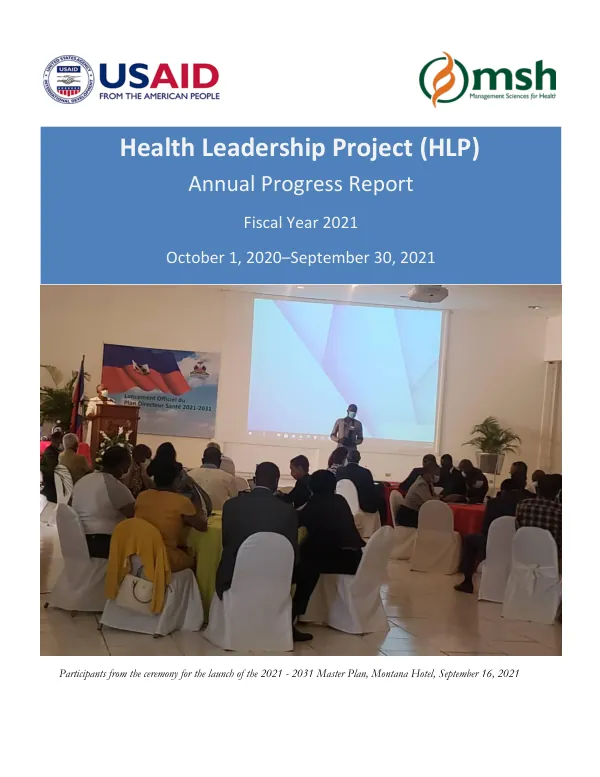
The USAID Health Leadership Project supports the Haitian Ministry of Health to build an optimal health system that is accessible, accountable, affordable, and less reliant on external partners for the equitable delivery of quality health services.
2021 · 2 pages
Sign in to readA free account is required to download.
Abstract
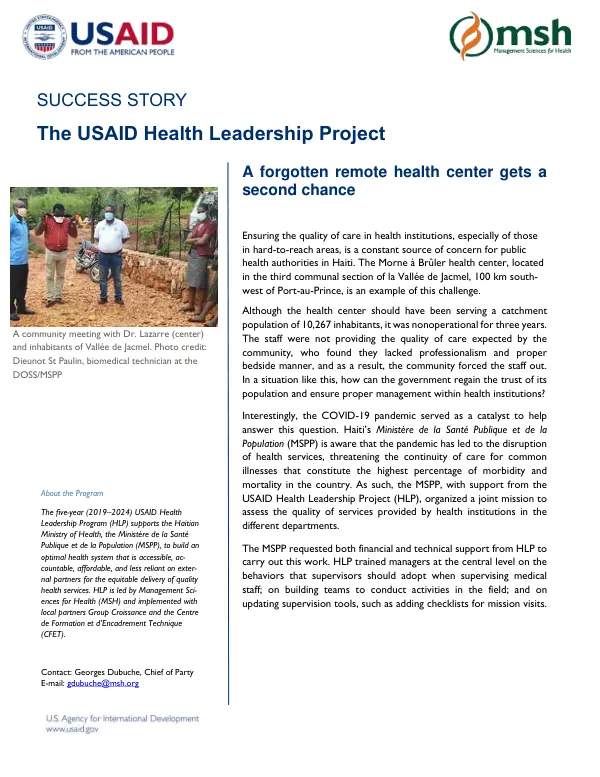
The five-year program, led by Management Sciences for Health (MSH) and implemented with local partners Group Croissance and the Centre de Formation et d'Encadrement Technique (CFET), aims to strengthen the health system's capacity to deliver quality services, particularly in hard-to-reach areas. Ensuring the quality of care in health institutions is a constant source of concern for public health authorities in Haiti. The Morne à Brûler health center, located in the third communal section of la Vallée de Jacmel, is an example of this challenge. Although the health center should have been serving a catchment population of 10,267 inhabitants, it was nonoperational for three years due to staff providing substandard care. The community forced the staff out, and the health center remained closed. The COVID-19 pandemic served as a catalyst to help address this issue. Haiti's Ministère de la Santé Publique et de la Population (MSPP) organized a joint mission to assess the quality of services provided by health institutions in the different departments. The MSPP requested financial and technical support from the USAID Health Leadership Project (HLP) to carry out this work. HLP trained managers at the central level on the behaviors that supervisors should adopt when supervising medical staff, building teams to conduct activities in the field, and updating supervision tools. During this mission, Dr. Ted Lazarre, a Technical Manager of the MSPP's Direction d'Organisation des Services de Santé (DOSS), discovered that the Morne à Brûler health center had not been operating for three years. Dr. Lazarre and his team applied good governance practices, engaging stakeholders, establishing a common vision, and promoting proper management of resources to respond to this challenge. With support from HLP, the team organized a community meeting with religious and departmental leaders in the area to identify and agree on a sustainable solution and way forward. The community was able to set a date for reopening the facility, assign roles and responsibilities for cleaning the center, and make available the necessary human and material resources. Thanks to the fact that the building and equipment had remained in good condition, and that there remained adequate stock of unexpired medicine and supplies, the center was able to open its doors in just one week. The population has since been able to benefit from the services offered by the center, including vaccinations and consultations with general practitioners. Dr. Lazarre observed the results of his team's intervention, stating, "This work made me feel useful. I can see the concrete results of this assessment visit for the population." As a result of the contact established with the DOSS, the commune now has the tools and resources to continue discussions and negotiations with the MSPP to ensure that well-trained health personnel will be permanently deployed to work at Morne à Brûler.