USAID
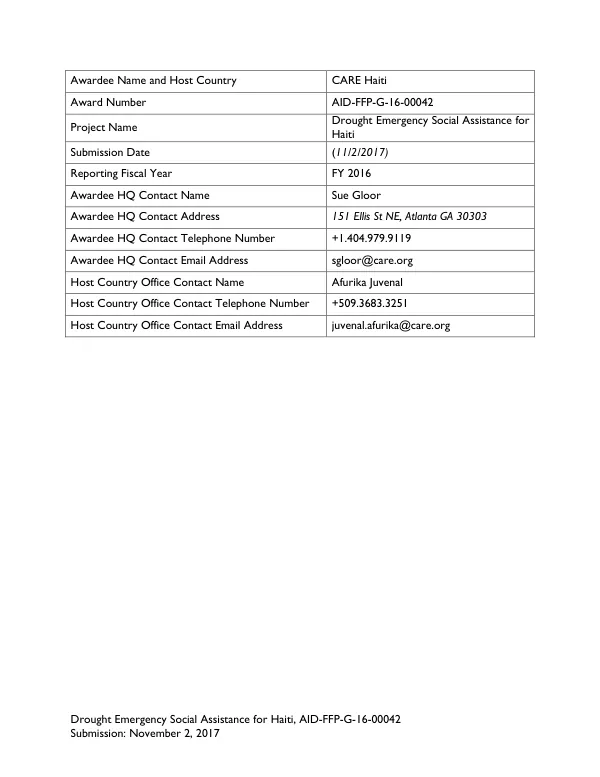
Drought Emergency Social Assistance for Haiti, AID-FFP-G-16-00042
The Drought Emergency Social Assistance for Haiti project was implemented in response to the 2015/2016 El-Nino drought crisis in Haiti.
2017 · 23 pages
Sign in to readA free account is required to download.
Abstract
The project aimed to protect and improve the livelihoods of 14,785 households (80,000 people) in two communes of the Central Plateau Department and four communes of the South-East Department. CARE's emergency response had two components: immediate income needs to access critical food and livelihoods needs, and future resilience of drought-affected communities. The project involved the transfer of $250 USD to 14,785 selected beneficiary households over the project period, resulting in an investment of approximately 590,000 person-days in community physical assets such as rehabilitation of micro-watersheds/catchments for water source productivity and dry season farming, low-cost rainwater reservoirs, and market and sanitation infrastructure. The project also supported community and institutional initiatives, including Village Savings and Loan Associations (VSLA), community nutrition awareness-raising activities, and planning and monitoring of community assets (agriculture and natural resources) by local and government structures. The project outputs included the identification and targeting of 14,785 beneficiary households for cash transfer activities, with 15,048 households (6,750 female or 45%) identified and worked with by the end of the reporting period. Of these households, 13,236 (88%) were physical asset workers, 891 (6%) were social workers, and 921 (6%) were direct cash transfers beneficiaries. The project also involved the selection and support of high-performing VSLA groups in the Central Plateau and South-East Departments, with 30 groups in the Central Plateau and 45 groups in the South-East Department receiving support. The project's targeting committee was formed during the first quarter to finalize beneficiary lists using initial lists drawn from the Ministry of Social Affairs and Labor (MAST)-led targeting database established under the Kore Lavi long-term safety net mechanism. The targeting processes on the ground were jointly supervised by MAST representatives and the heads of Community Support and Development Councils (CADEC). The project also involved the selection of two Micro Finance Institutions to process transfers to beneficiaries, with the Regional Credit Union for Economic and Social Promotion (CREPES) selected for the South-East Department and the Savings and Credit Cooperative of Lascahobas (COOPECLAS) selected for the Central Plateau Department. The project's results included the transfer of $40,968 to support 30 high-performing VSLA groups in the Central Plateau, enabling them to buy seeds and plant them in the beginning of August. The VSLA groups managed to buy a total of 1,469 marmites of bean seeds, 1,714 marmites of congo pea seeds, 814 marmites of corn seeds, 2,697 marmites of peanut seeds, and 1,408 marmites of pea seeds. The project also identified 45 additional VSLA groups in the South-East Department with 1,345 members (997 or 74% female), and will sign a contract with them to give them support before the next agricultural season that starts mid-November. The project's implementation involved the formation of a targeting committee to finalize beneficiary lists, the selection of high-performing VSLA groups, and the transfer of funds to support these groups. The project's results included the transfer of funds to support VSLA groups, enabling them to buy seeds and plant them, and the identification of additional VSLA groups in the South-East Department. The project's overall goal was to protect and improve the livelihoods of drought-affected communities in Haiti.