MANAGEMENT SYSTEMS INTERNATIONAL
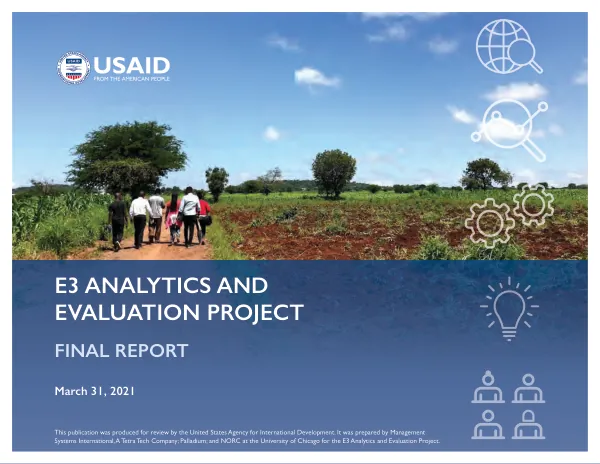
E3 Analytics and Evaluation Project Final Report
The E3 Analytics and Evaluation Project was launched in 2013 by the United States Agency for International Development (USAID) to support the technical leadership of the Bureau for Economic Growth, Education, and Environment (E3).
2021 · 58 pages
Sign in to readA free account is required to download.
Abstract
The project aimed to deliver rigorous evaluations, analytic products, and technical assistance to further evidence-based decision-making around project design and implementation. The project's scope allowed for a broad range of analytic services, including performance evaluations, assessments, and other support to inform project designs. USAID clients from across and outside E3 technical offices took advantage of this breadth of assistance to commission 121 activities during the life of the project. These activities informed some of the E3 Bureau's most challenging and ambitious technical work across the diverse sectors and regions in which the Bureau was active. The project team collected data in 44 countries and delivered more than 1,500 products to USAID clients. These products ranged from foundational design documents to final analytic reports and summary briefing notes. Delivering this volume and complexity of services required a flexible, scalable model that the project's core implementing partners—Management Systems International, a Tetra Tech company, together with Palladium and NORC at the University of Chicago—worked closely to develop and refine over the life of the project. The project team also carried out many targeted rapid assistance activities to help USAID clients address immediate evidence, planning, and learning needs. Results from project studies provided critical results and lessons learned to help the Agency make evidence-based decisions and foster greater development impact. The project's highly collaborative process involved an explicit sequence of carefully documented consultations, agreement on key research questions, development of study design options, and detailed design proposal and agreement with USAID to implement the study. Through these 121 activities, the project team developed innovative tools and resources and useful lessons learned that were generated through the project's services and products. A focus group discussion in Cambodia as part of the project's evaluation of climate risk management at USAID highlighted the importance of engaging with local stakeholders to inform project designs. The project's evaluation of the Responsible Land-Based Investment Pilot in Mozambique demonstrated the effectiveness of using data collection to inform project implementation. The project's impact was felt across the E3 Bureau, with results from project studies providing critical results and lessons learned to help the Agency make evidence-based decisions and foster greater development impact. The project's legacy continues to shape the E3 Bureau's approach to evidence-based decision-making, with a focus on delivering rigorous evaluations, analytic products, and technical assistance to inform project design and implementation. The project's geographic focus spanned 44 countries, with a diverse range of activities conducted in various sectors, including climate risk management, land tenure assistance, and renewable energy. The project's timeframes ranged from short-term rapid assistance activities to long-term impact evaluations, with a focus on delivering high-quality products to USAID clients within tight deadlines. The project's recommendations emphasized the importance of engaging with local stakeholders, using data collection to inform project implementation, and developing innovative tools and resources to support evidence-based decision-making. The project's legacy continues to shape the E3 Bureau's approach to evidence-based decision-making, with a focus on delivering rigorous evaluations, analytic products, and technical assistance to inform project design and implementation.