USAID DEC
Towards an AIDS-free Generation: Health Policy Plus Supports PEPFAR's Drive to Reach HIV Treatment, Care, Support Targets
Sign inAVENIR HEALTH
Towards an AIDS-free Generation: Health Policy Plus Supports PEPFAR's Drive to Reach HIV Treatment, Care, Support Targets
The Health Policy Plus (HP+) initiative is a five-year cooperative agreement funded by the U.S.
2016 · 2 pages
Sign in to readA free account is required to download.
Abstract
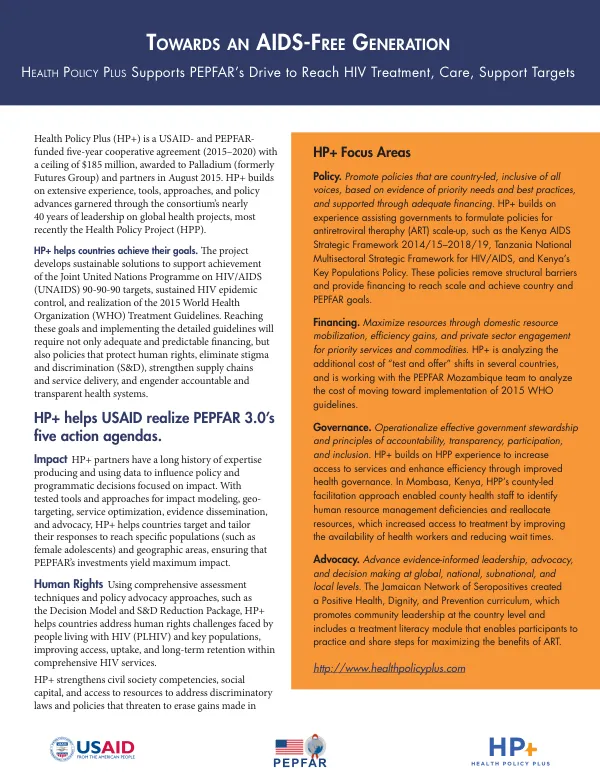
Agency for International Development (USAID) and the President's Emergency Plan for AIDS Relief (PEPFAR). The agreement, which began in August 2015 and has a ceiling of $185 million, aims to support PEPFAR's drive to reach HIV treatment, care, and support targets. HP+ is implemented by Palladium, in collaboration with several partners, including Avenir Health, Futures Group Global Outreach, and Plan International USA. HP+ helps countries achieve their goals by developing sustainable solutions to support the achievement of the Joint United Nations Programme on HIV/AIDS (UNAIDS) 90-90-90 targets, sustained HIV epidemic control, and realization of the 2015 World Health Organization (WHO) Treatment Guidelines. The project focuses on four key areas: policy, financing, governance, and advocacy. In the policy area, HP+ promotes policies that are country-led, inclusive of all voices, based on evidence of priority needs and best practices, and supported through adequate financing. HP+ also works to maximize resources through domestic resource mobilization, efficiency gains, and private sector engagement for priority services and commodities. The project operationalizes effective government stewardship and principles of accountability, transparency, participation, and inclusion. Additionally, HP+ advances evidence-informed leadership, advocacy, and decision making at global, national, subnational, and local levels. HP+ uses its Stigma and Discrimination Reduction Package to reduce barriers to access and increase uptake of services. The package includes a globally validated and standardized measurement questionnaire, training "menus" and materials, and action planning, codes of conduct development, and a facility checklist. The project also strengthens civil society competencies, social capital, and access to resources to address discriminatory laws and policies that threaten to erase gains made in the HIV response. HP+ has a long history of expertise in producing and using data to influence policy and programmatic decisions focused on impact. The project uses tested tools and approaches for impact modeling, geo-targeting, service optimization, evidence dissemination, and advocacy to help countries target and tailor their responses to reach specific populations and geographic areas. HP+ also builds on the Gender and Sexual Diversity (GSD) training curriculum to reduce workplace discrimination while strengthening PEPFAR programming to meet the needs of marginalized and vulnerable groups. The project's efficiency focus is on site-level efficiency, increasing service quality without increasing cost. HP+ helps countries understand resource requirements to effectively achieve 90-90-90 and epidemic control targets. The project also assists local teams with implementing PEPFAR's strategic pivot to high-burden locations. HP+'s experience measuring and linking expenditures to site- and above-site-level results and health outcomes improves program-level efficiencies. HP+ also works to unlock domestic financing for HIV, which is key to achieving long-term sustainability in the response to HIV and AIDS. The project partners with and strengthens the capacity of civil society to build the business case and advocate effectively. HP+ supports the Sustainable Financing Initiative (SFI) through evidence-based advocacy efforts with parliamentarians, ministries of finance, and senior government officials to secure and utilize enhanced domestic funding for the scale-up of HIV programming. HP+ convenes and facilitates collaboration among multiple sectors and partners to fulfill their shared responsibility to people living with HIV (PLHIV). The project provides a platform for continued partnership among PEPFAR, UN agencies, the Global Fund, and national governments. HP+ will continue to advance evidence-informed advocacy and decision making by serving as a convening partner—bringing together international organizations; the public, private, and nonprofit sectors; and civil society to jointly plan and pursue policy reforms.