USAID DEC
EADS Snapshot on Doing Business 2014
The Doing Business 2014 report is the 11th annual report by the World Bank, presenting quantitative indicators on 11 areas of business regulation for 189 economies.
2014 · 5 pages
Sign in to readA free account is required to download.
Abstract
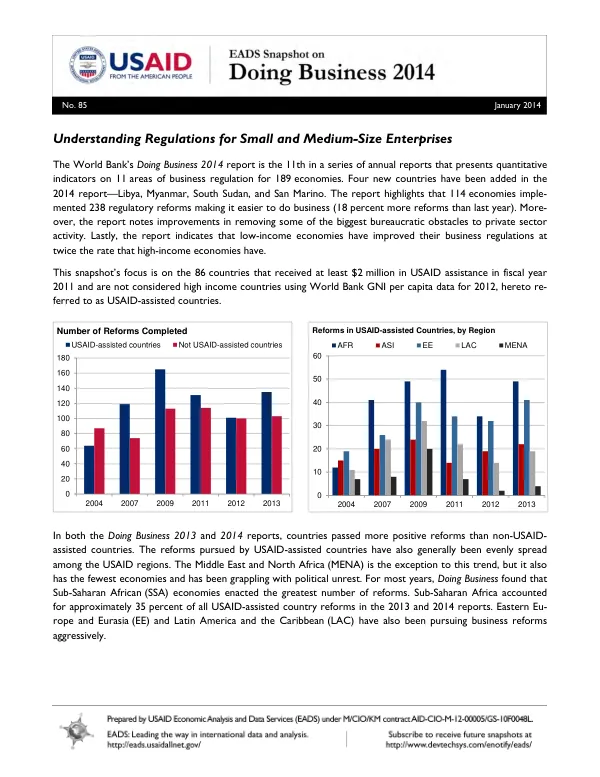
Four new countries have been added to the report: Libya, Myanmar, South Sudan, and San Marino. The report highlights that 114 economies implemented 238 regulatory reforms, making it easier to do business, with 18 percent more reforms than the previous year. The report focuses on 86 countries that received at least $2 million in USAID assistance in fiscal year 2011 and are not considered high-income countries. These countries, referred to as USAID-assisted countries, have generally pursued business reforms evenly across the USAID regions. However, the Middle East and North Africa (MENA) region is an exception, with the fewest economies and grappling with political unrest. Sub-Saharan Africa (SSA) economies have enacted the greatest number of reforms, accounting for approximately 35 percent of all USAID-assisted country reforms in the 2013 and 2014 reports. The top USAID-assisted country in the 2014 report was Georgia, ranked as the 8th best economy for doing business. However, Georgia's rank only increased by one spot from the 2013 report, scoring the best in registering property. Other USAID-assisted countries have seen impressive improvements since last year's Doing Business report. Ukraine, Philippines, and Rwanda saw the greatest progress, moving up 28, 25, and 22 spots respectively. These countries had significant reforms to improve their rankings, mainly in dealing with construction permits, getting credit, and paying taxes. The Distance to Frontier Measure is a new indicator introduced in the 2013 report to gauge how successful an economy has been at creating a business-friendly environment. The measure is derived from the highest performing economy in nine of the Doing Business categories, excluding employing workers. A score closer to 100 is interpreted as being closer to the frontier and therefore an indicator that an economy has created a business-friendly environment. Regional comparison shows that all regions have scored high on the starting a business measure, with Eastern Europe (EE) being the closest to the frontier. However, the MENA region was furthest from the frontier in resolving insolvency, while SSA region was furthest from the frontier on average in five of the ten areas measured by Doing Business. The Doing Business 2014 report highlights that smaller informal sectors and greater gender equality tend to characterize all the good performers on Doing Business indicators. Countries with large informal sectors have poorly functioning regulatory business environments, which undermine entrepreneurship and economic performance. The report also notes that high corporate tax rates are negatively correlated with levels of corporate investment and entrepreneurship. Many economies implementing reforms in areas measured by Doing Business are also putting in place measures to improve gender equality. The World Bank's Doing Business Rankings are calculated based on ten sub-indices, which cover different reform areas. Each factor in the sub-index is assigned a percentile rank, and those percentiles are calculated as a simple average. The ten sub-index percentile ranks are then calculated as a simple average or score, generating values from 1 (highest) to 189 (lowest). The report assessed 11 areas of the life of a business, excluding employing workers data in this year's ease of doing business ranking.