FHI 360
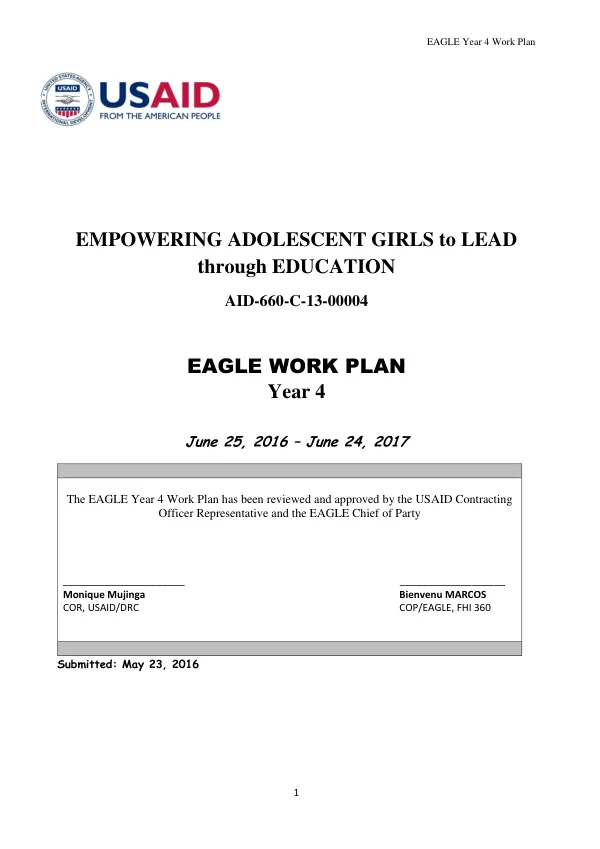
EAGLE Year 4 Work Plan: Empowering Adolescent Girls to Lead through Education
The EAGLE project aims to empower adolescent girls to lead through education in the Democratic Republic of Congo.
2016 · 33 pages
Sign in to readA free account is required to download.
Abstract
The project contributes to the USAID DRC strategy, which seeks to create positive outcomes across key sectors, including education, health, gender, and social protection. EAGLE also supports the U.S. Strategy to Preventing and Responding to Gender-based Violence Globally. The project's overarching vision is to create opportunities for adolescent girls to acquire the education and skills necessary to become active, positive agents for change within their families, schools, and communities. EAGLE's holistic programming targets adolescent girls during a critical transition period from primary school to secondary school, addressing challenges such as increased direct opportunity costs, the need to contribute to family livelihood, and cultural pressures to marry and begin a family. The EAGLE project explicitly recognizes the interdependence among educational attainment, health outcomes, and equitable gender norms. The project targets individual and community change, both of which are necessary for transformation of long-held attitudes and practices. The three Intermediate Results (IR) of the EAGLE Results Framework are: 1. Improved transition from primary to secondary school and improved completion rates for lower secondary school for EAGLE scholars. 2. Increased capacity for self-efficacy regarding life choices for EAGLE scholars. 3. Improved knowledge, attitudes, and practices regarding Adolescent Sexual and Reproductive Health (ASRH), Sexual and Gender-Based Violence (SGBV) prevention and response, and gender equality within EAGLE school communities. EAGLE is expected to further lay the foundation for the socio-economic and health benefits that research has demonstrated accrue from girls staying in school through adolescence. These benefits include higher earnings, improved health status for self and children, delayed sexual debut/motherhood, reduced risk of contracting HIV, and increased civic participation. The project will continue working with 54 primary and secondary school communities in the peri-urban areas of Kinshasa and Lubumbashi. The activities planned for EAGLE in Year 4 will contribute to the three Intermediate Results. These results target individual (IR1 and IR2) and community change (IR3), which are both necessary for meaningful and sustainable change. Activities under IR1 are designed to minimize school-related costs for the most vulnerable students, especially girls, so that they may continue going to school, improve academic performance in core subjects, and empower primary school girls to plan for a successful transition to secondary education. Activities include merit and performance-based scholarships, after-school tutoring, and teacher training. The EAGLE project will also work to increase capacity for self-efficacy regarding life choices for EAGLE scholars through leadership skills training, confidence-building activities, and critical thinking exercises. Additionally, the project will aim to improve knowledge, attitudes, and practices regarding ASRH, SGBV prevention and response, and gender equality within EAGLE school communities through education and awareness-raising activities, community engagement, and the establishment of SGBV reporting and referral mechanisms. The project will continue to work closely with the Ministry of Primary, Secondary Education and New Citizenship Initiatives (MEPS-INC) and the Ministry of Gender, Family and Children (MGFE). The Ministry of Health (MOH) will also be consulted as needed. The EAGLE team will review and update the project's Results Framework and Work Plan annually to ensure that the project remains on track to achieve its goals and objectives.