USAID
EAGLE Year 4 Q3 Report-Annexes
The EAGLE program in the Democratic Republic of Congo has made significant progress in various areas, including education and health.
2018 · 62 pages
Sign in to readA free account is required to download.
Abstract
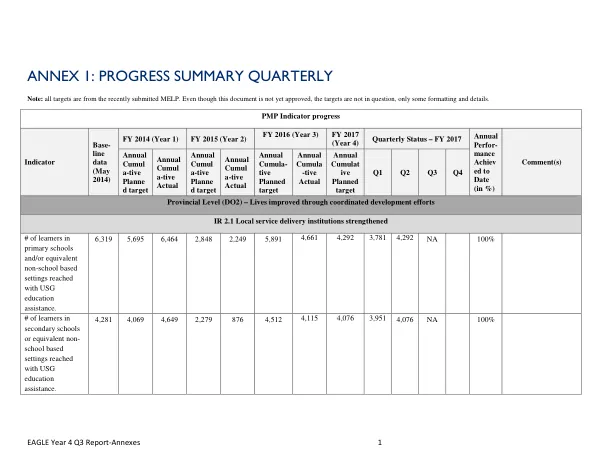
In the education sector, the number of learners in primary schools and/or equivalent non-school based settings reached with USG education assistance has shown a steady increase, from 5,695 in FY 2014 to 5,891 in Q1 FY 2017. The number of learners in secondary schools or equivalent non-school based settings reached with USG education assistance has also increased, from 4,069 in FY 2015 to 4,115 in Q2 FY 2017. In terms of education outcomes, the percentage of students who pass from 5th to 6th-grade primary at the end of the year has improved, from 72.1% in FY 2014 to 85.4% in Q2 FY 2017. The percentage of students in EAGLE schools who pass the TENAFEP has also shown an improvement, from 83.3% in FY 2014 to 89% in Q2 FY 2017. The EAGLE program has also made progress in training educators and administrators. The number of primary or secondary educators who complete professional development activities with USG support has increased, from 0 in FY 2014 to 459 in Q2 FY 2017. The number of education administrators and officials who complete professional development activities with USG assistance has also increased, from 44 in FY 2014 to 95 in Q2 FY 2017. In the health sector, the EAGLE program has made progress in training young people to deliver SRH/life skills sessions and peer advice. The number of young people trained to deliver SRH/life skills sessions and peer advice has increased, from 0 in FY 2014 to 270 in Q2 FY 2017. The average percentage of the target population reporting agreement with the concept that males and females should have equal access to social, economic, and political opportunities has also shown an improvement, from - in FY 2014 to 90% in Q2 FY 2017. The EAGLE program has also made progress in addressing GBV and coercion. The number of people reached by an individual, small group, or community-level intervention or service that explicitly addresses GBV and coercion has increased, from 0 in FY 2014 to 4,676 in Q2 FY 2017. In terms of infrastructure, the EAGLE program has made progress in building or repairing classrooms in schools. The number of classrooms built or repaired with USG assistance has increased, from 0 in FY 2014 to 18 in Q2 FY 2017. Overall, the EAGLE program has made significant progress in various areas, including education and health. The program has shown a steady increase in the number of learners reached with USG education assistance, improved education outcomes, and increased training of educators and administrators. The program has also made progress in addressing GBV and coercion and building or repairing classrooms in schools.