ADRA
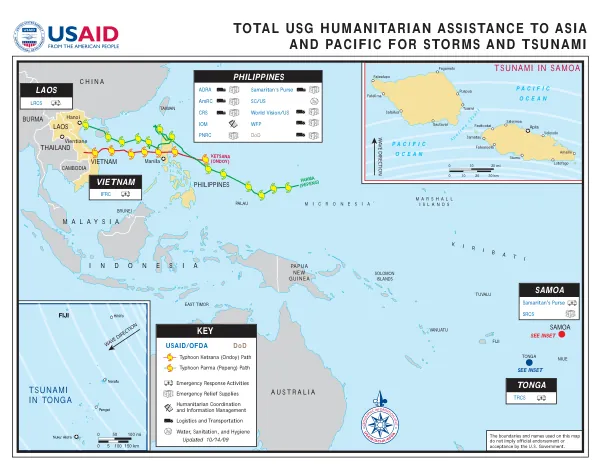
Asia and The Pacific Storms and Tsunami Program Maps 10/10/2009
Typhoon Ketsana, also known as Ondoy, made landfall in the Philippines on September 26, 2009, bringing heavy rainfall and widespread flooding to the country.
2009 · 3 pages
Sign in to readA free account is required to download.
Abstract
The storm's impact was particularly severe in the capital city of Manila, where the Pasig River overflowed its banks, inundating nearby communities and causing significant damage to infrastructure and property. The storm's effects were felt across a wide area, with reports of flooding and landslides in several provinces, including Rizal, Laguna, and Quezon. The National Disaster Risk Reduction and Management Council (NDRRMC) reported that over 400,000 people were affected by the storm, with more than 250,000 displaced from their homes. The death toll from the storm was estimated to be over 240 people, with many more injured. In addition to the Philippines, Typhoon Ketsana also affected other countries in the region, including Vietnam and Cambodia. The storm's impact was felt in these countries through heavy rainfall and flooding, although the severity of the damage was less than in the Philippines. Typhoon Parma, also known as Pepeng, made landfall in the Philippines on October 3, 2009, bringing further heavy rainfall and flooding to the country. The storm's impact was particularly severe in the northern provinces of the Philippines, including Cagayan and Isabela, where the Cagayan River overflowed its banks, causing widespread flooding and damage. The storm's effects were felt across a wide area, with reports of flooding and landslides in several provinces, including Benguet and Mountain Province. The NDRRMC reported that over 1.1 million people were affected by the storm, with more than 600,000 displaced from their homes. The death toll from the storm was estimated to be over 400 people, with many more injured. The United States Agency for International Development (USAID) provided humanitarian assistance to the affected countries, including the Philippines, Vietnam, and Cambodia. The assistance included emergency relief supplies, such as food, shelter, and medical aid, as well as support for the affected communities to recover from the disaster. The Indian Ocean and the Pacific Ocean were also affected by the storms, with reports of flooding and landslides in several countries, including India, Bangladesh, and Sri Lanka. The storms brought heavy rainfall and strong winds to these countries, causing significant damage to infrastructure and property. The total rainfall in the Philippines from Typhoon Parma was significant, with accumulated rainfall measurements obtained through NASA/JAXA TRMM Near-Real-Time Monitoring Products showing that the storm brought heavy rainfall to the country. The rainfall was particularly severe in the northern provinces of the Philippines, where the Cagayan River overflowed its banks, causing widespread flooding and damage. The humanitarian response to the storms was coordinated by the United Nations Office for the Coordination of Humanitarian Affairs (OCHA), with support from the International Federation of Red Cross and Red Crescent Societies (IFRC) and other humanitarian organizations. The response included emergency relief supplies, shelter, and medical aid, as well as support for the affected communities to recover from the disaster.