USAID
Ebola Response
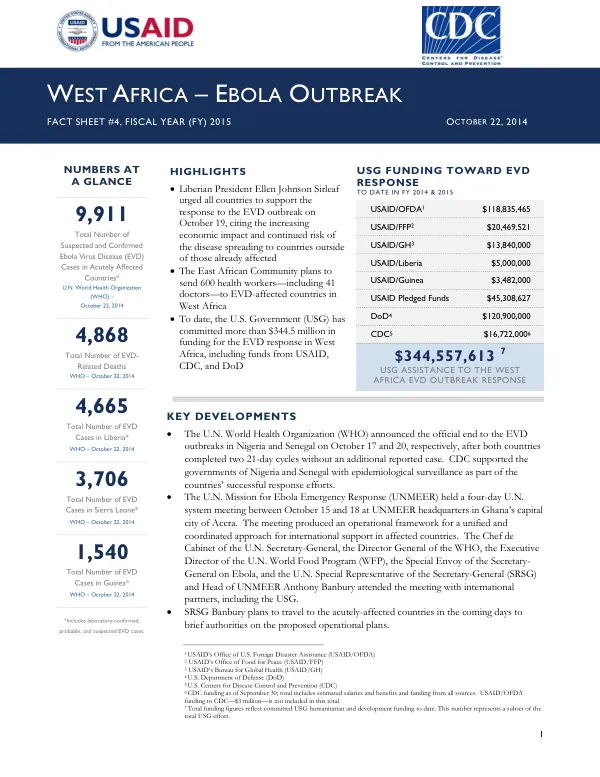
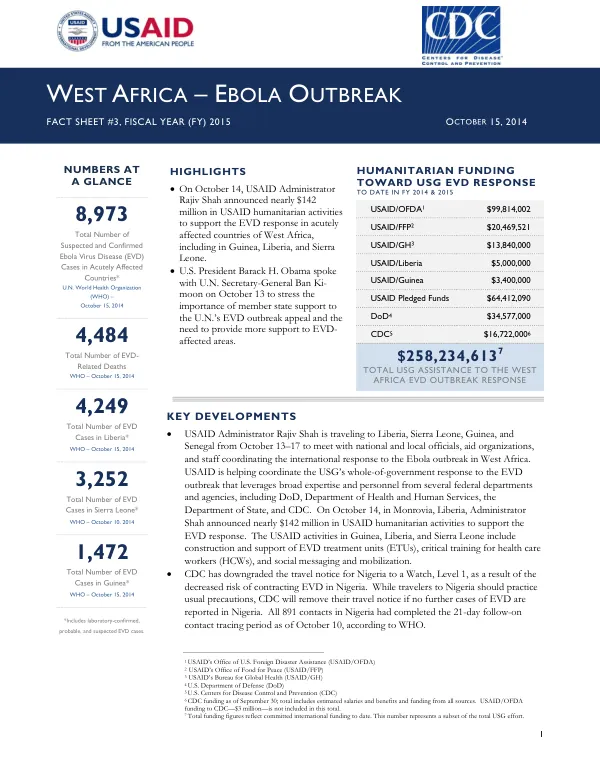
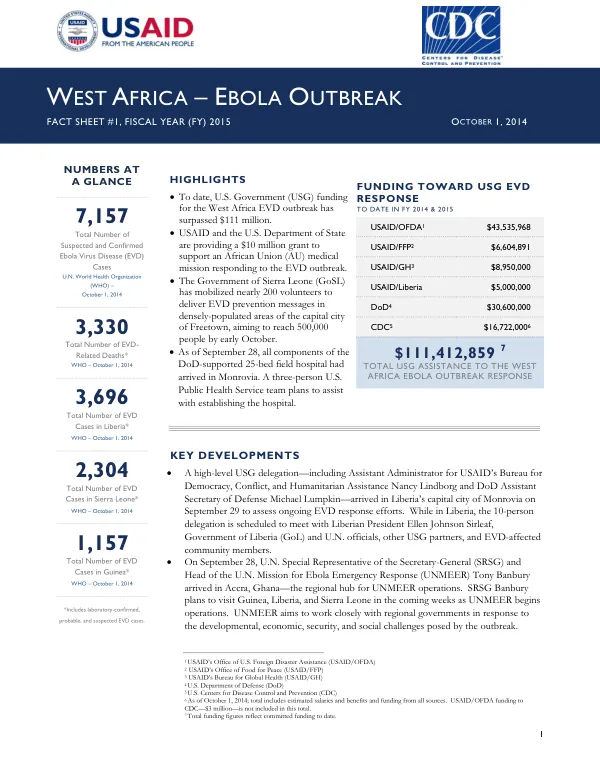
The Ebola epidemic has had significant negative impacts on the health systems, livelihoods, and household economies in Liberia, Sierra Leone, and Guinea.
2015 · 1 pages
Sign in to readA free account is required to download.
Abstract
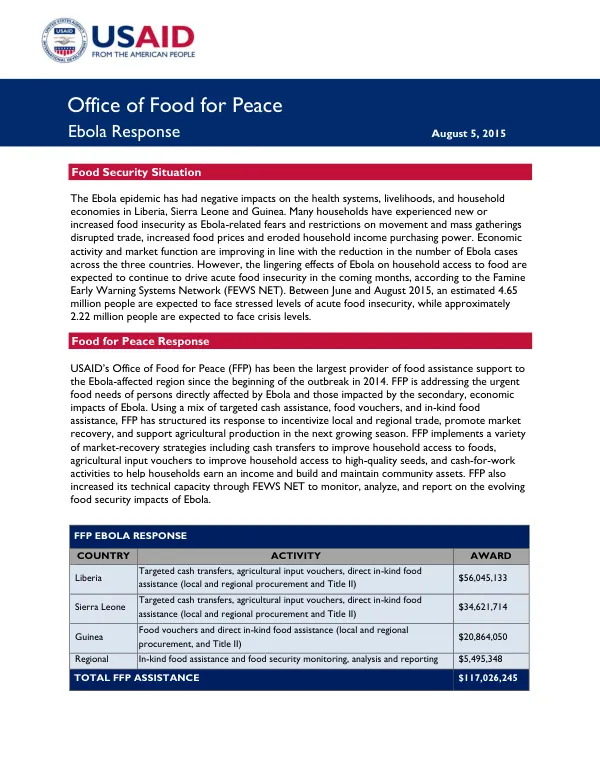
Many households have experienced new or increased food insecurity due to Ebola-related fears and restrictions on movement and mass gatherings, which have disrupted trade, increased food prices, and eroded household income purchasing power. Economic activity and market function are improving in line with the reduction in the number of Ebola cases across the three countries. However, the lingering effects of Ebola on household access to food are expected to continue to drive acute food insecurity in the coming months, according to the Famine Early Warning Systems Network (FEWS NET). Between June and August 2015, an estimated 4.65 million people are expected to face stressed levels of acute food insecurity, while approximately 2.22 million people are expected to face crisis levels. USAID's Office of Food for Peace (FFP) has been the largest provider of food assistance support to the Ebola-affected region since the beginning of the outbreak in 2014. FFP is addressing the urgent food needs of persons directly affected by Ebola and those impacted by the secondary, economic impacts of Ebola. Using a mix of targeted cash assistance, food vouchers, and in-kind food assistance, FFP has structured its response to incentivize local and regional trade, promote market recovery, and support agricultural production in the next growing season. FFP implements a variety of market-recovery strategies, including cash transfers to improve household access to food, agricultural input vouchers to improve household access to high-quality seeds, and cash-for-work activities to help households earn an income and build and maintain community assets. FFP's Ebola response includes targeted cash transfers, agricultural input vouchers, direct in-kind food assistance, and food vouchers. In Liberia, FFP provided $56,045,133 in assistance, including targeted cash transfers, agricultural input vouchers, and direct in-kind food assistance. In Sierra Leone, FFP provided $34,621,714 in assistance, including targeted cash transfers, agricultural input vouchers, and direct in-kind food assistance. In Guinea, FFP provided $20,864,050 in assistance, including food vouchers and direct in-kind food assistance. Additionally, FFP provided $5,495,348 in in-kind food assistance and food security monitoring, analysis, and reporting at the regional level. The total FFP assistance for the Ebola response is $117,026,245. FFP's response is focused on addressing the urgent food needs of persons directly affected by Ebola and those impacted by the secondary, economic impacts of Ebola. By providing a mix of targeted cash assistance, food vouchers, and in-kind food assistance, FFP aims to incentivize local and regional trade, promote market recovery, and support agricultural production in the next growing season. FFP's technical capacity has also been increased through FEWS NET to monitor, analyze, and report on the evolving food security impacts of Ebola.