FOOD AND AGRICULTURAL ORGANIZATION
West Africa – Ebola Outbreak Fact Sheet #4, Fiscal Year (FY) 2015
The U.N.
2015 · 7 pages
Sign in to readA free account is required to download.
Abstract
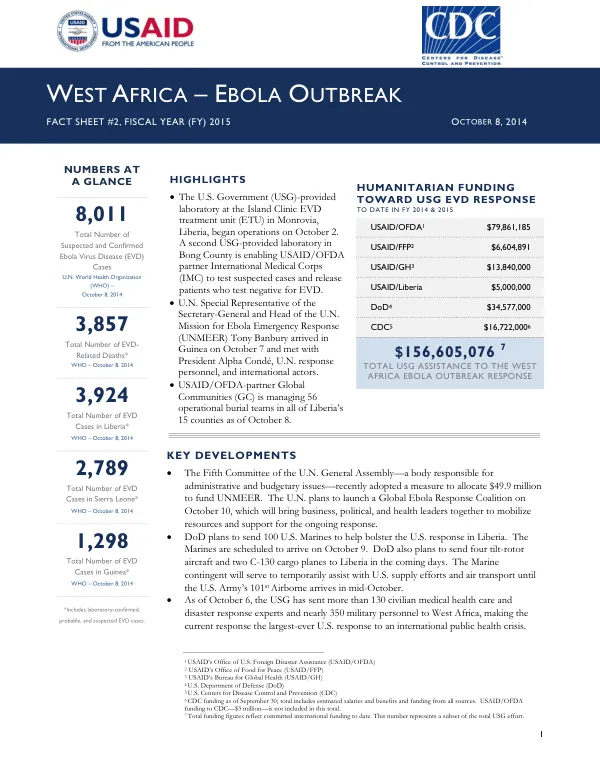
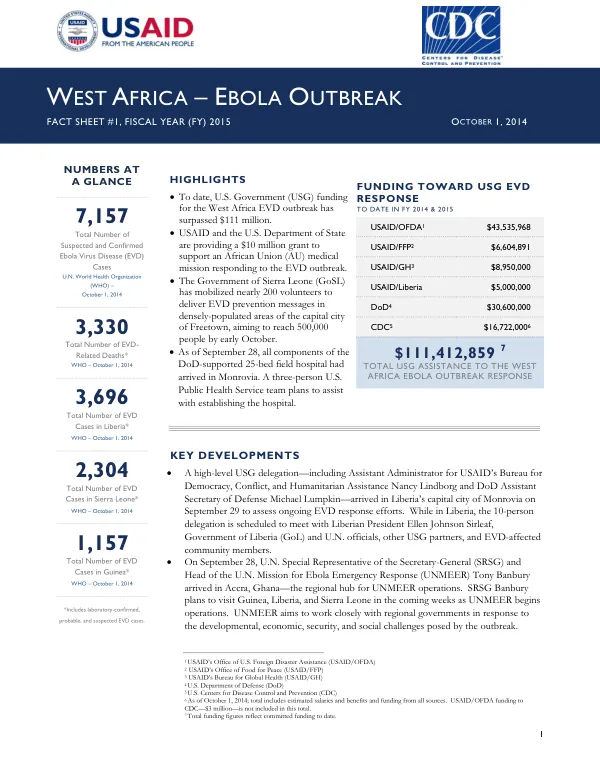
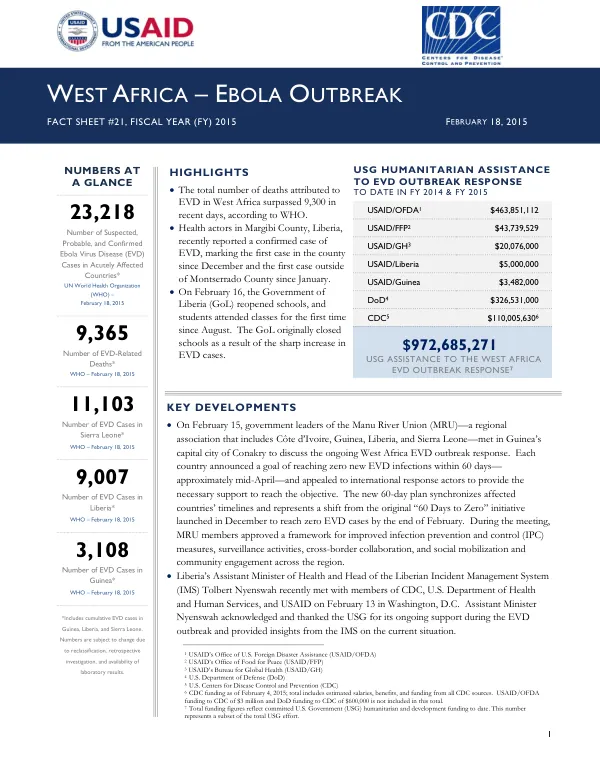
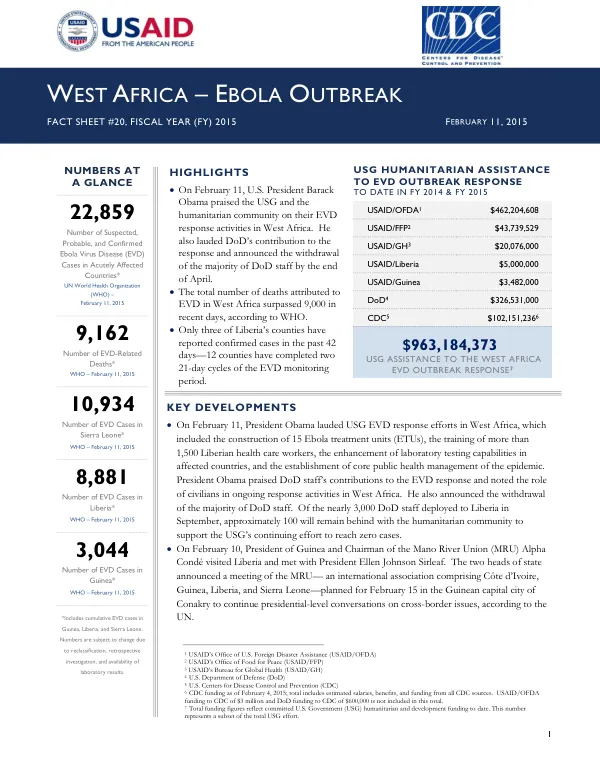
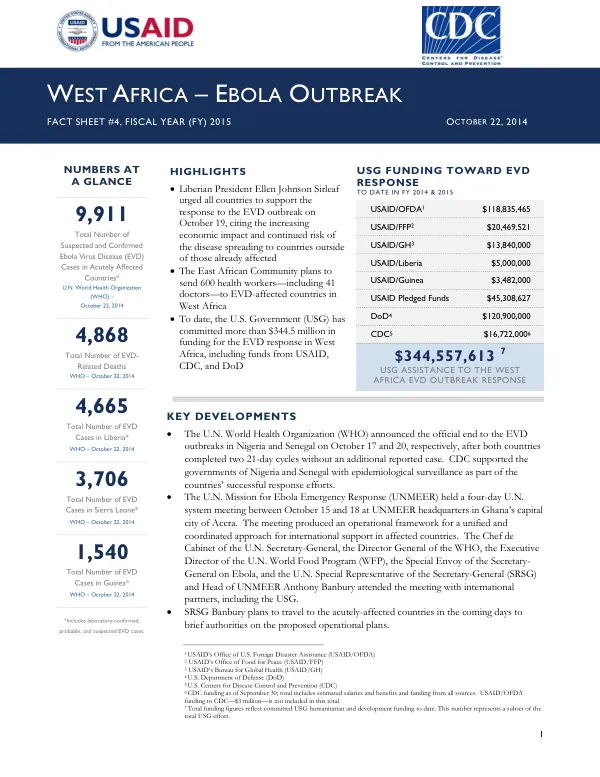
World Health Organization (WHO) announced the end to the EVD outbreaks in Nigeria and Senegal on October 20 and 20, respectively, after both countries completed five 21-day cycles without an additional reported case. The U.N. supported the governments of Nigeria and Senegal with epidemiological surveillance as part of their successful response efforts. The U.N. Mission for Ebola Emergency Response (UNMEER) held a four-day meeting between October 15 and 18 at UNMEER's headquarters in Ghana's capital city of Accra. The meeting produced an operational framework for a unified and coordinated approach for international support in affected countries. The meeting was attended by the Chef de Cabinet of the U.N. Secretary-General, the Director General of the WHO, the Executive Director of the U.N. World Food Program (WFP), the U.N. Special Representative of the Secretary-General (SRSG) and Head of UNMEER Anthony Banbury, and international partners, including the U.S. Government. SRSG Banbury plans to travel to the acutely affected countries in the coming days to brief authorities on the proposed plans. The U.S. Government has committed more than $344.5 million in funding for the EVD response in West Africa, with funds from USAID, CDC, and the U.S. Department of Defense. The U.N. reported on October 16 that it had received only $100,000 for the Ebola Response Multi-Partner Trust Fund created in mid-September, a fraction of the nearly $1 billion that the U.N. is requesting. The trust fund provides a flexible platform to finance unfunded priorities, including patient care, social mobilization, and community engagement. Approximately 22% of confirmed EVD cases are among children and youth under the age of 17, according to the U.N. Children's Fund (UNICEF). As of October 20, UNICEF had identified nearly 2,000 children affected by the outbreak, including more than 560 orphans stemming from the outbreak. The U.N. reported more than 9,900 reported cases of EVD and nearly 4,900 resulting deaths in Guinea, Liberia, and Sierra Leone. Major General Darryl Williams, the outgoing commander of the Joint Force Command (JFC), was replaced by Major General Darryl Williams on October 19. U.S. Ambassador to Liberia Deborah R. Malac, CDC staff, and representatives of the U.S. Government's Disaster Assistance Response team met with Major General Volesky and DoD personnel to discuss EVD response efforts and the overall U.S. Government strategy. A third cohort of trainees, including 35 clinicians and 25 non-clinicians, completed classroom and EVD treatment unit (ETU) trainings held by the Liberian Ministry of Health and Social Welfare (MoHSW) and the WHO. Trainings are divided into two phases: classroom training and work in a simulated ETU, and a mentorship component where students undertake work in an active ETU. Health care workers are undergoing trainings to increase the number of qualified personnel to staff additional ETUs as they begin receiving patients in the coming weeks. To date, 175 people have completed the non-mentoring portion of the training. The MoHSW and WHO are working to improve infection control (IPC) at the Island Clinic ETU in the capital city of Monrovia. They plan to reduce the number of beds to 100, originally planned for 160, and increase the frequency of monitoring staff as measures to improve overall IPC. CDC representatives have provided EVD assistance throughout Liberia, working with U.S. Peace Corps staff to provide valuable cultural insight and translation services. In addition, Peace Corps has provided staff to support CDC representatives conducting county-level EVD response activities. In Sierra Leone, the U.N. Food and Agriculture Organization (FAO) convened a second meeting with key stakeholders to formalize the Food Security and Livelihood Working Group. Participants raised concerns about the status of the current agricultural season and increasing food prices during a period of reduced economic activity. The WFP is designing a survey to measure disruptions to agricultural production and is supporting the Ministry of Agriculture, Forestry, and Food Security to strengthen monitoring to better understand the impact of EVD on food security and livelihoods. Between October 16 and 17, UNICEF held a two-day meeting in Kenema for 36 EVD survivors. The meeting was attended by CDC representatives, NGOs operating in the area, and a representative from the Ministry of Social Welfare, Gender, and Children's Affairs. According to CDC, survivors expressed strong interest and willingness to support the ongoing EVD response. Key issues surrounding EVD survivors include lost livelihoods, difficulty reintegrating due to stigma from the community, and other psychosocial trauma. In conjunction with UNICEF and the Emergency Response Consortium, CDC is training health care staff at peripheral health units on IPC measures. CDC has conducted a national-level train-the-trainers workshop for 22