USAID DEC
Ebola Virus Disease Infection Prevention and Control and the Provision of Primary Health Care and Water, Sanitation and Hygiene Infrastructure Semi-annual Report, October 30th, 2020, Agreement No: 720FDA20CA00005
Sign inMINISTRY OF HEALTH
Ebola Virus Disease Infection Prevention and Control and the Provision of Primary Health Care and Water, Sanitation and Hygiene Infrastructure Semi-annual Report, October 30th, 2020, Agreement No: 720FDA20CA00005
The Ebola Virus Disease Infection Prevention and Control and the Provision of Primary Health Care and Water, Sanitation and Hygiene Infrastructure project was launched in Ituri Province, Democratic Republic of the Congo (DRC), in response to the ongoing Ebola outbreak.
2020 · 11 pages
Sign in to readA free account is required to download.
Abstract
The project, funded by the Office of U.S. Foreign Disaster Assistance (OFDA), aimed to reduce morbidity and mortality among vulnerable populations through improved access to free quality health care, strengthened Ebola awareness, isolation, and case management, and ensured minimum water, sanitation, and hygiene (WASH) requirements were met at targeted health facilities (HFs) in Bunia, Komanda, Lolwa, Rwampara, and Nyankunde Health Zones (HZs). The project focused on infection prevention and control (IPC), health programming, and WASH-related activities in 37 targeted HFs and their surrounding communities, as well as operational support to the Makayanga Ebola Treatment Center (ETC). Due to insecurity in the Rwampara HZ, the project temporarily suspended activities in three HFs: Centre de Sante (CS) Walu, CS Balazana, and CS Bayhana. However, two new health facilities – CS Shari and CS Mwanga – were selected to serve displaced populations from Walu and Balazana areas, bringing the total number of facilities supported to 39. During the reporting period, the project trained and mentored 512 healthcare personnel, provided IPC support to 39 HFs, conducted EVD awareness and sensitization campaigns in surrounding communities, and reached 525,694 beneficiaries in total. This led to increased uptake of Ebola messages and timely submission of surveillance reports by HFs. The project also provided free primary health care at four HFs, with 8,108 outpatient consultations and 404 assisted deliveries. The project's health systems and clinical support sector focused on facility selection, infection prevention and control trainings, provision of IPC and PPE supplies, and infection prevention and control scorecard evaluation. Samaritan's Purse trained 184 healthcare workers on EVD and COVID-19 IPC, bringing the cumulative number of HCWs trained on EVD IPC to 427. The project also provided essential IPC materials and supplies to the targeted 39 HFs, including non-contact thermometers, examination gloves, hand sanitizers, and PPE. Infection prevention and control scorecard evaluation showed that 36 HFs reported IPC scores greater than 80%, with only one health facility reporting a score lower than 80%. However, insecurity in the Rwampara HZ hampered field movements to three HFs, resulting in a reduction in IPC scores. The project provided rehabilitation for 27 HFs, including repair of triages, isolation units, drainages, and fencing, to support safe temporary isolation of suspected cases. The project worked closely with the Ministry of Health (MoH), the World Health Organization (WHO), the Komanda and Bunia IPC Commission, and other non-governmental organizations (NGOs) in Ituri Province to identify and prioritize intervention sites. The project's progress and accomplishments were evaluated on a weekly basis, with a focus on improving IPC scores and reducing morbidity and mortality among vulnerable populations.
Related documents
Documents in this collection
 2009
2009USAID DEC
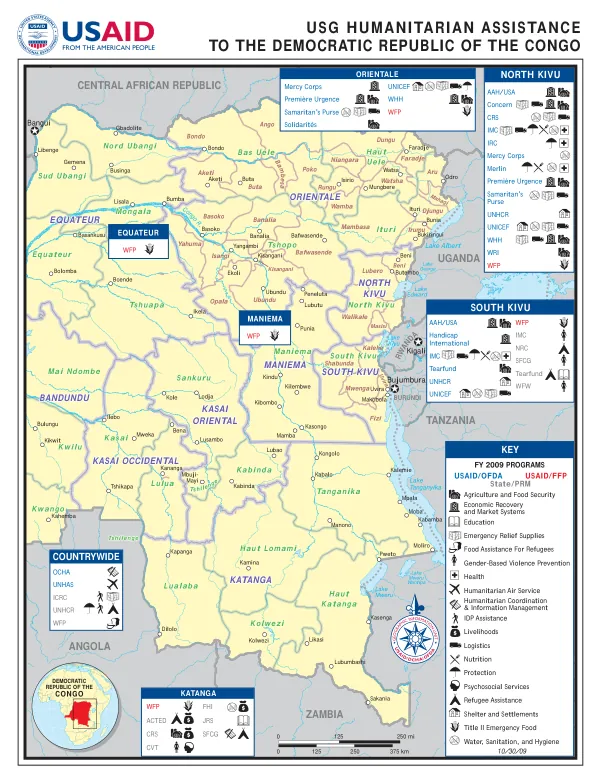
USG HUMANITARIAN ASSISTANCE TO THE DEMOCRATIC REPUBLIC OF THE CONGO
Open record 2019
2019USAID DEC