USAID DEC
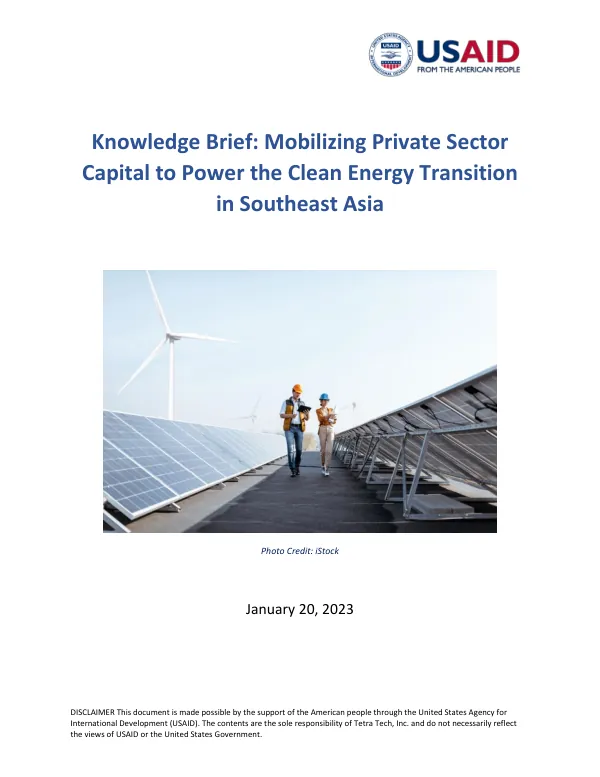
Knowledge Brief: Mobilizing Private Sector Capital to Power the Clean Energy Transition in Southeast Asia
Sign inTETRA TECH
Knowledge Brief: Mobilizing Private Sector Capital to Power the Clean Energy Transition in Southeast Asia
Southeast Asia's consumption of fossil fuels grew by approximately 70 percent over the past two decades, leading to increased carbon dioxide (CO2) emissions from energy-related consumption and contributing to climate change.
2023 · 16 pages
Sign in to readA free account is required to download.
Abstract
The industry and transport sectors accounted for most of this growth and fossil fuel (coal, oil, and gas) use, while the increased use of electricity in buildings accompanied a decline in the traditional use of biomass. Demand for electricity in the region will grow at a rate of 3 percent annually, with electricity capturing over a quarter of total final consumption by 2050. This will be underpinned by a rapid increase in urbanization, including increased appliance ownership and the uptake of air conditioners, and industrial growth. Given the region's rapid growth, Southeast Asia requires an estimated $350 billion in clean energy investments by 2030 to put countries on a decarbonization pathway to meet the region's climate goals. Globally, the Intergovernmental Panel on Climate Change (IPCC) estimates that the world will require up to $5 trillion in funding for climate-related activities annually by 2030 to create a transition path toward net-zero emissions and resilience in managing climate impacts. To support these goals, USAID in its Climate Strategy aims to mobilize $150 billion in public and private climate investments by 2030. USAID efforts in Southeast Asia are driving private sector engagement to lead to sustainable and effective development of clean energy systems. Deepened collaboration with the private sector will help to identify new enterprise-driven solutions, expand market-entry opportunities for American firms, and embrace transparent and competitive market-based solutions that will increase self-reliance at the country level. In addition, working with partner countries to integrate private sector perspectives in strategic planning will help leverage private funds to increase the investments needed to meet national clean energy targets. USAID has employed a three-pillar approach to mobilize private sector capital: lead government capacity building to enable financing mechanisms and regulations to support private sector engagement, introduce and promote business and financing models that advance renewable energy growth and mitigate risk, and increase public awareness and break down information barriers to maximize the deployment of renewable energy systems. The private sector is the driving force behind new innovations and growing industry expertise that will enhance decision-making and problem-solving. Only the private sector can provide the scale and resources required to match the complexity and challenges facing Southeast Asian countries to realize clean energy solutions. USAID projects in Southeast Asia have successfully implemented these strategic pillars, achieving significant results. For example, the Private Financing Advisory Network (PFAN) project mobilized $271 million in clean energy investments in Indonesia, while the Indonesia Clean Energy Development II (ICED II) Project mobilized $1.62 billion. The Vietnam Low Emission Energy Program V-LEEP I project mobilized $311 million in clean energy investments in Vietnam. These efforts have mitigated risks associated with increased investments in clean energy in the region and expanded opportunities for the private sector at home and abroad to embrace transparent and competitive market-based clean energy solutions. USAID continues to apply lessons learned to build and maintain regional engagement with the private sector and accelerate the deployment of clean energy by focusing on the three strategic objectives of Clean EDGE Asia: energy security to support growing economies, energy for sustainable development, and decarbonization to reach a carbon-neutral future. In addition, USAID's private sector engagement to mobilize and secure investments in the region supports the four priority areas of Clean EDGE Asia: improving utilities' capacity and readiness, increased deployment of clean energy technologies, transparency and accountability, and stakeholder engagement.
Related documents