USAID DEC
EC-LEDS Supports the Low-Carbon Transition, EC-LEDS (Enhancing Capacity for Low Emission Development Strategies)
Sign inUSAID
EC-LEDS Supports the Low-Carbon Transition, EC-LEDS (Enhancing Capacity for Low Emission Development Strategies)
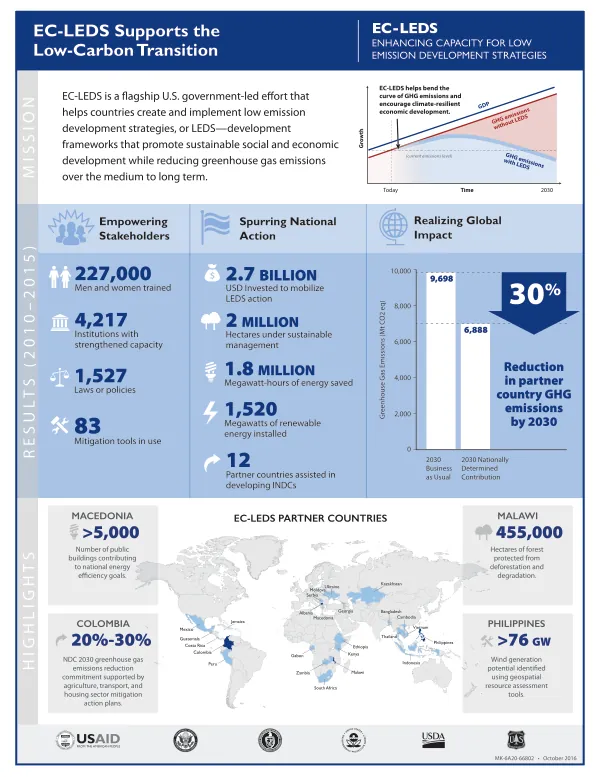
Low-carbon transition efforts are supported by EC-LEDS, a flagship U.S.
2016 · 1 pages
Sign in to readA free account is required to download.
Abstract
government-led initiative. This initiative helps countries create and implement low emission development strategies, or LEDS-development frameworks, that promote sustainable social and economic development while reducing greenhouse gas emissions over the medium to long term. A total of 227,000 men and women have been trained through EC-LEDS, with 11,417 institutions having strengthened their capacity. Additionally, 83 laws or policies have been implemented, and 83 mitigation tools are currently in use. The initiative has also invested $2.7 billion to mobilize LEDS action, resulting in 2 million hectares of land being brought under sustainable management. EC-LEDS has also led to significant reductions in greenhouse gas emissions. A total of 1.8 million megawatt-hours of energy has been saved, and 1,520 megawatts of renewable energy has been installed. Furthermore, 12 partner countries have been assisted in developing their Nationally Determined Contributions (NDCs) under the Paris Agreement. The initiative has also focused on enhancing capacity for low emission development strategies. EC-LEDS helps build the capacity of countries to develop and implement LEDS, making them more resilient to climate change and economic shocks. The initiative aims to realize global climate goals by 2030, with a target of reducing greenhouse gas emissions by 10,000 metric tons. EC-LEDS has achieved significant results in its partner countries. In Macedonia, over 5,000 public buildings are contributing to national energy efficiency goals. In Colombia, a 2030 greenhouse gas emissions reduction commitment is being supported by mitigation action plans in the agriculture, transport, and housing sectors. In the Philippines, 455,000 hectares of forest have been protected from deforestation and degradation, and wind generation potential has been assessed using geospatial resource assessment tools.