USAID DEC
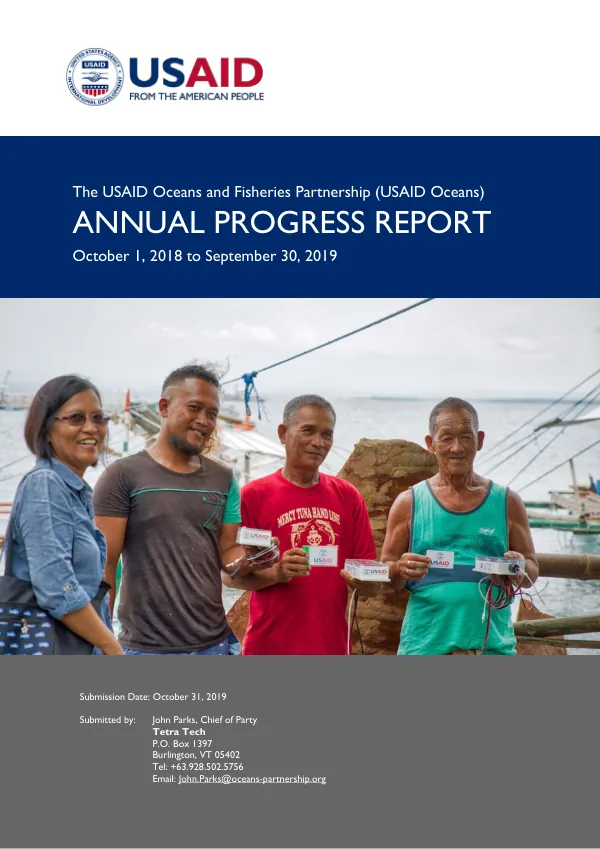
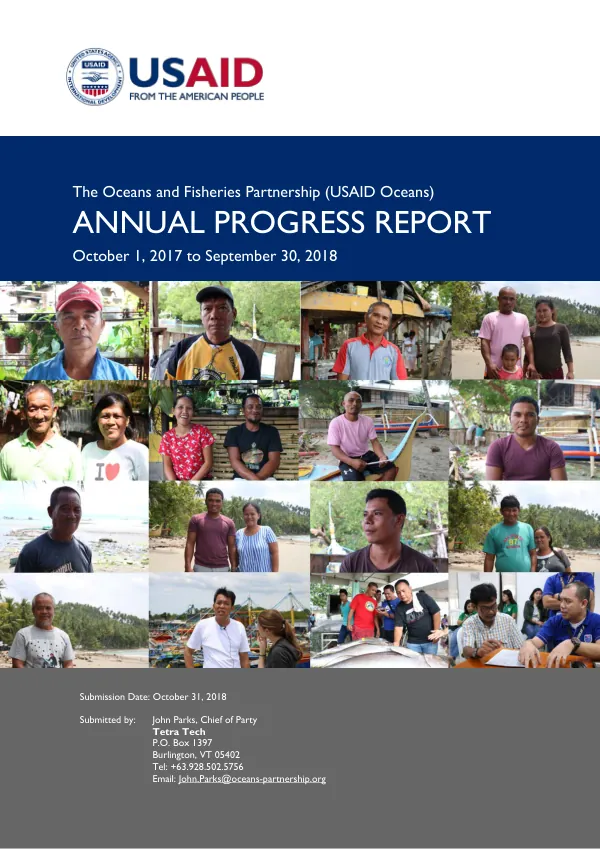
Annual Progress Report: The Oceans and Fisheries Partnership (USAID Oceans) Year Three (FY 2018)
Sign inTETRA TECH
Annual Progress Report: The Oceans and Fisheries Partnership (USAID Oceans) Year Three (FY 2018)
Background The impacts of illegal, unregulated, and unreported (IUU) fishing are widespread in the Asia-Pacific region, affecting regional governments, the private sector, and the general population.
2018 · 77 pages
Sign in to readA free account is required to download.
Abstract
IUU fishing poses environmental, economic, human welfare, and political challenges, with far-reaching consequences that span the globe. The estimated annual value of IUU fishing practices is between US $10 and 23 billion, representing 11 to 26 million tons of fish. IUU fishing comprises a significant percentage of the world's total seafood harvest, with IUU products equal to 14 to 33 percent of the world's total legal seafood harvest. The United States Agency for International Development Oceans and Fisheries Partnership (USAID Oceans) was launched on May 14, 2015, with a five-year, $19.95 million contract to combat IUU fishing in Southeast Asia and improve the region's capacity for building sustainable fisheries with sustainable management and regulatory frameworks. Since its launch, USAID Oceans has worked in partnership with the Southeast Asia Fisheries Development Center (SEAFDEC) and the Coral Triangle Initiative on Coral Reefs, Fisheries, and Food Security (CTI-CFF) to address sectoral human welfare concerns. Regional Activities and Achievements USAID Oceans has dedicated much of its first two years to building a strong foundation for regional cooperation and mutual support. The program has worked closely with its regional partners, SEAFDEC and CTI-CFF, to develop interoperable electronic catch documentation and traceability (eCDT) systems that enable full-chain, fully transparent seafood traceability. These investments have enabled USAID Oceans to cement its reputation as a regional thought leader in fisheries traceability, fisheries management, and human welfare. During Year Three, USAID Oceans provided technical guidance on eCDT standards, technical architecture, systems interoperability, and implementation methodologies. This included support to the SEAFDEC-developed ASEAN Catch Documentation Scheme (ACDS), which has evolved from a regional paper-based system to a fully electronic system. The program also provided technical assistance to the CTI-CFF, which has developed a comprehensive eCDT system for the Coral Triangle region. The Philippines: National and Local Activities and Achievements In the Philippines, USAID Oceans has worked closely with the Bureau of Fisheries and Aquatic Resources (BFAR) to develop and implement eCDT systems. The program has provided technical assistance to the BFAR in developing a comprehensive eCDT system, which has been implemented in several fisheries management areas (FMA) in the country. The program has also supported the development of a national eCDT system, which has been endorsed by the Philippine government. Indonesia: National and Local Activities and Achievements In Indonesia, USAID Oceans has worked closely with the Ministry of Marine Affairs and Fisheries (MMAF) to develop and implement eCDT systems. The program has provided technical assistance to the MMAF in developing a comprehensive eCDT system, which has been implemented in several FMA in the country. The program has also supported the development of a national eCDT system, which has been endorsed by the Indonesian government. Expansion Site Activities and Achievements USAID Oceans has also worked in several expansion sites, including Cambodia, Laos, and Vietnam. In these countries, the program has provided technical assistance to the national fisheries authorities in developing and implementing eCDT systems. The program has also supported the development of national eCDT systems, which have been endorsed by the respective governments. Management and Operations USAID Oceans has a strong management and operations team that provides technical assistance to the program's partners and supports the implementation of the program's activities. The program has a robust monitoring and evaluation system that tracks progress and identifies areas for improvement. Monitoring and Evaluation USAID Oceans has a comprehensive monitoring and evaluation system that tracks progress and identifies areas for improvement. The program uses a variety of indicators to measure its performance, including the number of eCDT systems implemented, the number of fisheries management areas covered, and the level of stakeholder engagement. FY 2018 Challenges and Lessons Learned During FY 2018, USAID Oceans faced several challenges, including the need to scale up the implementation of eCDT systems and to increase stakeholder engagement. The program also learned several lessons, including the importance of building strong partnerships with national fisheries authorities and the need to provide technical assistance to support the implementation of eCDT systems. Planned Tasks for the Next Reporting Period For the next reporting period, USAID Oceans plans to continue scaling up the implementation of eCDT systems and to increase stakeholder engagement. The program also plans to provide technical assistance to support the implementation of eCDT systems and to develop national eCDT systems in several countries. Annex I. Theory of Change and Guiding Principles USAID Oceans is guided by a theory of change that outlines the program's expected outcomes and the steps needed to achieve them. The program's guiding principles include the need to