TETRA TECH
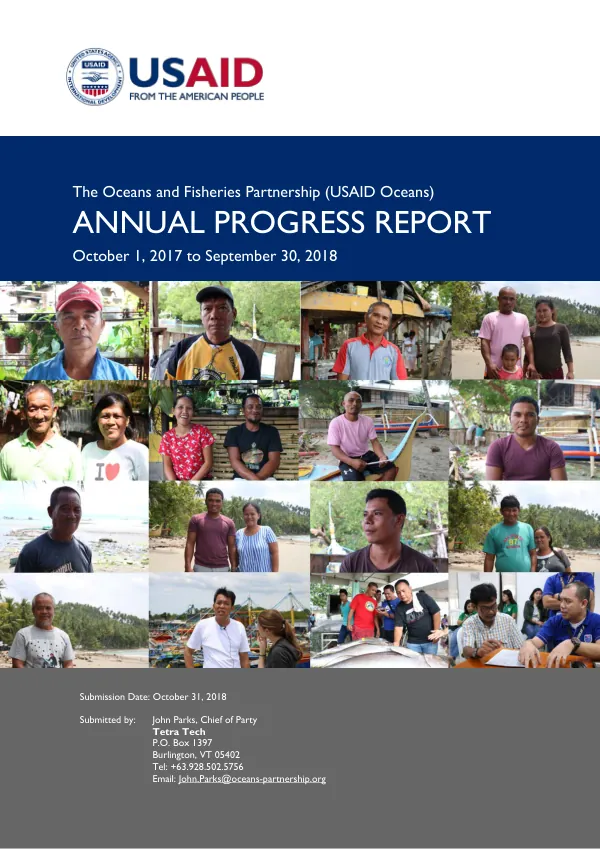
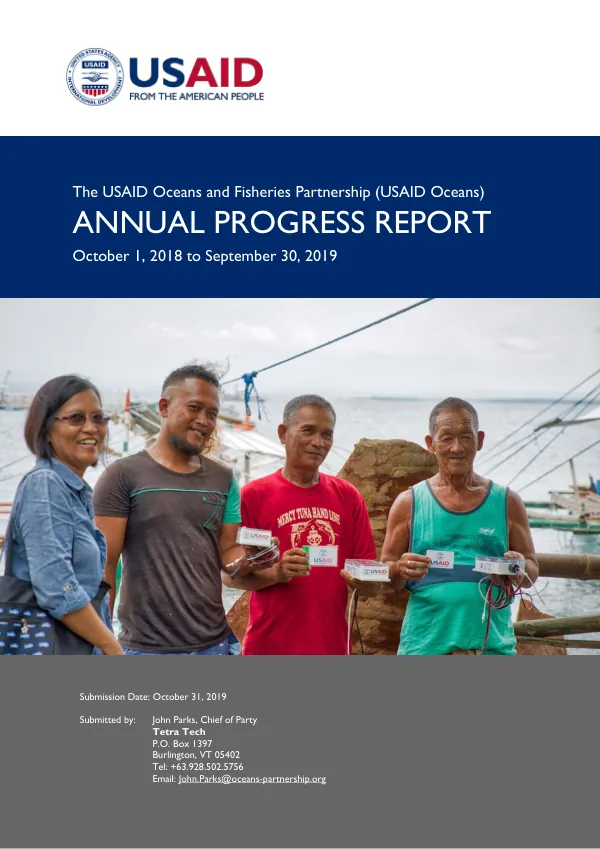
Annual Progress Report: USAID Oceans and Fisheries Partnership
The USAID Oceans and Fisheries Partnership was launched on May 14, 2015, with the goal of combating illegal, unreported, and unregulated (IUU) fishing in Southeast Asia.
2019 · 77 pages
Sign in to readA free account is required to download.
Abstract
The program is a five-year, USD $19.95 million regional program implemented by Tetra Tech in partnership with the Southeast Asia Fisheries Development Center (SEAFDEC) and the Coral Triangle Initiative for Coral Reefs, Fisheries, and Food Security (CTI-CFF). The program's explicit goals include improving the region's capacity for building sustainable fisheries with enhanced management and regulatory frameworks, and addressing sectoral human welfare concerns. Establishing legal, regulated, and responsible fisheries requires intergovernmental and regional cooperation to address the complex challenges of Southeast Asia's often interconnected marine resources, diverse ecosystems, and multi-tiered supply chains. Effective solutions require close coordination, collaboration, and mutual support. During its first three years, USAID Oceans dedicated much of its efforts to building the strong foundation required for regional collaboration, conducting research and design required to implement its core interventions, and establishing itself as a regional resource for technical guidance. In Year Four, USAID Oceans continued to work with its regional, national, and local partners, focusing on key achievements and impacts. The program's regional activities and achievements included the development of a regional plan of action (RPOA) for combating IUU fishing, the establishment of a regional technical advisory group (TAG) to provide technical guidance on eCDT standards and systems interoperability, and the conduct of research and design activities to support the implementation of core interventions. In the Philippines, national and local activities and achievements included the development of a national sustainable fisheries management plan (SFMP), the establishment of a national technical working group (TWG) to provide technical guidance on eCDT standards and systems interoperability, and the conduct of research and design activities to support the implementation of core interventions. In Indonesia, national and local activities and achievements included the development of a national RPOA for combating IUU fishing, the establishment of a national TAG to provide technical guidance on eCDT standards and systems interoperability, and the conduct of research and design activities to support the implementation of core interventions. Expansion site activities and achievements included the development of a regional RPOA for combating IUU fishing, the establishment of a regional TAG to provide technical guidance on eCDT standards and systems interoperability, and the conduct of research and design activities to support the implementation of core interventions. Management and operations activities included the development of a program management plan, the establishment of a program monitoring and evaluation (M&E) system, and the conduct of regular program reviews and assessments. Monitoring and evaluation activities included the development of a program M&E framework, the conduct of regular program monitoring and evaluation activities, and the analysis of program data and results. Challenges and lessons learned included the need for continued support and resources to sustain program activities, the importance of building strong partnerships and collaborations, and the need for ongoing research and design activities to support the implementation of core interventions. Planned tasks for the next reporting period included the continuation of regional, national, and local activities and achievements, the expansion of program activities to new countries and regions, and the continued development and implementation of core interventions. The program's theory of change and guiding principles emphasized the importance of building strong partnerships and collaborations, the need for ongoing research and design activities to support the implementation of core interventions, and the importance of monitoring and evaluating program activities and results.