USAID. MISSION TO DOMINICAN REPUBLIC
Economic education
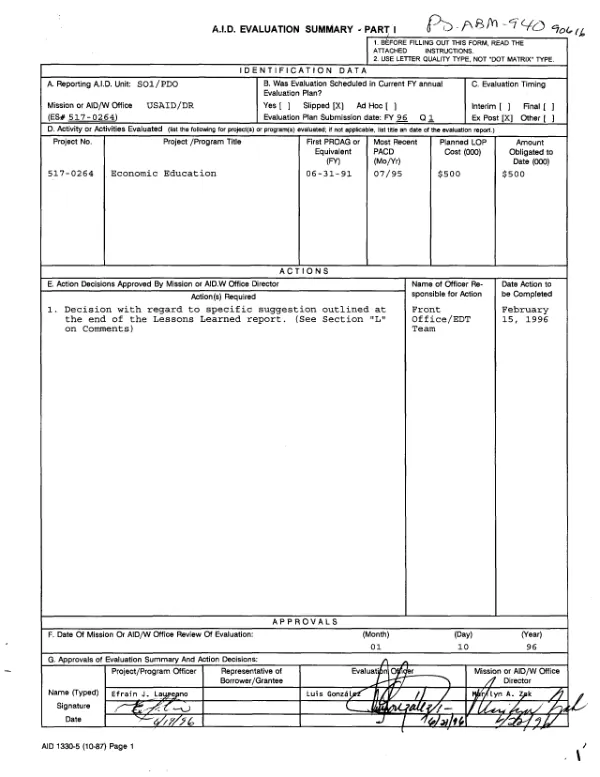
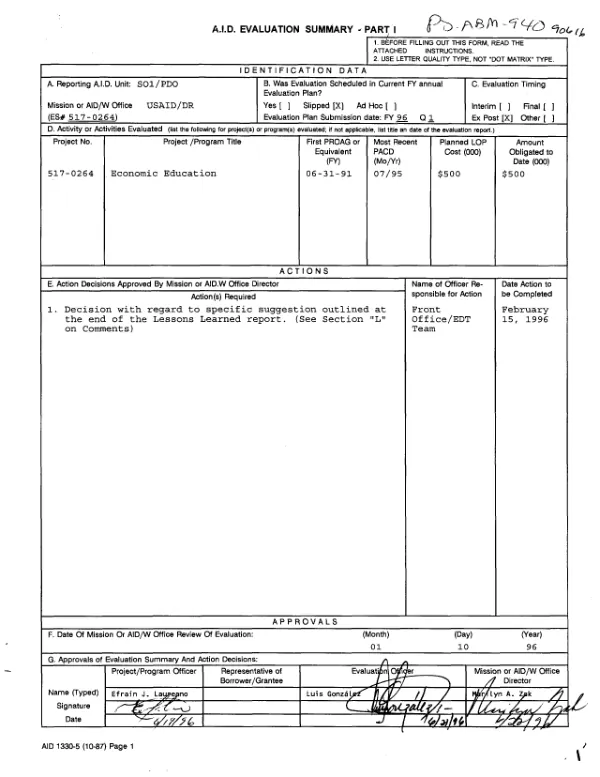
Summarizes attached ex post evaluation of a grant to Fundacion Economia y Desarrollo (FED) (6/91-7/95) to encourage informed debates on economic issues in public fora and the press in the Dominican Republic.
1996
Sign in to readA free account is required to download.
Abstract
Returns from the project exceeded expectations for projects of this kind, given the small investment involved. Almost without exception, those interviewed, whether friends or foes of economic liberalization, went out of their way to acknowledge FED"s success in shifting the terms of the debate on economic policy in the Dominican Republic. Also, there is little doubt that FED has had a major impact on policy reform decisions of the current government. Numerous lessons were learned. (1) USAID is often tempted to create a brand new institution to accomplish particular ends. Project experience demonstrates the wisdom of going, when possible, with a winner already in place. (2) USAID does not need big pockets to "buy" policy reform. In the end, difficult policy reforms will stick only if the country believes in them. The battlefield here is not one of money; it is one of ideas. Seen in this light, USAID/W"s decision to cede the area of macroeconomic policy to the international policy institutions due to the lack of resources might be premature. (3) Intellectual coherence is essential. As FED"s opponents are quick to point out, a major reason that FED has become so formidable an adversary is the rigor and coherency of its arguments, in contrast to spokespersons for other lines of economic policy. If FED were not so competent, its voice would be just one among many. (4) One can"t do everything. An economic policy unit will have an impact only if it narrows its sights. Focus on the most important reforms and be tenacious in seeing them through. (5) FED played an unusual and important role in policy reform by deflecting the pressure on the government to engage in direct confrontation with opposition interest groups, e.g., when FED floated the idea of reducing the tariff on imported milk. (6) Making policy decisions is one thing; carrying them out is another. The Dominican Republic still lacks a critical mass of trained personnel to carry out policy reform decisions. (7) Without media, there is no message. Perhaps the most distinctive feature of FED is its incessant visibility in both print and television media. Not only does it usually have something significant to say; it simply cannot be ignored. (8) A picture speaks a thousand words. People generally do not have the time or the inclination to read lengthy treatises on arcane economic matters. What does grab attention is graphics -- and FED has been ingenious in developing graphics that not only catch the eye but provoke the reader. (9) Keep it short and sweet. The published output about which FED receives the most feedback is "Mercado y Libertad" (a short daily newspaper article) and not "Sabado Economico" (a broader weekly newspaper article where formal analyses are usually presented). (10) Controversy can be a measure of success. To furnish policy leadership, one must differentiate one"s positions from others in vogue. If this position runs counter to entrenched interests, active resistance is to be expected. Interestingly, the more gradualist the government"s approach to policy change, the more persistent the resistance that is likely to emerge. It may be easiest for all concerned if ground is yielded in one fell swoop rather than inch by inch. (11) Attack the messages, not the messengers. Policy debate cannot be allowed to deteriorate into a free-for-all. If the debate assumes a personal adversarial cast -- not to be confused with aggressiveness in presenting one"s position -- one can win individual battles but wind up losing the war. Mudslinging can turn resistance to ideas into intransigence. The project"s major shortcoming was its occasional deterioration into ad hominem debate. (12) An economic policy foundation requires a critical mass of technical talent, not just a leader. FED is too identified with its Executive Director. Its ideas will gain more currency when there are more well-qualified people espousing them. (13) Policy leadership, public education, and consensus building are distinct and not necessarily compatible. One has to take into account the practical trade offs among these functions. FED attached first priority to policy leadership, second to public education, and lowest priority to consensus building. Most people agree that FED"s success in the first two areas had much to do with its selection of priorities. As recommended in the evaluation, USAID/DR will use the remaining funds from the Economic Policy and Practice Project (5170262) to finance an effort by FED to develop a strategy for realigning public sector budget priorities to address poverty concerns.