USAID DEC
Economic Recovery from Ebola for Liberia (EREL) FY16 Q1 Quarterly Report October-December 2015
Sign inMERCY CORPS INTERNATIONAL
Economic Recovery from Ebola for Liberia (EREL) FY16 Q1 Quarterly Report October-December 2015
The Economic Recovery from Ebola for Liberia (EREL) program is designed to assist 30,000 households (150,000 individuals) who have been economically affected by the Ebola Virus Disease (EVD) outbreak in Liberia.
2015 · 36 pages
Sign in to readA free account is required to download.
Abstract
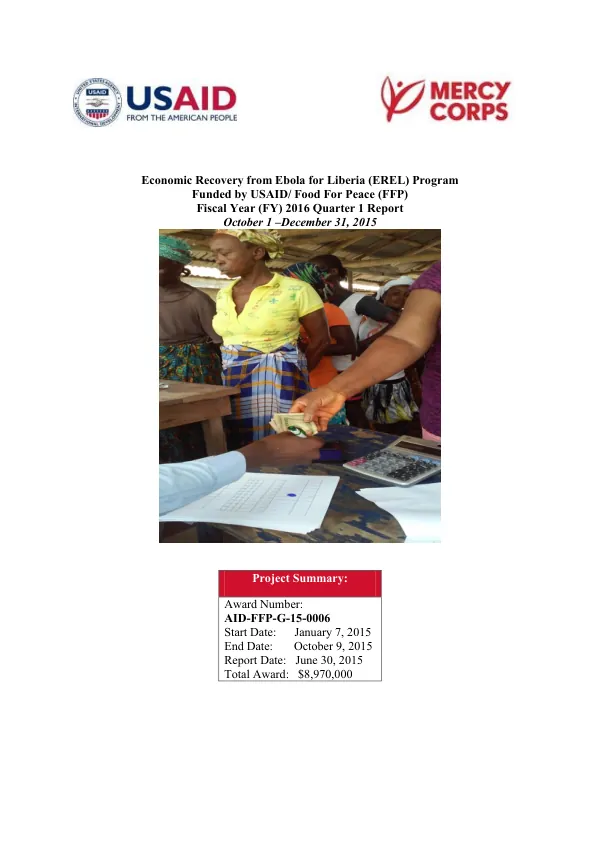
The program targets three of the most affected counties – Lofa, Montserrado, and Margibi – and aims to fill minimum food basket gaps, maintain normal agricultural production, protect vulnerable households' assets from depletion, and minimize the negative impacts on child nutrition. The program consists of two components: direct cash transfers to the most vulnerable households and agricultural input vouchers targeting vulnerable households that contain smallholder farmers. During the quarter, a total of 12,751 households completed their third tranches of cash transfers, and 90 households completed their second tranches. An additional 1,298 farming households received agricultural inputs vouchers and exchanged them for agricultural inputs at trade fairs held in Margibi and Montserrado counties. Post-distribution monitoring conducted among cash recipients revealed that the greatest proportion of cash received was spent on the purchase of food, with close to three-quarters (73%) of the cash spent on food items by households. Expenditures on health constituted households' second-largest proportion, with 11% of the total cash spent on health. The analyses also revealed that 5% of the cash was spent on investments in petty trade/small businesses and purchase of additional agricultural tools. The EREL program continued its beneficiary verification process to ensure that beneficiaries meet the project's eligibility criteria. During the project, a total of 90 beneficiary households were identified as not meeting the full eligibility criteria and were de-listed. Mercy Corps will conduct a verification process to determine whether households that participated in Phase I of the project will be eligible to participate in the second phase of the project. The total amount of cash disbursed to the project beneficiaries during this quarter was $535,592. The EREL project has disbursed a total of $2,142,210 to the project beneficiaries up to the end of 2015, which constitutes 85% of the total amount budgeted for Phase I ($2,520,000). This indicates that the program is 85% on track with its Phase I cash transfers target. Data analysis for Montserrado County indicates that the monthly income from sources other than the EREL program ranged from $11.90 to $119, with the most dominant source being agriculture, which constitutes 54% of the income. The additional income came from several sources, including petty trade, casual labor, and others. The data analyses indicated that cash transfers are making an impact in the lives of the beneficiaries, with all respondents from Margibi County stating that the cash is assisting them to meet not only their food needs but also their education, health, and investment needs. The hunger situation within households is improving in all of the counties, as beneficiaries report that they are eating more frequently following assistance from EREL. Data analysis for Montserrado County indicates that 82% of beneficiaries can feed their children twice daily, 7% feed their children once daily, and 5% feed their children less than once daily.