USAID DEC
Emergency Assistance to Conflict Affected Populations (EACAP) FY16 Q3 Quarterly Report
Sign inMERCY CORPS INTERNATIONAL
Emergency Assistance to Conflict Affected Populations (EACAP) FY16 Q3 Quarterly Report
The humanitarian insecurity in northeast Nigeria caused by Boko Haram and the counter insurgency continues to create an urgent humanitarian need.
2016 · 8 pages
Sign in to readA free account is required to download.
Abstract
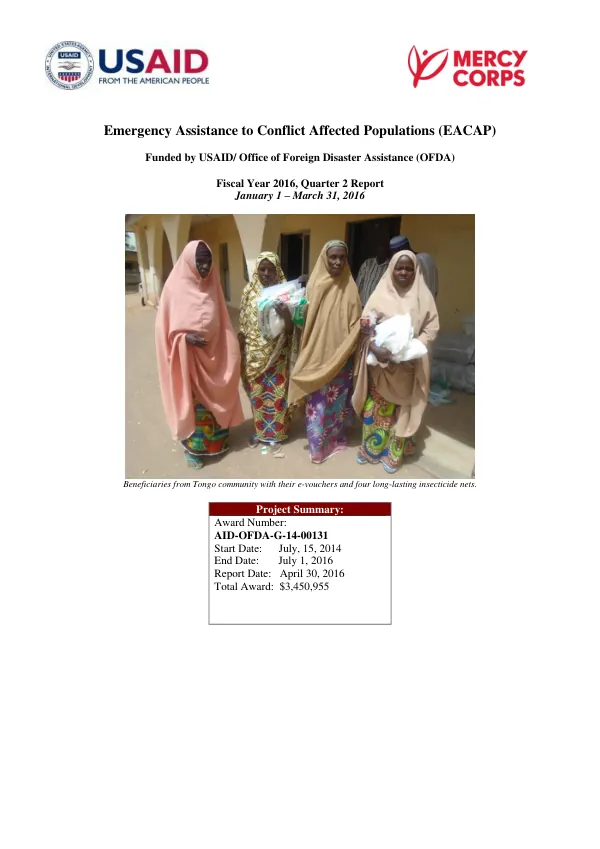
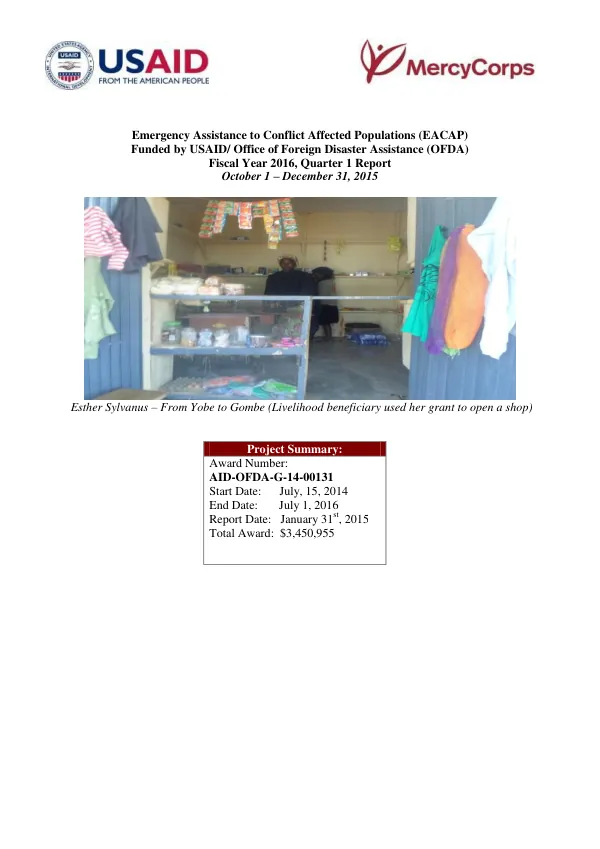
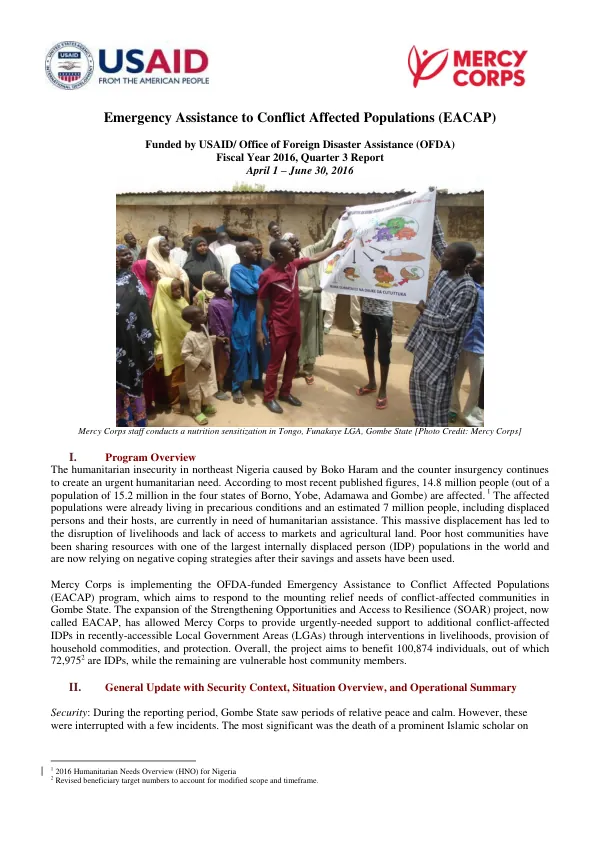
According to most recent published figures, 14.8 million people (out of a population of 15.2 million in the four states of Borno, Yobe, Adamawa and Gombe) are affected. The affected populations were already living in precarious conditions and an estimated 7 million people, including displaced persons and their hosts, are currently in need of humanitarian assistance. This massive displacement has led to the disruption of livelihoods and lack of access to markets and agricultural land. Poor host communities have been sharing resources with one of the largest internally displaced person (IDP) populations in the world and are now relying on negative coping strategies after their savings and assets have been used. Mercy Corps is implementing the OFDA-funded Emergency Assistance to Conflict Affected Populations (EACAP) program, which aims to respond to the mounting relief needs of conflict-affected communities in Gombe State. The expansion of the Strengthening Opportunities and Access to Resilience (SOAR) project, now called EACAP, has allowed Mercy Corps to provide urgently-needed support to additional conflict-affected IDPs in recently-accessible Local Government Areas (LGAs) through interventions in livelihoods, provision of household commodities, and protection. Overall, the project aims to benefit 100,874 individuals, out of which 72,975 are IDPs, while the remaining are vulnerable host community members. During the reporting period, Gombe State saw periods of relative peace and calm, but these were interrupted with a few incidents, including the death of a prominent Islamic scholar and a clash between communities in Billiri and Kaltungo local governments over land. The military and police intervened. The movement of internally displaced persons (IDPs) has slowed in Gombe State, with the EACAP team still periodically hearing from stakeholders about new IDPs settling in certain communities but at a much lower level than at the peak of the crisis. Mercy Corps requested and received a No Cost Extension (NCE) of three months, allowing the program to continue until September 30, 2016. The NCE will allow Mercy Corps to support 1,000 new households with either livelihood grants or non-food item (NFI) vouchers. Mercy Corps continues its active role in humanitarian coordination groups, including participation in sector working groups, the Humanitarian Country Team (HCT), and an INGO forum at the Abuja level, as well as coordination with SEMA and NEMA at the state level. The EACAP program has made significant progress in its three sectors: Economic Recovery and Market Systems, Agriculture and Food Security, and Logistics, Support and Relief Commodities. In the Economic Recovery and Market Systems sector, 987 households received livelihood grants, with a total value of approximately USD 100 each. In the Agriculture and Food Security sector, the program completed its activities, providing support to 589 individuals. In the Logistics, Support and Relief Commodities sector, the program completed the second tranche of NFI e-voucher top-ups to 2,000 households.