USAID DEC
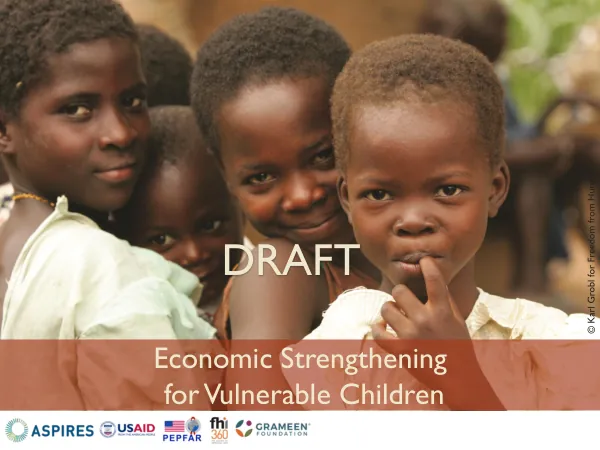
Economic Strengthening for Vulnerable Children
Economic strengthening for vulnerable children is a critical component of addressing poverty and improving well-being.
84 pages
Sign in to readA free account is required to download.
Abstract
This approach focuses on supplying, protecting, and growing physical, natural, financial, human, and social assets to reduce economic vulnerability and increase resilience to future shocks. By empowering households to provide for the essential needs of children in their care, economic strengthening can have a lasting impact on child well-being. The economic-strengthening pathway is a framework for understanding the progression from economic vulnerability to secure and resilient households. This pathway involves several key stages, including recovering assets and stabilizing household consumption, building self-insurance mechanisms and protecting key assets, smoothing household income and promoting asset growth, and expanding household income and consumption. By following this pathway, households can move from a state of economic distress to one of increased stability and security. A critical component of economic strengthening is the identification and assessment of household vulnerabilities and assets. This involves giving a name to the household, drawing a picture of the household, and listing their vulnerabilities, assets, and other characteristics. By understanding the unique needs and circumstances of each household, organizations can design and implement targeted economic-strengthening interventions that address specific vulnerabilities and promote asset growth. Levels of economic well-being can be categorized into four distinct stages: destitution, struggling to make ends meet, prepared to grow, and secure. Households in destitution are unable to meet their basic needs, while those struggling to make ends meet are able to meet their needs but lack the resources to invest in the future. Prepared to grow households have the resources to invest in their future, but may still face significant challenges. Secure households, on the other hand, have a stable and sustainable income and are able to provide for their children's needs. Effective economic-strengthening interventions require a deep understanding of the complex relationships between economic well-being, household assets, and child well-being. By integrating economic strengthening with other interventions, such as HIV/health programs, organizations can maximize beneficiary well-being and promote sustainable development. This requires a comprehensive approach that addresses the unique needs and circumstances of each household, while also building the evidence base and strengthening program implementation.