USAID DEC
Service Provider Network Mapping and Analysis
The ONA or mapping approach is a crucial component of implementing a project or activity, particularly in the context of service provider networks.
49 pages
Sign in to readA free account is required to download.
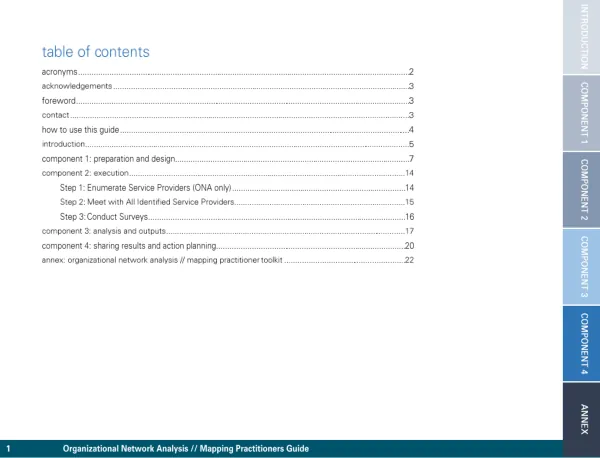
Abstract
These tools serve to identify and document the relevant service providers operating in a specific geographic area, facilitating coordination and collaboration among stakeholders. The ONA is a more comprehensive tool that collects baseline data on coordination between service providers, while the mapping is a more streamlined and easy-to-use tool. Both approaches aim to provide a locally relevant service directory, including a summary gap analysis, sociograms documenting the nature and strength of current coordination among service providers, and a GIS map of service providers. Data collection for the ONA or mapping involves two phases: enumeration and separate service provider interviews. The enumeration phase involves collecting data on individual service providers, including location, details of their services, eligibility criteria, and GPS coordinates. The service provider interviews, which can last between 45-60 minutes, aim to gather relational data showing current collaboration between service providers. The data analysis process requires a higher skill level for the ONA, which involves analyzing relational data and producing sociograms. In contrast, the mapping requires no specialized skills and can be completed in Microsoft Excel. The time required for data collection and analysis varies depending on the characteristics of the catchment area and the number of service providers identified. The Level of Effort (LOE) for implementing the ONA or mapping approach includes survey design and editing, creating a digital survey, ethics review, management of data collectors, data collection, data analysis, and sharing results with stakeholders. The LOE for the ONA is estimated to be 40-60 days, while the mapping requires 20-40 days. Costs associated with implementing the ONA or mapping approach include LOE, daily stipends for data collectors, travel costs, and potential institutional review board (IRB) fees. Projects should seek local approval from the appropriate Ministry or government authority and check with local IRB requirements, costs, and timeframes, which vary substantially by country. Understanding local geopolitical boundaries, transportation options and costs, and making decisions about inclusion early on are critical considerations when implementing the ONA or mapping approach. A clear understanding of district/city boundaries and units, as well as the services that work in only certain regions or group of villages, is essential for forming a useful referral network. Additionally, making decisions about inclusion early on helps to ensure that the purpose of the network is well understood by stakeholders.
Related documents