DAI
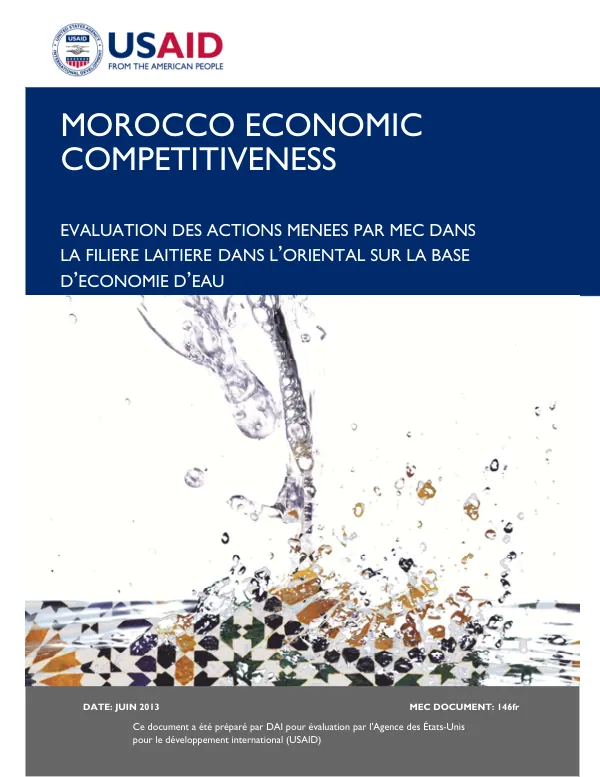
ECONOMIE D’EAU DANS LA FILIERE LAITIERE DANS L’ORIENTAL
The agricultural development initiative in Morocco began in 2018 with a focus on improving economic competitiveness in the Oriental region.
2013 · 17 pages
Sign in to readA free account is required to download.
Abstract
The project, led by MEC, aimed to introduce a water management approach in the dairy sector. The objectives of the project were to sensitize industries to the optimal use of water and environmental protection, respect good environmental practices, strengthen technical capacities of units, and create nuclei for dissemination of best practices. The project identified three pilot units: COLAIMO, Mon Lait, and Oued Za. The tasks conducted in these units included the realization of an optimization study of water consumption. The consumption of water in each unit was considered in its entirety, and efforts were made to reconcile the rationality of consumption with the constraints imposed by the manufacturing process. Based on a precise analysis of performances and exploitation constraints, recommendations were formulated and presented as projects in the form of files, validated by the responsible personnel of each unit. The results of the diagnostic conducted in each unit revealed that the specific consumption of water, expressed in liters of water consumed per liter of treated milk, exceeded four. Each dairy unit has a unique situation that affects its management, both technically and environmentally. The mode of management, the size of the unit, and the degree of technical supervision reflect this situation. The situation regulatory in the dairy sector is governed by the law on water 10-95 and its implementing texts. This law reinforces the principle of the polluter pays and defines the limits of water pollution by industrial sector. In the case of the three dairy units studied, they discharge their effluents into the sewage networks of the localities where they are located. For the case of COLAIMO, the administration in charge of sanitation is the Autonomous Distribution of Water and Electricity of Oujda. This administration is responsible for collecting the fees related to sanitation and should, in principle, set the threshold of pollutant charges not to be exceeded in the effluents. The three dairy units have no obligation or incentive to prioritize water management. The project aimed to sensitize them to become "citizen" companies that do not wait to be summoned by a regulation to act. They were encouraged to have an environmental policy that inscribes itself in a principle of responsibility and contribution to sustainable development. In COLAIMO, the treated water is sent to a large tank of 500 tons capacity for storage. The different workshops are supplied with water from this tank through a main pipeline. In the absence of meters at the upstream of each workshop, the management of water is a difficult task to achieve. The water consumed by COLAIMO comes from the network of RADEEO and the well. All the water of the process is softened and treated. The analysis of the readings taken on the general meter during 2009 and 2010 shows that the daily consumption of water by COLAIMO is of the order of 310 m3/j. The workshops of water consumption are: the cleaning of equipment and premises, the production of steam, hot and cold water, the elaboration of yogurt and mix, the cooling of machines, the condensation of refrigerant fluids, the irrigation of green spaces, and others. In relation to this consumption, the specific consumption of COLAIMO is of the order of 4 liters/liter of treated milk. The diagnostic conducted in situ at COLAIMO allowed the identification of opportunities and ways of improvement. The project recommended the implementation of a water management program, the installation of meters at the upstream of each workshop, and the reduction of water consumption by 20%. The project also recommended the implementation of a wastewater treatment system and the reduction of wastewater discharge by 50%.