USAID DEC
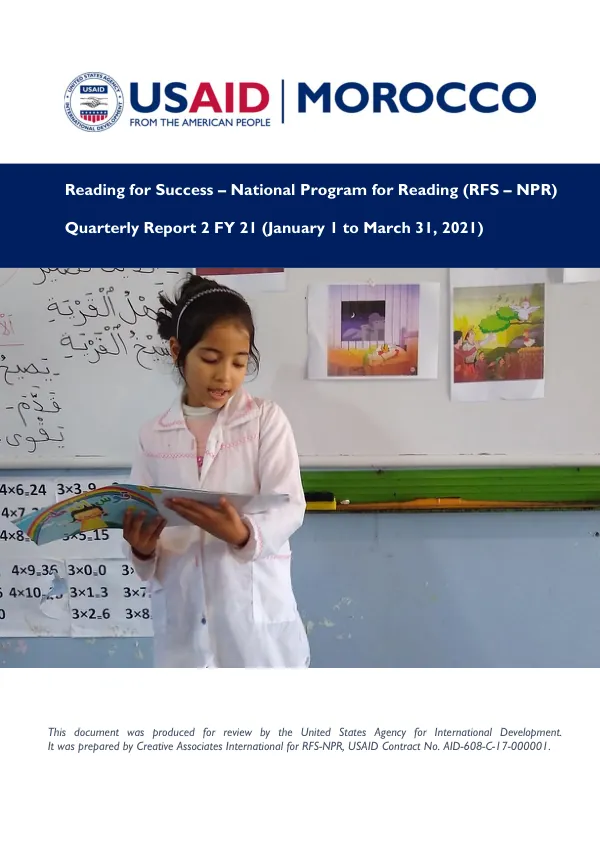
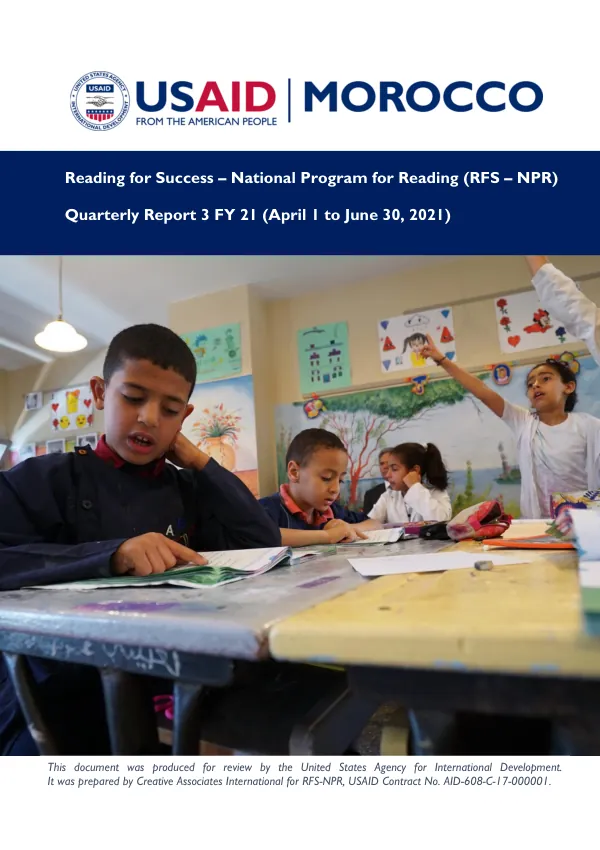
Quarterly Report 3 FY 21: Reading for Success – National Program for Reading (RFS-NPR)
Sign inCREATIVE ASSOCIATES INTERNATIONAL INC.
Quarterly Report 3 FY 21: Reading for Success – National Program for Reading (RFS-NPR)
The Reading for Success-National Program for Reading (RFS-NPR) is a USAID-funded initiative aimed at improving reading and writing skills among primary school students in Morocco.
2021 · 50 pages
Sign in to readA free account is required to download.
Abstract
The program began on May 19, 2017, and is set to conclude on May 18, 2022. The quarterly report for the period of April 1 to June 30, 2021, highlights key accomplishments and progress made during this time. Improved reading and writing materials used in primary schools were a major focus of the program during the reporting period. Meetings were held with grades 5-6 textbook authors and publishers to review and finalize the Arabic language curriculum for grades 1-6. Additionally, new supplemental reading materials were reviewed and validated to expand primary school students' access to digital reading. The program also made significant progress in improving reading and writing instruction in primary schools. Continued work was done on the development of Massive Open Online Courses (MOOCs) to support teacher training and professional development. Furthermore, reading enrichment programs were expanded to reach more students, and learning and assessment systems were improved to better track student progress. Midline data collection for the school effectiveness study was conducted, with sample targets achieved for grades 5 and 6. Endline data collection for the Arabic language curriculum effectiveness study and the supplementary reading materials study was also completed, with sample targets achieved for both studies. Benchmarking workshops were held to compare the program's progress with other similar initiatives. Management of implementation was a key area of focus during the reporting period. Key developments and challenges were addressed, and a summary of activity progress and management was provided. Cross-cutting themes such as capacity building, sustainability, gender equity, inclusion, and stakeholder collaboration were also emphasized. The program's monitoring and evaluation plan (MELP) was implemented, with indicators results reported in Appendix G. The program's implementation timeline and progress indicators were also reported in Appendix H. Key meetings with USAID and partners were held during the quarter, and a list of activities and participants can be found in Appendix J. Activities planned for the next quarter were also outlined in Appendix K. The program's communications and outreach efforts were also reported, with details on the activities and participants listed in Appendix L. The report concludes with a summary of the program's progress and achievements during the reporting period.