USAID DEC
The Urban Transition and Agricultural Development: Implications for International Assistance Policy
Sign inUNITED NATIONS ENVIRONMENTAL PROGRAMME , NAIROBI
The Urban Transition and Agricultural Development: Implications for International Assistance Policy
The urban transition and agricultural development in developing countries are inextricably linked, with significant implications for international assistance policy.
2010 · 32 pages
Sign in to readA free account is required to download.
Abstract
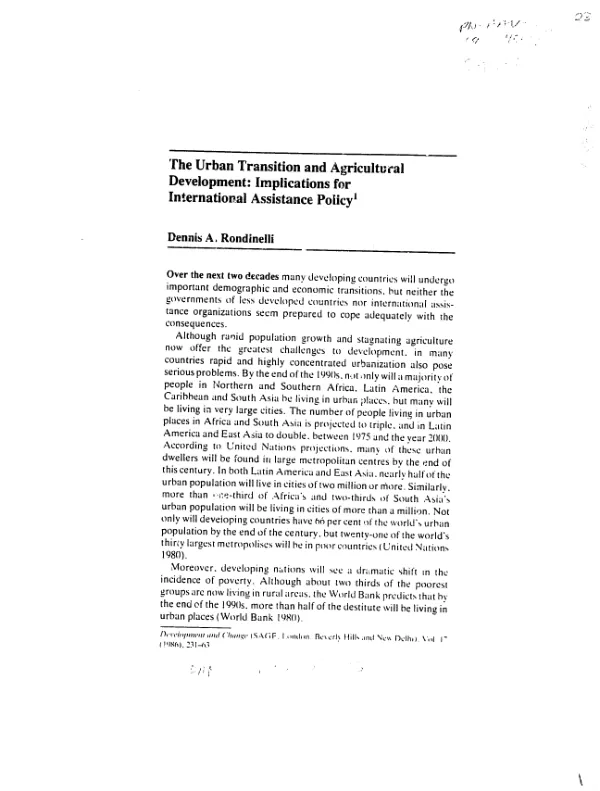
Over the next two decades, many developing countries will undergo important demographic and economic transitions, with a majority of people living in urban places by the end of the 1990s. Rapid and highly concentrated urbanization poses serious problems, including high concentrations of poverty in large cities, straining urban services, facilities, and infrastructure. The number of people living in urban places in Africa and South Asia is projected to triple, and in Latin America and East Asia to double, between 1975 and the year 2000. Many of these urban dwellers will be found in large metropolitan centres, with nearly half of the urban population in Latin America and East Asia living in cities of two million or more. Similarly, more than a third of Africa's and two-thirds of South Asia's urban population will be living in cities of more than a million. Developing countries will see a dramatic shift in the incidence of poverty, with more than half of the destitute living in urban places by the end of the 1990s. The pattern of urbanization in contemporary developing countries is far more concentrated, with large percentages of the urban population found in one or two very large metropolises. These cities have industrial bases too small to provide sufficient employment for either their residents or the migrants attracted to them. The 'middle level' settlements of the urban hierarchy, including market towns, small cities, and secondary urban centres, tend to be few in number, economically weak, and unevenly distributed geographically. These towns also tend to be weakly linked to each other, to larger or smaller urban settlements, or to their rural hinterlands. As a result, high concentrations of poverty in the big cities seriously strain urban services, facilities, and infrastructure. The rapid urbanization often drains the more educated, productive, ambitious, and entrepreneurial elements of the rural population, leaving nonmetropolitan regions in still worse condition. Insufficient investment in market towns, small cities, and intermediate urban centres restricts their capacity to support agriculture, provide markets for increased farm production, or offer sufficient numbers of jobs to attract rural migrants. In many of these countries, both the settlement system and the national economy tend to become more polarized and more dualistic. International assistance organizations and governments in developing countries will be facing substantially different problems arising from this urban transition than have confronted them in the past. The underlying contention is that rural and urban development are inextricably related, and an understanding of those relationships must inform development policy and international assistance strategies. The classical economic growth theory, which views rural-agricultural development and urban-industrial development as conflicting sources of economic and social change, has been widely criticized. The two-sector model, which assumes that the impetus for labour transfer from the rural to the urban sector in developing countries is the expansion of urban employment opportunities through growth of the modern sector, has been shown to be flawed. The pace of the transfer is determined by the rate of capital accumulation in industry, but this model fails to account for the complex social, psychological, and economic factors influencing people's decisions to migrate from rural areas to cities. Studies have shown that migration from rural areas is influenced by perceived or expected employment opportunities, rather than actual employment opportunities. Migrants compare the possibilities of obtaining jobs or higher wages in cities with the advantages of remaining in rural areas. The decision to migrate is also influenced by social, psychological, and other factors, which are perceived differently by different social and age groups in rural areas. The underdevelopment of agriculture and the slow pace of industrialization have reinforced each other in preventing strong internal markets from emerging in many developing countries. Industrialization simply cannot take hold in countries where the vast majority of people live in poverty, and where cities do not have strong or diversified enough economies to absorb the growing numbers of people migrating to them in search of jobs.