TETRA TECH ARD, INC.
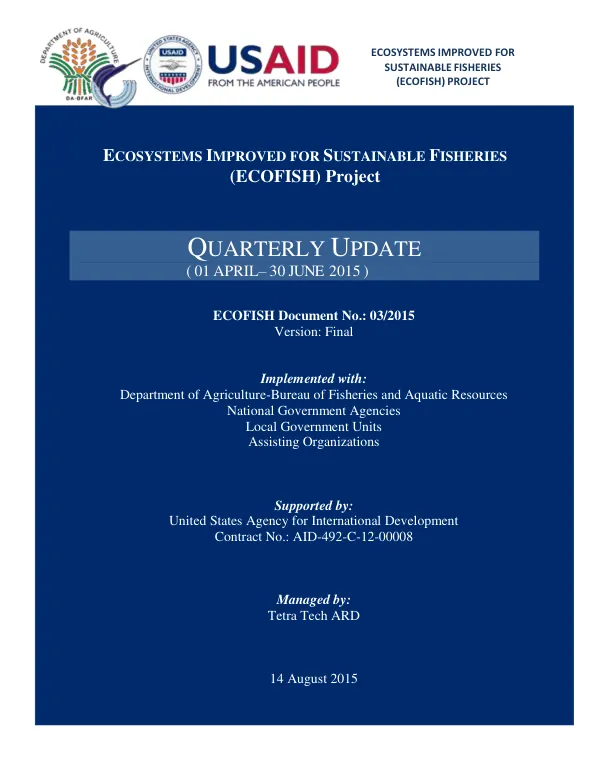
Ecosystems Improved for Sustainable Fisheries (ECOFISH) Project
The Ecosystems Improved for Sustainable Fisheries (ECOFISH) Project is a collaborative effort between the Department of Agriculture-Bureau of Fisheries and Aquatic Resources, National Government Agencies, Local Government Units, and Assisting Organizations.
2015 · 55 pages
Sign in to readA free account is required to download.
Abstract
The project is supported by the United States Agency for International Development (USAID) under Contract No. AID-492-C-12-00008 and managed by Tetra Tech ARD. The project's primary objective is to improve the sustainability of fisheries in the Philippines through the implementation of ecosystem-based approaches to fisheries management. The project focuses on eight key sites, including the Calamianes Island Group, Danajon Reef, Lingayen Gulf, San Bernardino – Ticao Pass – Lagonoy Gulf, Southern Negros, Surigao del Norte and del Sur, Sulu Archipelago, and Verde Island Passage. Implementation of the project involved a range of activities, including the establishment of marine protected areas, the development of fisheries management plans, and the provision of training and capacity-building programs for local stakeholders. The project also focused on improving the livelihoods of fishers and their communities through the development of sustainable fishing practices and the promotion of eco-tourism. At the national level, the project achieved several important milestones, including the development of a national fisheries management plan and the establishment of a national fisheries information management system. The project also supported the development of a national system for boat registration and the implementation of a national program for the conservation of marine biodiversity. At the site level, the project achieved significant results, including the establishment of marine protected areas, the development of fisheries management plans, and the provision of training and capacity-building programs for local stakeholders. For example, in the Calamianes Island Group, the project supported the establishment of a marine protected area and the development of a fisheries management plan. In the Danajon Reef, the project supported the development of a marine protected area and the implementation of a coral reef conservation program. Despite these achievements, the project also faced several challenges, including the need to improve the capacity of local stakeholders to manage fisheries sustainably and the need to address the impacts of climate change on fisheries. The project also faced challenges related to the implementation of the project's activities, including the need to improve the coordination and communication among project stakeholders. The project's schedule of upcoming important activities includes the continuation of the implementation of the project's activities, including the establishment of marine protected areas, the development of fisheries management plans, and the provision of training and capacity-building programs for local stakeholders. The project also plans to continue its efforts to improve the livelihoods of fishers and their communities through the development of sustainable fishing practices and the promotion of eco-tourism. Overall, the ECOFISH Project has made significant contributions to the improvement of fisheries sustainability in the Philippines, and its achievements and lessons learned will continue to inform the development of fisheries management policies and programs in the country.
Related documents