USAID DEC
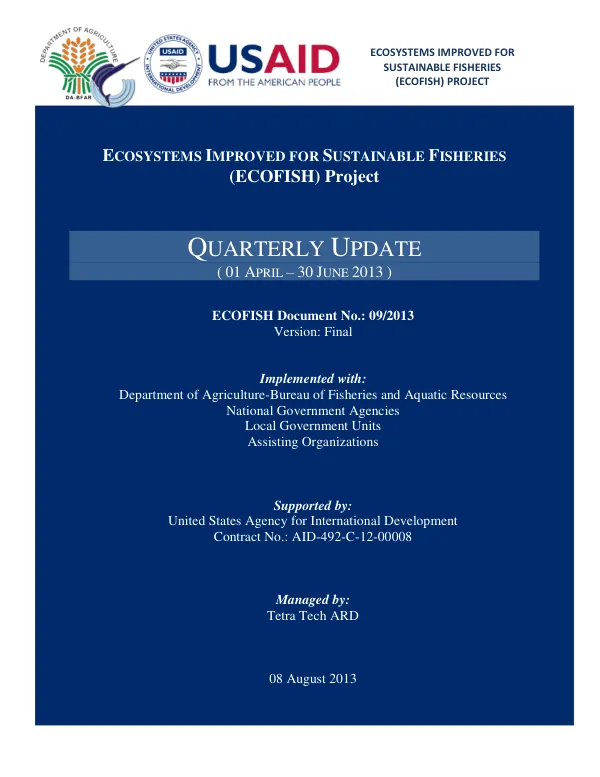
Ecosystems Improved for Sustainable Fisheries (ECOFISH) Project Quarterly Progress Update (01 April 2013 – 30 June 2013)
Sign inTETRA TECH ARD, INC.
Ecosystems Improved for Sustainable Fisheries (ECOFISH) Project Quarterly Progress Update (01 April 2013 – 30 June 2013)
The Ecosystems Improved for Sustainable Fisheries (ECOFISH) Project is a collaborative effort between the Department of Agriculture-Bureau of Fisheries and Aquatic Resources, National Government Agencies, Local Government Units, and Assisting Organizations.
2013 · 35 pages
Sign in to readA free account is required to download.
Abstract
The project is supported by the United States Agency for International Development (USAID) through Contract No. AID-492-C-12-00008. Tetra Tech ARD manages the project. The ECOFISH Project aims to improve fisheries management and conservation in the Philippines. The project focuses on eight key sites: Calamianes Island Group, Danajon Reef, Lingayen Gulf, San Bernardino – Sorsogon Bay – Lagonoy Gulf, Southern Negros, Surigao del Norte and del Sur, Tawi-Tawi, and Verde Island Passage. These sites were selected based on their high conservation value and potential for sustainable fisheries management. At the national level, the project has made significant progress in implementing the Ecosystem Approach to Fisheries Management (EAFM). The project has established a National Fisheries Management Office and has developed a comprehensive fisheries management plan. The plan aims to promote sustainable fisheries practices, reduce bycatch, and protect critical habitats. At the site level, the project has implemented various activities to improve fisheries management and conservation. In the Calamianes Island Group, the project has established a marine protected area and has implemented a fisheries management plan. In the Danajon Reef, the project has conducted a coral reef assessment and has developed a reef management plan. In the Lingayen Gulf, the project has implemented a fisheries monitoring system and has conducted a fish stock assessment. The project has also made significant progress in engaging local communities and stakeholders in fisheries management and conservation. The project has established a network of community-based fisheries management organizations and has provided training and capacity-building programs for local fishermen and community leaders. Despite the progress made, the project still faces several challenges, including limited resources and capacity constraints. The project has identified several priority implementation issues, including the need for improved data collection and analysis, enhanced community engagement and participation, and increased support for fisheries management and conservation efforts. The project has a comprehensive schedule of activities for the next quarter, including the implementation of fisheries management plans, the establishment of marine protected areas, and the conduct of fisheries monitoring and research activities. The project will continue to work with local communities, stakeholders, and government agencies to promote sustainable fisheries practices and conserve critical habitats. The project has established a network of partners and stakeholders, including government agencies, non-government organizations, and local communities. The project has also established a system of monitoring and evaluation to track progress and identify areas for improvement. The project's success will depend on the continued support and commitment of all stakeholders, including government agencies, local communities, and international partners. The project will continue to work towards its goal of improving fisheries management and conservation in the Philippines and promoting sustainable fisheries practices.