FHI 360
USAID Egyptian Pioneers AWP 2024
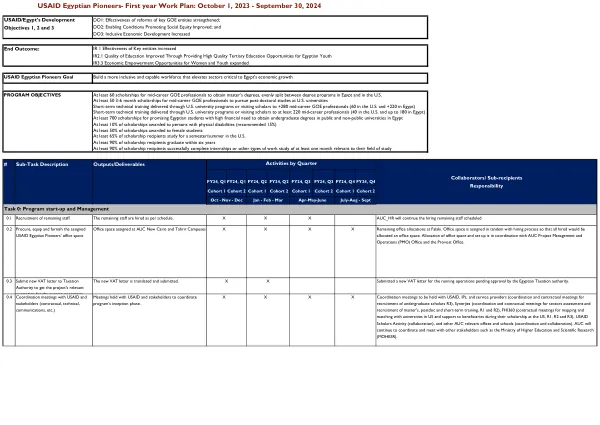
The USAID Egyptian Pioneers program aims to build a more inclusive and capable workforce that elevates sectors critical to Egypt's economic growth.
2024 · 7 pages
Sign in to readA free account is required to download.
Abstract
The program's objectives include providing at least 700 scholarships for Egyptian students to obtain undergraduate degrees in Egyptian and non-public universities, with a focus on increasing the number of female and physically disabled scholarship recipients. Additionally, the program seeks to provide at least 65% of scholarship recipients with the opportunity to study for a semester or summer in the United States. The program's sectors assessment and sectors assessment report will be conducted by AUC and Synerjies in collaboration with USAID/Egypt and MOHESR. The report will identify priority sectors and sub-sectors, and will guide the development of comprehensive human capacity plans for postdoctoral studies and short-term training. The report will also inform the process of selecting institutions and candidates for training. The program's advisory board will be established to provide strategic policies and direction for the activity's three results. The board will consist of stakeholders from the GOE, non-GOE, and academia, and will meet bi-annually to discuss sustainability plans and provide support and guidance to the USAID Egyptian Pioneers activity. The program's implementation will be carried out in four quarters, with the first quarter focusing on program start-up and management, including the procurement and furnishing of office space, submission of a new VAT letter to the Taxation Authority, and coordination meetings with USAID and stakeholders. The second quarter will focus on sectors assessment and consultation, including the validation of the sectors assessment report and the identification of approved sector programs in universities. The program's outreach, recruitment, and selection process will be conducted by AUC and Synerjies, with the goal of selecting institutions and candidates for training. The process will involve consultation sessions with USAID/Egypt experts, AORs, and implementing partners to ensure alignment with USAID areas of focus. The program's advisory board will provide strategic policies and direction for the activity's three results, and will meet bi-annually to discuss sustainability plans and provide support and guidance to the USAID Egyptian Pioneers activity. The program's implementation will be carried out in four quarters, with the first quarter focusing on