RTI INTERNATIONAL
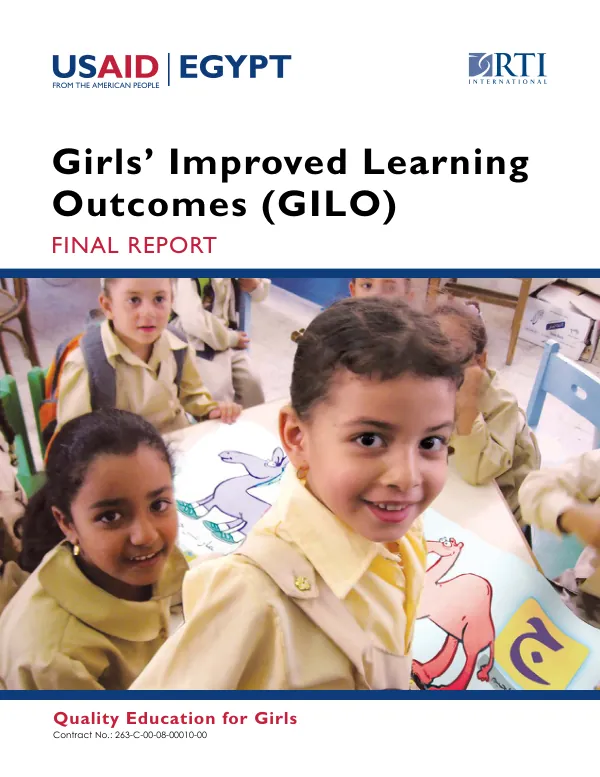
Girls' Improved Learning Outcomes (GILO) Final Report
Girls' Improved Learning Outcomes (GILO) is a project initiated by USAID/Egypt to enhance the quality of education for girls in Egypt.
2014 · 378 pages
Sign in to readA free account is required to download.
Abstract
The project was launched in 2007 and aimed to improve early grade reading literacy in Arabic, increase educational access for girls, and decentralize Ministry of Education (MOE) functions. The project's main successes and accomplishments include improved early grade reading literacy in Arabic outcomes, increased educational access for girls, and decentralization of MOE functions. The project also focused on improving educational quality, strengthening school governance and management, and building capacity for decentralized governance. One of the key achievements of the project was the expansion of equitable access to education for girls. This was achieved through the selection of schools for GILO support, furnishing and equipping schools for student-centered active learning, and mobilizing Boards of Trustees (BOTs) and Community Education Teams (CETs) to expand access to education for girls. The project also enhanced school management with community-supported approaches, which included the formation of BOTs and strengthened school governance. The project also focused on improving educational quality through the training and mobilization of master teachers, Idara supervisors, and teachers. This included the development of the Early Grade Reading Program (EGRP), which aimed to improve early grade reading literacy in Arabic. The EGRP was implemented in 27 governorates and included a cascade training model, which trained teachers and supervisors to implement the program. The project also assessed the impact of the EGRP through the Early Grade Reading Assessment (EGRA) in 2009 and 2011. In addition to improving educational quality, the project also strengthened school governance and management. This was achieved through the formation of BOTs and strengthened school governance, which included the promotion of girls' access to education and learning. The project also built capacity for decentralized governance, which included the implementation of decentralized education finance and technical support to the MOE for efficient and effective fiscal decentralization. The project also included a monitoring and evaluation component, which aimed to assess the project's progress and impact. This included the development of a communication strategy, assessments and baselines, and case study findings. The project also included a performance monitoring plan (PMP), which tracked the project's progress and identified areas for improvement. The project's achievements were documented through a series of annexes, which included a list of GILO major areas of focus and interventions, a list and description of activities, and EGRA results from 2009 and 2011. The project also included a series of exhibits, which included maps of priority communities for GILO, data maps of GILO-supported schools, and a performance monitoring plan (PMP). Overall, the GILO project made significant contributions to improving the quality of education for girls in Egypt. The project's achievements in improving early grade reading literacy, increasing educational access, and decentralizing MOE functions have had a lasting impact on the education sector in Egypt.