RTI INTERNATIONAL
EdData II: 2nd National Egypt Grade 3 EGRA – The Classroom Observations
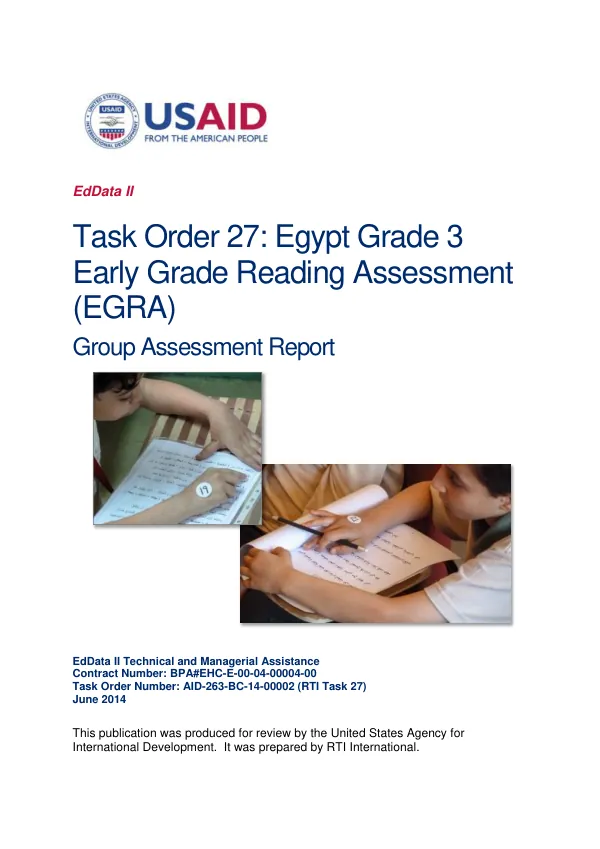
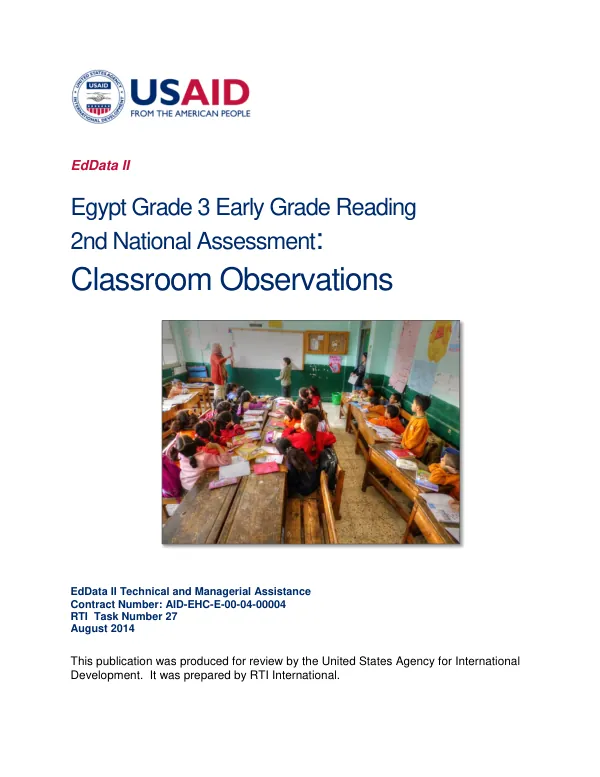
The 2nd National Egypt Grade 3 Early Grade Reading Assessment, Classroom Observations, was conducted as a component activity of the Early Grade Reading Assessment (EGRA) for Grade 3 in April 2014.
2014 · 25 pages
Sign in to readA free account is required to download.
Abstract
A stratified random sample of 39 schools from the larger EGRA sample of 200 schools was selected for the classroom observations. Each school had one Grade 3 class observed, and the observations were conducted by trained Ministry of Education (MOE) staff with significant experience in the Early Grade Reading Program and reading assessment. The classroom observations applied a formal instrument to the observation of a full class period of Grade 3 Arabic reading, as well as separate interviews with the observed teacher, school principal, and librarian. The observations aimed to provide current, empirical information on the teaching methods, instructional activities, and learning resources applied by Grade 3 teachers in their reading instruction. Additionally, the observations sought to understand the training experience and understandings of early grade reading of key school personnel, the specific challenges to implementing the early grade reading program in schools, the availability and use of Early Grade Reading learning resources in school classes and libraries, and the technical support available to Grade 3 teachers for improved reading instruction. The observations were conducted in a random sub-set of 39 schools from five sub-national regions encompassing 25 of Egypt's 27 governorates. The schools were not informed in advance of the classroom observation. The trained MOE staff who conducted the observations had significant experience of both the ministry's Early Grade Reading Program and reading assessment. The findings of the classroom observations are significantly positive. The observations provide valuable insights into the current state of Grade 3 reading instruction in MOE schools. The data collected through the classroom observations will be useful in informing the development of effective reading instruction strategies and in identifying areas for improvement in the Early Grade Reading Program. The classroom observations instrument was developed by RTI International with technical assistance from Medina Korda and Drs. Amy D. Mulcahy-Dunn, Joseph DeStefano, and Margaret (Peggy) Dubeck. Dr. Samir Shafik Habib and Ahmed Ismail of RTI International, and formerly COP and DCOP respectively of the GILO Project, liaised directly with the MOE in planning the classroom observations, prepared and tested the Arabic version of the instrument, mobilized a cadre of 10 MOE professionals with significant experience and training in early reading assessment, and then trained that cadre to conduct the classroom observations alongside the EGRA Teams during school visits. The classroom observations provide current, empirical information on the teaching methods, instructional activities, and learning resources applied by Grade 3 teachers in their reading instruction. The observations also provide insights into the training experience and understandings of early grade reading of key school personnel, the specific challenges to implementing the early grade reading program in schools, the availability and use of Early Grade Reading learning resources in school classes and libraries, and the technical support available to Grade 3 teachers for improved reading instruction.
Related documents