USAID DEC
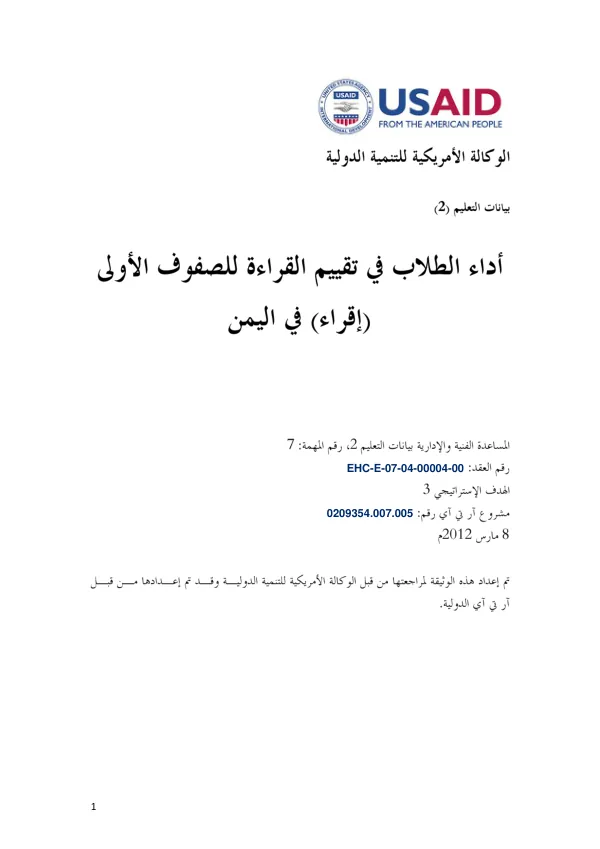
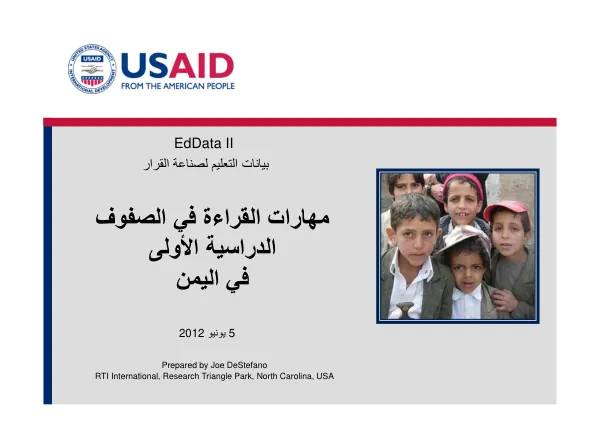
EdData II: Strategic Contract for Technical Assistance to the Ministry of Education in Yemen
Sign inRTI INTERNATIONAL
EdData II: Strategic Contract for Technical Assistance to the Ministry of Education in Yemen
The EdData II project is a contract between RTI International and the United States Agency for International Development (USAID)/Yemen.
2012 · 11 pages
Sign in to readA free account is required to download.
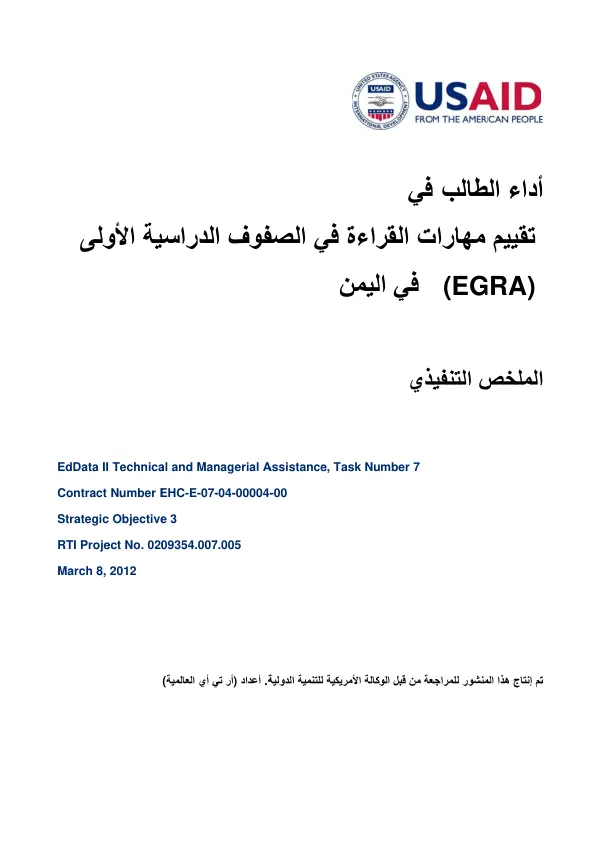
Abstract
The project's objective is to improve education in Yemen, with a focus on enhancing literacy and numeracy skills among children. The project is implemented in partnership with the Ministry of Education (MOE) and the World Bank. The project's methodology involves conducting assessments and evaluations to identify areas of improvement in education. The assessments include the Early Grade Reading Assessment (EGRA), which measures reading skills among children in grades 1-3. The EGRA assesses children's ability to read aloud, recognize letters and words, and understand basic reading comprehension. The results of the EGRA assessments indicate that children in Yemen are struggling with reading skills, particularly in grades 1-3. The assessments show that only 12.3% of children in grade 3 can read with fluency, and 27% of children in grade 3 can read with accuracy. The assessments also indicate that children's reading skills are improving over time, with a 5.8% increase in reading fluency among children in grade 2 and a 27% increase among children in grade 3. The project's findings suggest that children's reading skills are influenced by various factors, including their socio-economic status, access to education, and the quality of teaching. The project recommends that the MOE and other stakeholders focus on improving the quality of teaching, increasing access to education, and providing support to children from disadvantaged backgrounds. The project also assesses the effectiveness of various interventions aimed at improving reading skills among children. The assessments include the use of scales to measure children's reading skills, which indicate that children's reading skills are improving over time. The project's findings suggest that the use of scales is an effective way to measure children's reading skills and track progress over time. The project's recommendations include the need to improve the quality of teaching, increase access to education, and provide support to children from disadvantaged backgrounds. The project also recommends the use of scales to measure children's reading skills and track progress over time. The project's findings have implications for education policy and practice in Yemen. The project's recommendations suggest that the MOE and other stakeholders should focus on improving the quality of teaching, increasing access to education, and providing support to children from disadvantaged backgrounds. The project's use of scales to measure children's reading skills also provides a useful tool for tracking progress over time and evaluating the effectiveness of interventions aimed at improving reading skills.