RTI INTERNATIONAL
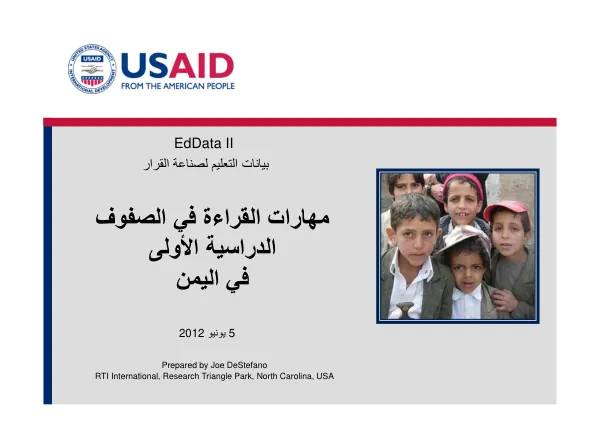
EdData II Student Performance on the Early Grade Reading Assessment (EGRA) in Yemen
The Early Grade Reading Assessment (EGRA) in Yemen is a critical component of the country's education system.
2012 · 70 pages
Sign in to readA free account is required to download.
Abstract
The assessment is designed to evaluate student performance in reading skills, with a focus on early grade students. The EGRA is a tool used to measure the effectiveness of reading instruction and identify areas for improvement. Student performance on the EGRA in Yemen is a key indicator of the country's progress towards achieving its education goals. The assessment is administered to students in the early grades, typically between 6 and 10 years old. The results of the EGRA provide valuable insights into the reading skills of Yemeni students, including their ability to recognize letters, words, and simple sentences. The EGRA results in Yemen are influenced by various factors, including access to education, socio-economic status, and the quality of reading instruction. Research has shown that students who have access to education for a longer period of time tend to perform better on the EGRA. Additionally, students from higher socio-economic backgrounds tend to have better reading skills than their peers from lower socio-economic backgrounds. The EGRA results in Yemen also highlight the importance of reading instruction in the early grades. Students who receive high-quality reading instruction tend to perform better on the EGRA than those who receive low-quality instruction. The results of the EGRA can be used to inform education policy and improve reading instruction in Yemen. According to the EGRA results, the average number of correct answers in the four subtests for non-chronic students in Yemen is 11. The results also show that access to school on time has a positive effect on reading performance, while late access to school has a negative effect. Furthermore, the availability of reading opportunities in school has a positive effect on reading performance, while the absence of reading opportunities has a negative effect. The EGRA results in Yemen are presented in several tables, including Table 2, which shows the number of participants in the final sample by governorate and social type. Table 3 presents the ages of the students participating in the EGRA, while Table 4 provides a summary of the reading performance of students in the EGRA in Yemen. Table 5 presents a summary of the reading performance of students in the EGRA, excluding zero scores, while Table 6 compares the reading performance of students in the EGRA with the number of items attempted. Table 7 presents a summary of the reading performance of students in the EGRA, excluding zero scores, and comparing it with the number of items attempted. The EGRA results in Yemen are consistent with the country's education goals and objectives. The results highlight the importance of improving reading instruction in the early grades and increasing access to education for all students. The EGRA results can be used to inform education policy and improve reading instruction in Yemen, ultimately contributing to the country's development and progress.