US MILLENNIUM CHALLENGE CORPORATION
Education Data Analyses for USAID Basic Education Project in Georgia
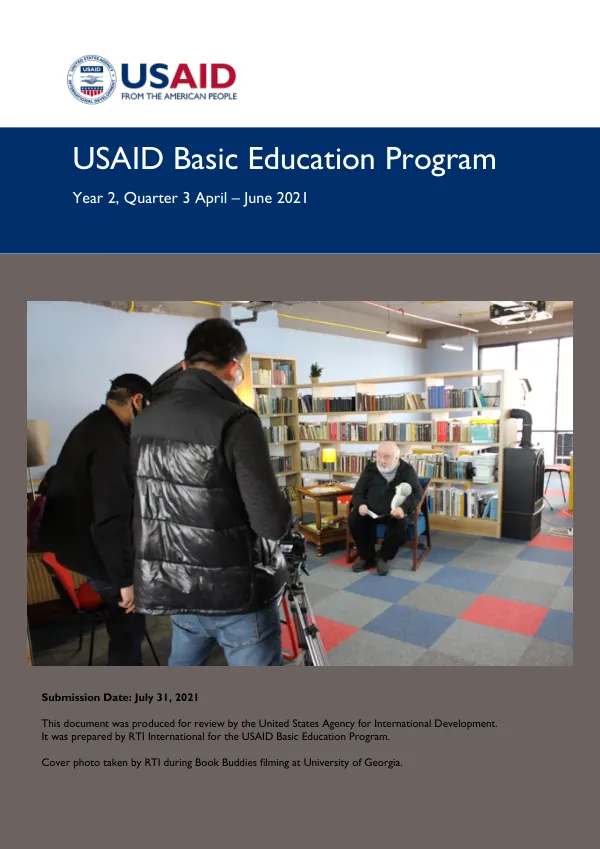
The USAID Basic Education project in Georgia aims to expand and institutionalize critical thinking, problem-solving, and entrepreneurial skills building as a foundation of education in public schools.
2018 · 42 pages
Sign in to readA free account is required to download.
Abstract
This desk review of education assessments was conducted to better understand factors influencing teaching and learning at Georgian schools and inform the Project Approval Document (PAD) design. The review focuses on International Assessments and National Assessments conducted in Georgia since 2012. High-quality national and international assessments provide valuable information to monitor learning achievements, identify and analyze factors influencing teaching and learning, track progress over time, and benchmark country performance relative to the international community. The Millennium Challenge Corporation (MCC) supports the National Assessment and Examination Center (NAEC) to carry out assessments, analyze educational outcomes, and provide the Ministry of Education, educators, parents, and other stakeholders with useful information for decision-making. Georgian students fall far behind their peers internationally, with results from TIMSS, PISA, and PIRLS showing that they perform poorly and well below international averages. The majority of students perform at low or lowest levels in mathematics, reading, and science, and the share of high-performing students is below five percent across all assessments. However, Georgian students have shown substantial improvement in PISA and TIMSS from previous cycles, which is a promising trend. Georgia performs much better than countries with comparable economic development and education expenditure. Student performance is correlated to country expenditure on education, which itself stems from country economic development expressed in Gross Domestic Product per person. Georgia's annual education expenditure for students of 6-15 years stands at $1,170, the lowest compared to all PISA participating countries. USAID funding can benefit from relatively high returns on its investment at the current extremely low expenditures on education. Equity is a problem at Georgian schools, with students from poorer backgrounds attending schools with scarce learning resources and having less qualified teachers. This creates a big gap in performance between rural and urban, public and private, or ethnic minority schools. USAID project design should consider prioritizing schools with a high share of socially and economically vulnerable students. Development of additional teaching aids or learning support materials for rural and ethnic minority schools should be contemplated. Georgian teachers have fewer professional development opportunities compared to other countries. TALIS showed that only 50% of basic and secondary education teachers participated in any type of professional courses and workshops in Georgia, which is 21% lower than the OECD average. This rate is even lower at rural schools, where only about every third teacher (38%) has taken any type of training. PISA has found a positive correlation between teachers' professional development activities and student outcomes. Possible vendors could be asked to propose innovative ways to incentivize rural and ethnic minority teachers' participation in professional development activities. Factors under the control of educators have a significant influence on student learning outcomes. All assessments confirm that factors such as school and classroom climate, teachers' attitude to subjects and teaching, schools' focus on academic excellence, and student-engaging teaching strategies and techniques have a significant impact on student learning outcomes. USAID program should continue to focus on student-centered teaching methodologies, in support of teachers' collaboration, and schools' academic excellence. Students' intrinsic factors have a significant influence on their performance. Assessment results show that motivation, self-esteem, attitude to subject, and understanding the importance of mathematics for future career opportunities have a significant influence on learning results. The Project should support the development of skills and knowledge among educators to influence these factors in students. Stereotypes and gender bias influence learning outcomes. In Georgia, girls perform better in mathematics and science, but assessments show that 34% of students study in a classroom where the teacher thinks that boys can learn math better than girls, and 43% of students have teachers who think that studying mathematics requires special skills. This should be changed to ensure that teachers and parents provide a supportive and positive learning environment to both boys and girls. Studies confirm that these stereotypes influence learning outcomes. Awareness of the negative impact of these stereotypes and bias should be included in the Program.