RTI INTERNATIONAL
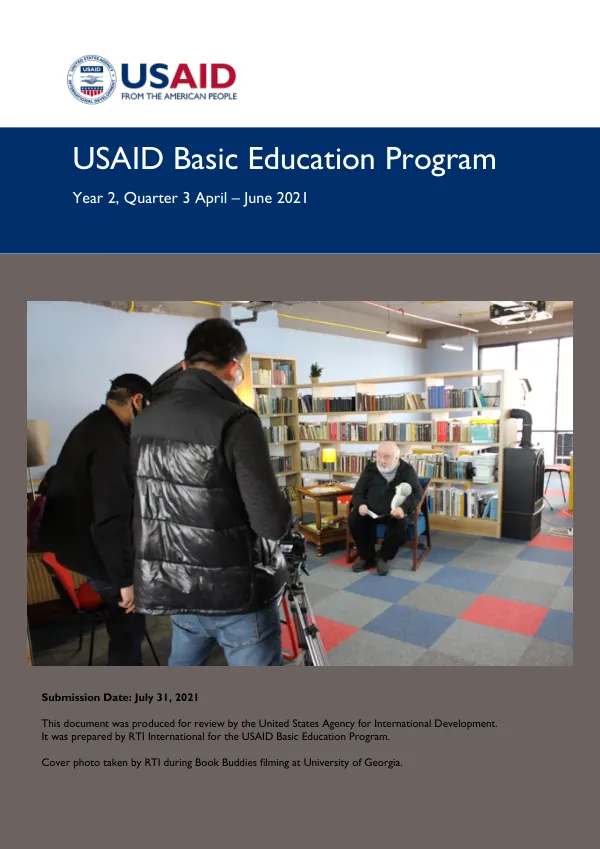
USAID Basic Education Program Year 2 Quarter 3 Report, Apr - Jun 2021
The USAID Basic Education Program is a four-year initiative implemented by RTI International in partnership with the University of Georgia, seven regional universities, Child and Family Society, and the Center for Integration and Inter-ethnic Relations.
2021 · 46 pages
Sign in to readA free account is required to download.
Abstract
The program aims to institutionalize student-centered instruction through a systemic reform of pre-service and in-service teacher professional development and the use of research and data to inform policy and classroom practice. The program seeks to achieve three objectives: current teachers and administrators implement student-centered curricula, future teachers acquire student-centered teaching skills and future administrators acquire relevant instructional leadership skills, and educational policies are developed with the use of data and evidence. In April 2021, USAID awarded the program additional funding to assess the early grade reading and mathematics skills of Grade 2 and Grade 6 students. The assessment will be administered in 300 public primary schools located throughout Georgia and will provide rich data about the reading and mathematics skills of all Georgian students. Implementation of the program has been ongoing since January 2020, with a focus on direct collaboration with the Georgian Ministry of Education and Science. The program has made significant progress in training and mentoring current primary grade teachers and administrators, providing them with access to contemporary learning resources and materials, and informing classroom instruction with continuous assessment of students. Additionally, the program has been working to establish reading and math practice outside of school hours and to develop educational policies using data and evidence. The program has also been working to develop the capacity of future teachers and administrators to implement student-centered instruction. University faculty has been trained to educate future teachers in student-centered methodologies, and future teachers have been provided with opportunities for school-based practice and research at universities. The program has also been working to integrate cross-cutting issues and USAID forward priorities, including gender equality, female empowerment, and social inclusion, into its activities. In terms of program implementation challenges, the program has faced difficulties in procuring equipment and materials, as well as in engaging with stakeholders. However, the program has made significant progress in addressing these challenges and has developed a number of strategies to overcome them. The program has also been working to establish a learning management system to support teacher professional development and to provide a platform for teachers to share best practices and resources. The program has also been working to engage with private sector partners and to leverage their expertise and resources to support the program's goals. Additionally, the program has been working to establish a number of partnerships with local organizations and universities to support teacher professional development and to provide opportunities for school-based practice and research. In terms of financial management, the program has been working to ensure that all financial transactions are properly documented and accounted for. The program has also been working to establish a number of financial management systems to support the program's activities and to ensure that all financial resources are used efficiently and effectively. Overall, the USAID Basic Education Program has made significant progress in implementing its objectives and has developed a number of strategies to overcome the challenges it has faced. The program is well-positioned to achieve its goals and to make a lasting impact on the Georgian education system.
Related documents