USAID
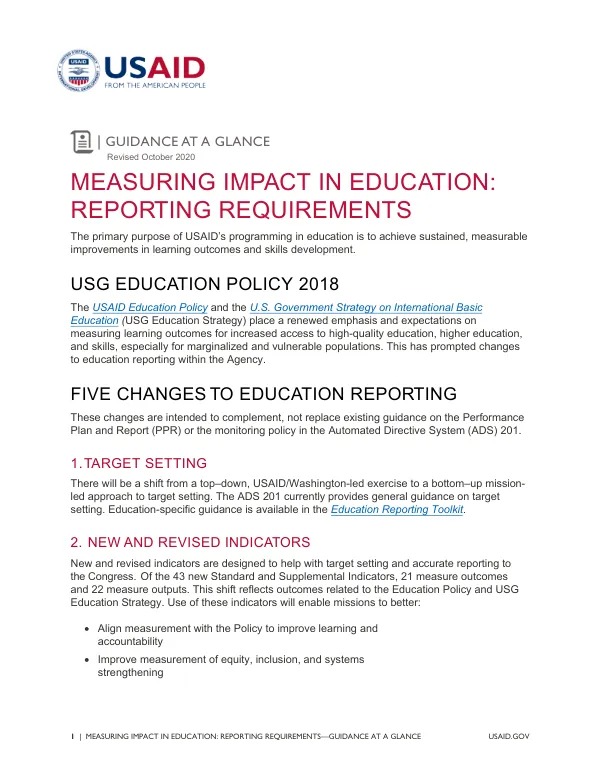
Education Reporting Guidance: Guidance at a Glance
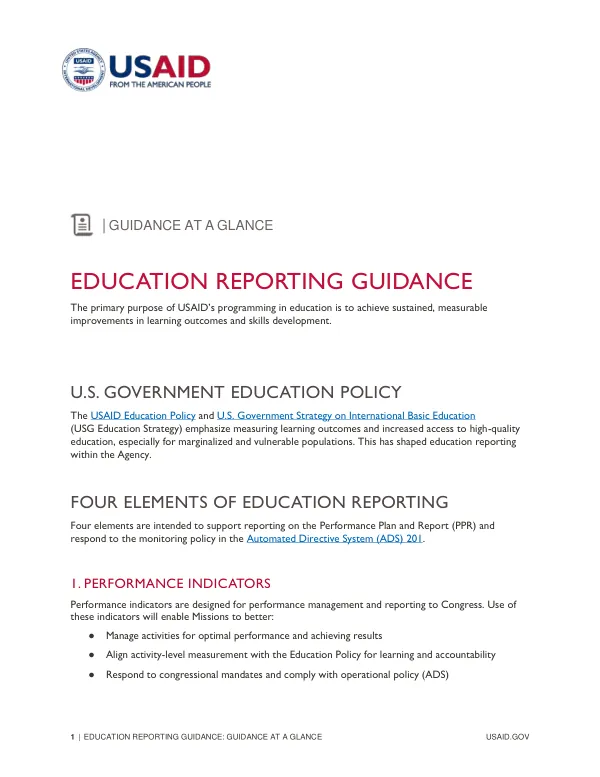
USAID's primary purpose in education programming is to achieve sustained, measurable improvements in learning outcomes and skills development.
4 pages
Sign in to readA free account is required to download.
Abstract
The U.S. Government Education Policy and U.S. Government Strategy on International Basic Education emphasize measuring learning outcomes and increased access to high-quality education, especially for marginalized and vulnerable populations. This has shaped education reporting within the Agency. Four elements support reporting on the Performance Plan and Report (PPR) and respond to the monitoring policy in the Automated Directive System (ADS) 201. Performance indicators are designed for performance management and reporting to Congress. They enable Missions to better manage activities for optimal performance and achieving results, align activity-level measurement with the Education Policy for learning and accountability, and respond to congressional mandates and comply with operational policy (ADS). Standard Foreign Assistance Indicators (Standard Indicators) are assigned, as applicable, by USAID's Bureau for Development, Democracy, and Innovation/Center for Education (DDI/EDU) to Operating Units (OUs). Standard Indicators measure outputs and outcomes that reflect the priorities of the Education Policy. Supplemental Indicators respond to the priorities of the Education Policy that are newer areas of measurement for USAID, such as numeracy, teacher quality, pre-primary skills, and an expanded set of youth skills. Unlike Standard Indicators, uptake of Supplemental Indicators by OUs is voluntary, but strongly encouraged as these indicators help USAID tell a more complete story of education programming worldwide. Custom Indicators are specific to OUs and are typically created to satisfy individual reporting or measurement needs. These indicators remain unchanged unless an OU decides it is appropriate to transition an existing Custom Indicator into a Standard or Supplemental Indicator. Archived Indicators can be continued by OUs if they are unable to transition to a new indicator. When methodologically feasible, DDI/EDU encourages OUs to transition to the new indicators because using them makes it easier for the Center to report accurate results to Congress. Data disaggregation is essential to ensure programs reach their intended beneficiaries and to monitor USAID's engagement with children and youth who are marginalized and vulnerable. All disaggregates must be reported for each Standard Indicator on which an OU reports. The disaggregates under many indicators facilitate reporting and better monitoring of the progress toward improving equity and inclusion. Two key disaggregates now included in all person-level indicators are persons with disabilities and individuals affected by crisis and conflict.
Related documents