USAID
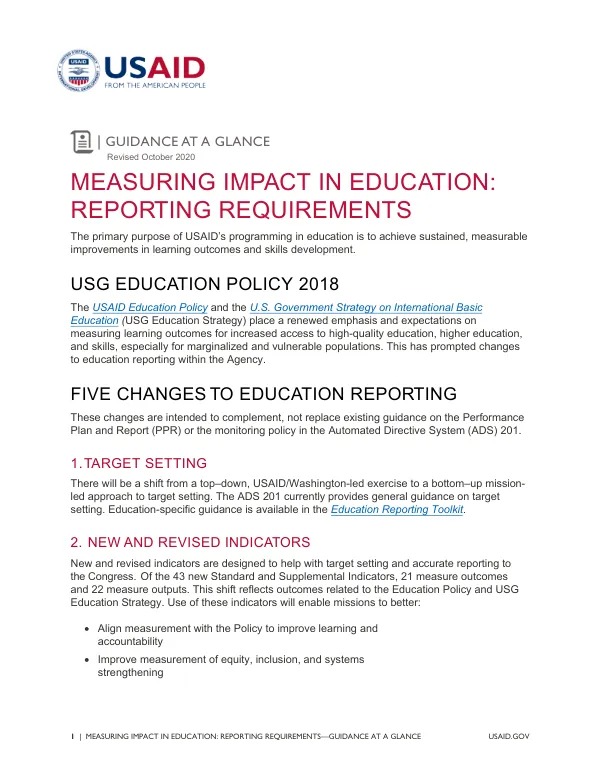
Measuring Impact in Education: Reporting Requirements—Guidance at a Glance
The primary purpose of USAID's programming in education is to achieve sustained, measurable improvements in learning outcomes and skills development.
2020 · 4 pages
Sign in to readA free account is required to download.
Abstract
This goal is in line with the USAID Education Policy and the U.S. Government Strategy on International Basic Education, which emphasize the importance of measuring learning outcomes for increased access to high-quality education, higher education, and skills, especially for marginalized and vulnerable populations. To achieve this goal, USAID has introduced changes to education reporting within the Agency. The changes are intended to complement existing guidance on the Performance Plan and Report (PPR) or the monitoring policy in the Automated Directive System (ADS) 201. The five key changes to education reporting include target setting, new and revised indicators, data disaggregation to ensure equity and inclusion, standardized program structure and definitions, and streamlined reporting. Target setting has shifted from a top-down, USAID/Washington-led exercise to a bottom-up mission-led approach. This change is intended to improve the alignment of measurement with the Education Policy and USG Education Strategy. Education-specific guidance on target setting is available in the Education Reporting Toolkit. New and revised indicators have been introduced to help with target setting and accurate reporting to the Congress. Of the 43 new Standard and Supplemental Indicators, 21 measure outcomes and 22 measure outputs. These indicators are designed to improve measurement of equity, inclusion, and systems strengthening. Standard Indicators are assigned by the Bureau for Economic Growth, Education, and Environment/Office of Education (E3/ED) to operating units (OUs) and include 26 indicators. Supplemental Indicators, on the other hand, respond to the priorities of the Policy and focus on topics such as numeracy skills, teacher quality, social-emotional skills, and an expanded range of youth skills. Data disaggregation is essential to ensure programs reach their intended beneficiaries and monitor USAID's engagement with children and youth who are marginalized and vulnerable. The E3/ED includes disaggregates in reporting requirements because the information they provide is central to the Policy and USAID's education work. Two key disaggregates now included in many indicators are persons with disabilities and individuals affected by crisis and conflict. Standardized program structure and definitions have been revised to improve reporting. The revisions include updated Standardized Program Structure and Definitions (SPSD) Program Area Narratives for Standard Indicators relating to basic and higher education and the Key Issue Narrative for Engagement of Higher Education Institutions. These revisions are intended to facilitate reporting and better monitor progress toward improving equity and inclusion. Streamlined reporting is also a key change to education reporting. The PPR will be E3/ED's main reporting mechanism starting in 2019, and the current Data Call used with the previous USAID Education Strategy (2011-2015) will be done away with. Missions and partners will still be asked to help E3/ED with current tasks, such as submitting datasets and learning assessments to the Development Data Library and updating the Education Activity Roster.
Related documents