USAID DEC
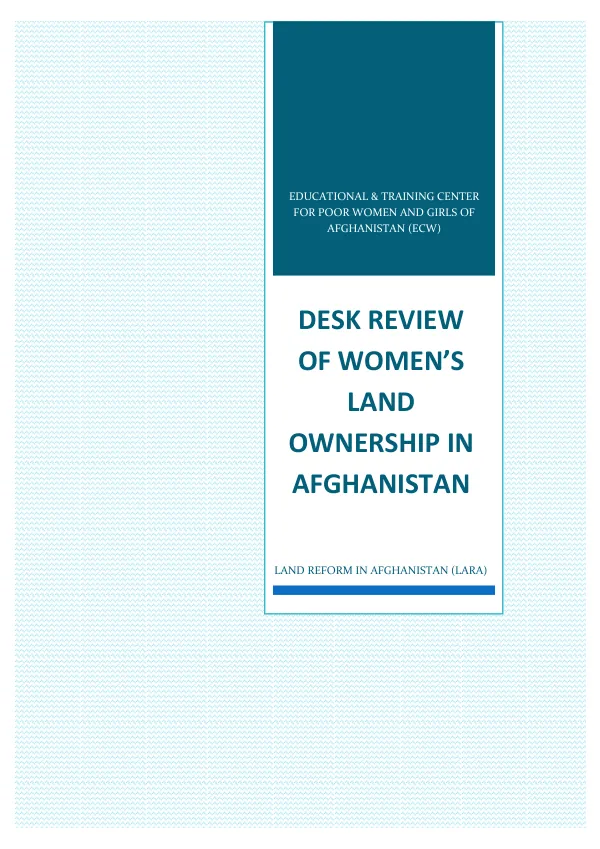
Educational & Training Center for Poor Women & Girls of Afghanistan (ECW) Desk Review of Women’s Land Ownership in Afghanistan
Sign inUSAID DEC
Educational & Training Center for Poor Women & Girls of Afghanistan (ECW) Desk Review of Women’s Land Ownership in Afghanistan
Women's land ownership rights in Afghanistan are governed by Islamic Sharia and the country's Civil Code.
2014 · 28 pages
Sign in to readA free account is required to download.
Abstract
The Holy Quran prescribes three types of ownership guaranteeing women's economic self-sufficiency: inheritance, wage and property, and mehr and milk-wage. Inheritance rights are based on the principle of equal distribution among male and female offspring, with boys inheriting twice as much as girls. However, if a girl is the sole child of the deceased, she inherits half of the property. The Civil Code of Afghanistan, specifically Articles 1993 to 2051, outlines the inheritance rights of women and girls in detail. The code stipulates that women have equal rights to property and inheritance as men, and that they are entitled to enjoy ownership and property through business and labor. The code also provides for the protection of women's property rights, including the right to acquire and make use of property without restriction. The Constitution of Afghanistan, Article 22, states that citizens of Afghanistan, including women, have equal rights and duties before the law. Article 40 of the Constitution further emphasizes that property is immune from invasion, and that no person shall be forbidden from acquiring and making use of a property except within the limits of law. Despite these provisions, women in Afghanistan continue to face significant barriers to accessing their inheritance rights. Cultural and social norms often prevent women from claiming their inheritance, and a lack of awareness about their rights under Islamic Sharia and the Civil Code contributes to this problem. Women are often forced to hand over their property to their brothers or other male relatives, leaving them without economic self-reliance. The Educational and Training Center for Poor Women and Girls of Afghanistan (ECW) has conducted a desk review of women's land ownership in Afghanistan to address these issues. The review aims to strengthen the bonds and cooperation among NGOs and legal reforms to ensure the realization of every citizen's ownership rights. The investigation has been conducted in collaboration with other organizations and has availed of various resources, including the Holy Quran, the Civil Code, and recommendations from Sharia lecturers and experts in inheritance principles. The review has identified 97 substantial questions pertinent to the land inheritance rights of women and girls, and has addressed the trajectory of women and girls' lives from their childhood to their marriage, along with their respective rights. The investigation has also probed domestic cases in far-flung and remote villages and urban areas to substantiate the social and cultural hindrances impeding women's and girls' access to their inheritance rights. The ECW's investigation is hoped to serve as a guideline for those studying Islamic land inheritance rights from both the legal and Islamic perspectives. The overall goals and objectives of the investigation are to rally support for gender-related issues, raise public awareness, and promote progress in this regard, particularly with regards to women's land ownership rights in Afghanistan.
Related documents