USAID DEC
Effect of Community Improvement Collaborative on postpartum family planning in Uganda
Sign inFHI 360
Effect of Community Improvement Collaborative on postpartum family planning in Uganda
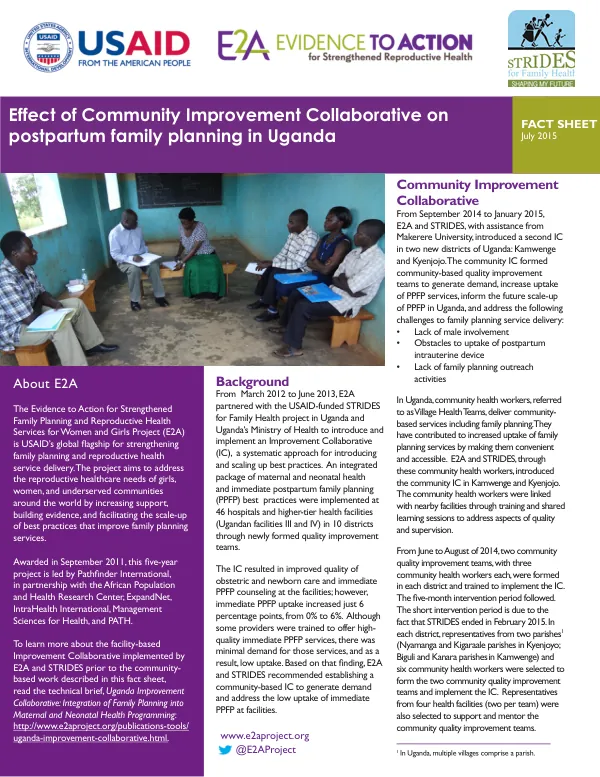
The Evidence to Action for Strengthened Family Planning and Reproductive Health Services for Women and Girls Project (E2A) introduced a community-based quality improvement initiative in two districts of Uganda, Kamwenge and Kyenjojo, from September 2014 to January 2015.
2015 · 2 pages
Sign in to readA free account is required to download.
Abstract
The initiative aimed to generate demand and increase uptake of postpartum family planning (PPFP) services, addressing challenges such as lack of male involvement, obstacles to uptake of postpartum intrauterine device, and lack of family planning outreach activities. Community health workers, referred to as Village Health Teams, played a crucial role in delivering community-based services, including family planning. E2A and STRIDES, through these community health workers, introduced the community quality improvement initiative in the two districts. The community health workers were linked with nearby facilities through training and shared learning sessions to address aspects of quality and supervision. The community quality improvement teams, consisting of three community health workers each, were formed in each district and trained to implement the initiative. The teams were linked with nearby facilities and received mentorship and supervision from facility mentors and district quality improvement team members. The initiative focused on improving the quality of PPFP counseling and services, increasing the uptake of PPFP, and addressing the unmet need for family planning counseling and services during the extended postpartum period. The results of the initiative showed significant improvements in the uptake of PPFP services. In five months, the community quality improvement teams reached 2,602 women with family planning counseling, with 52% of women counseled being eligible for PPFP counseling and services. The acceptance of injectables, lactational amenorrhea method (LAM), and other family planning methods was also high, with 85% of women eligible for PPFP accepting either LAM or DMPA. The findings of the initiative suggest that offering high-quality family planning counseling and services at the community level can help address the unmet need for PPFP faster than relying on facility services alone. A platform that links community health workers, facilities offering family planning services, and district quality improvement leaders is necessary to affect quick changes on the quality of PPFP. The initiative demonstrates the potential of community-based quality improvement initiatives in improving the uptake of PPFP services and addressing the unmet need for family planning counseling and services in hard-to-reach areas. The Evidence to Action for Strengthened Family Planning and Reproductive Health Services for Women and Girls Project (E2A) is a USAID-funded project that aims to strengthen family planning and reproductive health service delivery. The project is led by Pathfinder International, in partnership with several organizations, and has been implemented in several countries, including Uganda. The project's goal is to address the reproductive healthcare needs of girls, women, and underserved communities around the world by increasing support, building evidence, and facilitating the scale-up of best practices that improve family planning services. The project has been implemented in several districts in Uganda, including Kamwenge and Kyenjojo, where the community-based quality improvement initiative was introduced. The initiative has shown promising results in improving the uptake of PPFP services and addressing the unmet need for family planning counseling and services in hard-to-reach areas. The project's findings and recommendations have implications for the scale-up of PPFP services and the development of community-based quality improvement initiatives in other countries.