USAID DEC
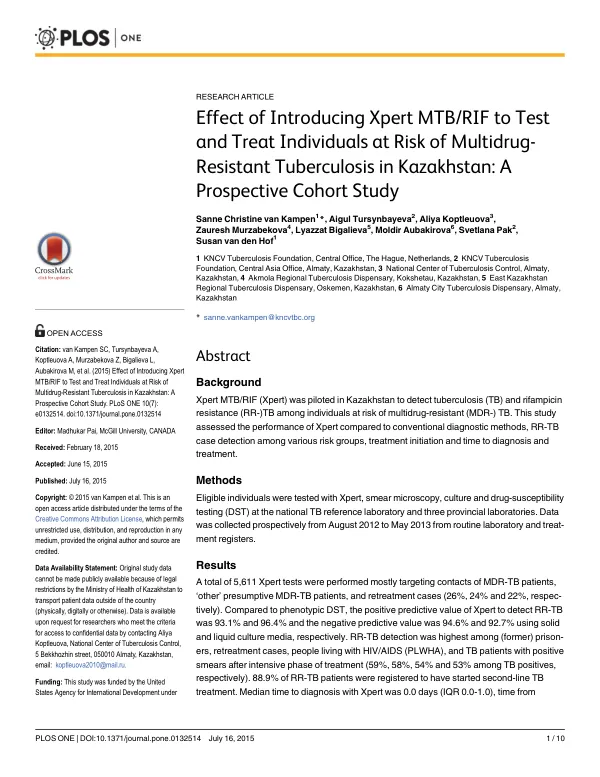
Effect of Introducing Xpert MTB/RIF to Test and Treat Individuals at Risk of Multidrug-Resistant Tuberculosis in Kazakhstan: A Prospective Cohort Study
Sign inKNCV TUBERCULOSIS FOUNDATION
Effect of Introducing Xpert MTB/RIF to Test and Treat Individuals at Risk of Multidrug-Resistant Tuberculosis in Kazakhstan: A Prospective Cohort Study
The study assessed the effectiveness of Xpert MTB/RIF in detecting multidrug-resistant tuberculosis (MDR-TB) in Kazakhstan.
2015 · 10 pages
Sign in to readA free account is required to download.
Abstract
Xpert MTB/RIF is a rapid molecular test that detects TB and rifampicin-resistant (RR-)TB with high sensitivity and specificity. The test was implemented in four pilot sites in Kazakhstan, and the results showed that Xpert MTB/RIF had a positive predictive value of 93.4% and a negative predictive value of 94.6% compared to phenotypic drug-susceptibility testing (DST). The study found that the yield of Xpert MTB/RIF was maximized by increasing referrals from penitentiary and HIV centers to TB centers. The median time to diagnosis with Xpert MTB/RIF was 0.0 days, and the median time from diagnosis to start of second-line treatment was 3.0 days. The study also found that the implementation of Xpert MTB/RIF reduced the time to diagnosis and allowed earlier initiation of treatment. The study population included individuals at risk of MDR-TB, such as contacts of MDR-TB patients, presumptive MDR-TB patients, and retreatment cases. The diagnostic and treatment algorithm used for eligible individuals included Xpert MTB/RIF testing, smear microscopy, culture, and DST. The study found that the implementation of Xpert MTB/RIF improved case finding and treatment initiation among various risk groups. The study's findings suggest that the implementation of Xpert MTB/RIF can improve the detection and treatment of MDR-TB in Kazakhstan. The study's results also highlight the importance of increasing referrals from penitentiary and HIV centers to TB centers to maximize the yield of Xpert MTB/RIF. The study's findings have implications for the implementation of Xpert MTB/RIF in other countries with high MDR-TB burdens. The study's results also show that the implementation of Xpert MTB/RIF can reduce the time to diagnosis and allow earlier initiation of treatment. This is particularly important for individuals with MDR-TB, who require prompt treatment to prevent the spread of the disease. The study's findings suggest that the implementation of Xpert MTB/RIF can improve health outcomes for individuals with MDR-TB. The study's results also highlight the importance of improving the quality of data collection and treatment information. The study found that the original registers were incompletely filled, especially in two of the sites, which made it difficult to obtain complete treatment information. The study's findings suggest that improving the quality of data collection and treatment information is essential for effective implementation of Xpert MTB/RIF. The study's results also show that the implementation of Xpert MTB/RIF can improve the detection and treatment of MDR-TB among various risk groups. The study found that the yield of Xpert MTB/RIF was maximized by increasing referrals from penitentiary and HIV centers to TB centers. The study's findings suggest that the implementation of Xpert MTB/RIF can improve health outcomes for individuals with MDR-TB. The study's results also highlight the importance of improving the quality of care for individuals with MDR-TB. The study found that the implementation of Xpert MTB/RIF can reduce the time to diagnosis and allow earlier initiation of treatment. The study's findings suggest that improving the quality of care for individuals with MDR-TB is essential for effective implementation of Xpert MTB/RIF.
Related documents