USAID DEC
Establishing Health Science Education Development Centers to Lead Internal Quality Improvement Efforts in Ethiopia’s Higher Education Institutions
Sign inFEDERAL MINISTRY OF HEALTH
Establishing Health Science Education Development Centers to Lead Internal Quality Improvement Efforts in Ethiopia’s Higher Education Institutions
The HRH Project supported higher education institutions in Ethiopia to establish robust and sustainable internal quality improvement systems.
2019 · 4 pages
Sign in to readA free account is required to download.
Abstract
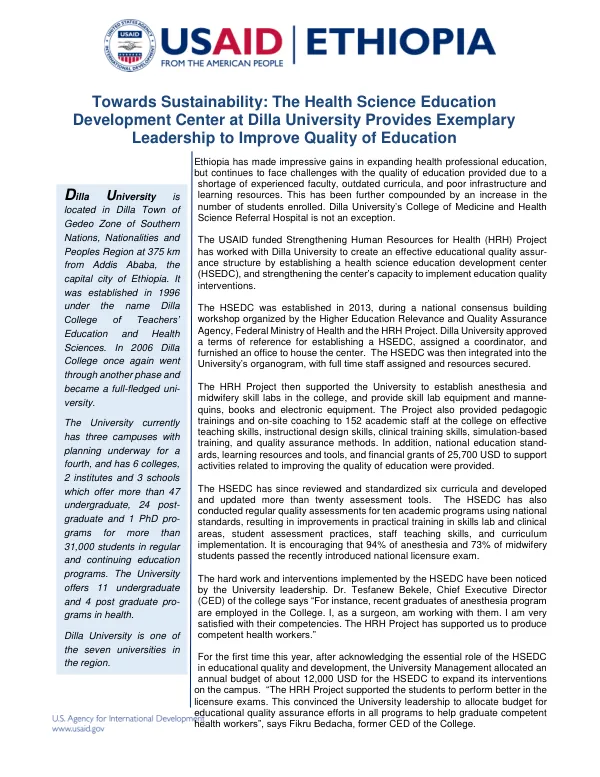
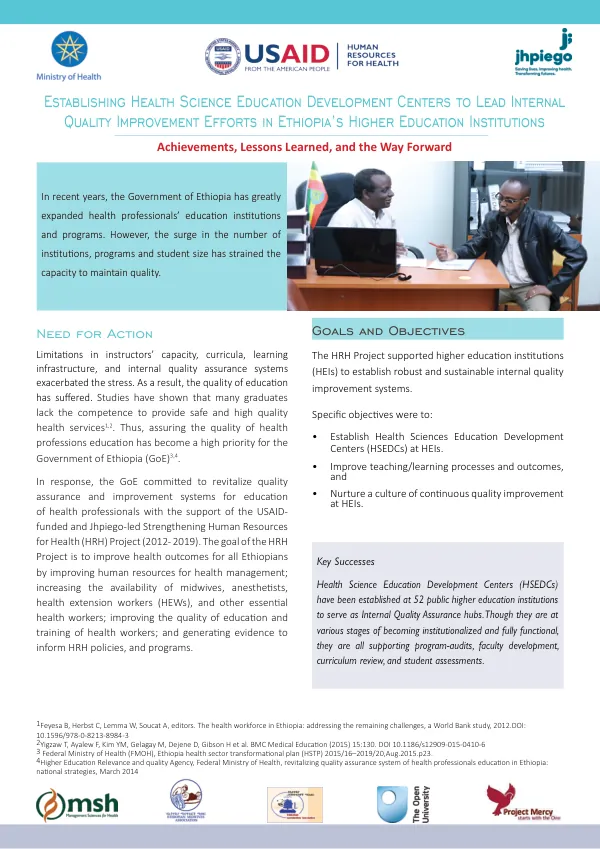
The project's specific objectives were to establish Health Sciences Education Development Centers (HSEDCs) at higher education institutions, improve teaching and learning processes and outcomes, and nurture a culture of continuous quality improvement. Establishing Health Science Education Development Centers to Lead Internal Quality Improvement Efforts in Ethiopia's Higher Education Institutions has been a key focus of the project. HSEDCs have been established at 52 public higher education institutions to serve as internal quality assurance hubs. Although they are at various stages of becoming institutionalized and fully functional, they are all supporting program-audits, faculty development, curriculum review, and student assessments. The Government of Ethiopia has greatly expanded health professionals' education institutions and programs in recent years. However, the surge in the number of institutions, programs, and student size has strained the capacity to maintain quality. Limitations in instructors' capacity, curricula, learning infrastructure, and internal quality assurance systems have exacerbated the stress, resulting in a decline in the quality of education. Studies have shown that many graduates lack the competence to provide safe and high-quality health services. In response to these challenges, the Government of Ethiopia committed to revitalize quality assurance and improvement systems for education of health professionals with the support of the USAID-funded and Jhpiego-led Strengthening Human Resources for Health (HRH) Project. The project's goal is to improve health outcomes for all Ethiopians by improving human resources for health management, increasing the availability of midwives, anesthetists, health extension workers, and other essential health workers, improving the quality of education and training of health workers, and generating evidence to inform HRH policies and programs. The HRH Project collaborated with the Federal Ministry of Health and the Higher Education Relevance and Quality Agency to develop an internal quality assurance manual, educational standards for 17 academic programs, clinical practice management guidelines, simulation-based training management guidelines, and seven faculty development training packages. The project also provided on-site coaching and mentoring to support HSEDCs in developing operational plans and budgets, reviewing curricula, training instructors and preceptors, and developing learning and assessment tools. Conducting self-audits to improve academic programs was another key strategy employed by the project. The project introduced a standards-based Quality Improvement (QI) approach, using HERQA's national standards to support HSEDCs in conducting internal self-audits for a total of 155 academic programs in 48 HEIs. Findings from self-audits were used to formulate action plans and address gaps, with repeated audits for 155 academic programs to track progress. The project also established HSEDCs at health training institutions, providing ongoing technical support to nominate, orient, and train focal persons and teams for tasks at the HSEDCs. Faculty development was a key area of focus, with the project providing training to improve educators' performance and students' learning outcomes. A total of 7,795 instructors, skills lab assistants, and preceptors were trained in 52 institutions, and an additional 1,336 faculty were trained using local resources mobilized by the HSEDCs. Capacity building in Training of Trainers (TOT) level courses for HSEDCs was also a key area of focus, with the project training 1,058 HSEDC focal persons, members, and faculty from public HEIs and private colleges on TOT level courses that built the capacity of the HSEDCs to operationalize their functions, support education programs, train instructors, and guide QI activities. The project also provided financial support to the HSEDCs, using fixed amount award (FAA) and fixed obligation grant (FOG) agreements to support faculty development, self-audits, curricula review, and education research, and develop learning and assessment tools. Advocacy workshops and review meetings were also conducted to support the HSEDCs in their quality improvement efforts. The project supported the HSEDCs to conduct advocacy and awareness creation workshops with leaders of HEIs, FMOH, Federal Ministry of Education, HERQA, regional health bureaus, and other stakeholders, resulting in the mobilization of resources, approval of HSEDC structure, and support for staffing and budget needs. Key takeaways from the project include the establishment of HSEDCs strengthening the capacity of HEIs to monitor and improve the quality of health professions education, and the establishment of HSEDCs at training institutions being an efficient and effective way to support the government's goal of improving the quality of education. Strong advocacy, demonstration of results by the HSEDCs, and integration into institutional organogram helped to ensure sustainability.
Related documents