USAID
Effectiveness of Voluntary Counseling and Testing Interventions
Voluntary Counseling and Testing (VCT) is a client-initiated approach that allows individuals to learn their HIV status through pre- and post-test counseling and an HIV test.
2012 · 4 pages
Sign in to readA free account is required to download.
Abstract
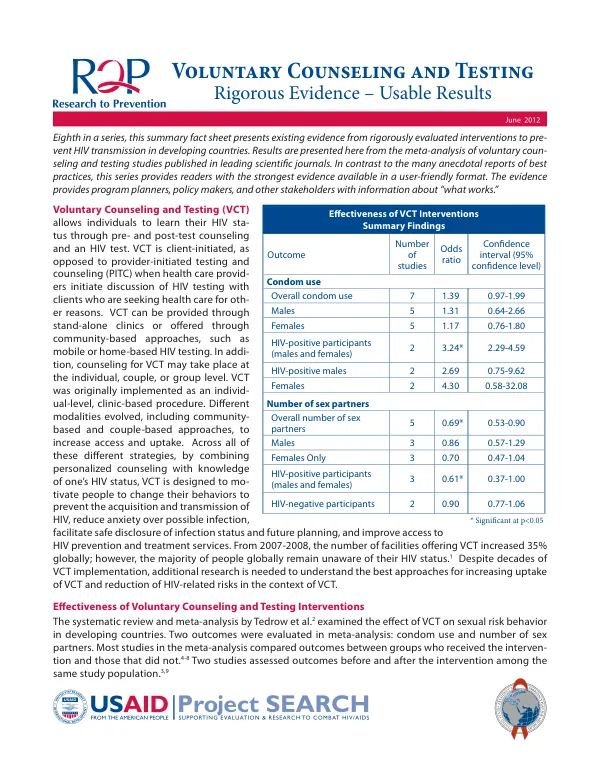
VCT can be provided through stand-alone clinics or community-based approaches, such as mobile or home-based HIV testing. Counseling for VCT may take place at the individual, couple, or group level. The approach was originally implemented as an individual-level, clinic-based procedure but has evolved to include community-based and couple-based approaches to increase access and uptake. The main purpose of VCT is to motivate individuals to change their behaviors to prevent the acquisition and transmission of HIV, reduce anxiety over possible infection, facilitate safe disclosure of infection status and future planning, and improve access to HIV prevention and treatment services. From 2007-2008, the number of facilities offering VCT increased 35% globally, but the majority of people globally remain unaware of their HIV status. Despite decades of VCT implementation, additional research is needed to understand the best approaches for increasing uptake of VCT and reduction of HIV-related risks in the context of VCT. A systematic review and meta-analysis by Tedrow et al. examined the effect of VCT on sexual risk behavior in developing countries. The meta-analysis included 17 studies that met the selection criteria, which were published in peer-reviewed journals between January 1990 and July 2010. The studies evaluated behavioral, psychological, or biological outcomes related to HIV prevention in developing countries and used either a pre-/post- or multi-arm design. The meta-analysis found that VCT had a statistically significant impact on reducing the overall reported number of sexual partners. Participants who did not receive VCT had significantly more sexual partners compared to participants who did receive VCT. The meta-analysis also found that VCT had a marginally significant effect on reducing the number of sexual partners among people who tested positive for HIV. People who tested HIV-positive had fewer sex partners compared to those who did not receive VCT or compared to before they were tested. The meta-analysis results indicate that participants receiving VCT were more likely to report reducing their number of sexual partners than those who did not receive VCT. All individual studies showed a positive trend toward reducing their number of sexual partners when comparing those who received VCT to those who did not. Although VCT did not have a significant overall effect on condom use, people living with HIV who received VCT reported an increase in condom use compared to people living with HIV who did not receive VCT. Two studies reporting on positive and negative life events showed that those who received VCT did not experience a significant increase in negative life events as compared to those who did not receive VCT. However, these studies showed that those who received VCT and tested HIV-negative were more likely to disclose their HIV status than those who received VCT and tested HIV-positive. The available evidence suggests that VCT can have an effect on reducing unprotected sex and the number of sex partners. The meta-analysis results indicate that participants receiving VCT were more likely to report reducing their number of sexual partners than those who did not receive VCT. All individual studies showed a positive trend toward reducing their number of sexual partners when comparing those who received VCT to those who did not. Although VCT did not have a significant overall effect on condom use, people living with HIV who received VCT reported an increase in condom use compared to people living with HIV who did not receive VCT. The vast majority of studies in this meta-analysis took place in a clinic setting, so differences in modalities could not be compared in meta-analysis. However, one employment-based VCT program demonstrated that providing on-site VCT services increased uptake significantly as compared to providing vouchers for off-site VCT services. The available meta-analytic evidence shows that VCT can be effective at reducing some HIV risk behaviors, including overall number of sexual partners and condom use among people living with HIV.