USAID DEC
Effects of community-based health insurance on modern family planning utilization in Ethiopia
Sign inPATHFINDER INTERNATIONAL
Effects of community-based health insurance on modern family planning utilization in Ethiopia
Community-based health insurance (CBHI) has been established in several developing countries to expand access to modern healthcare services.
2019 · 12 pages
Sign in to readA free account is required to download.
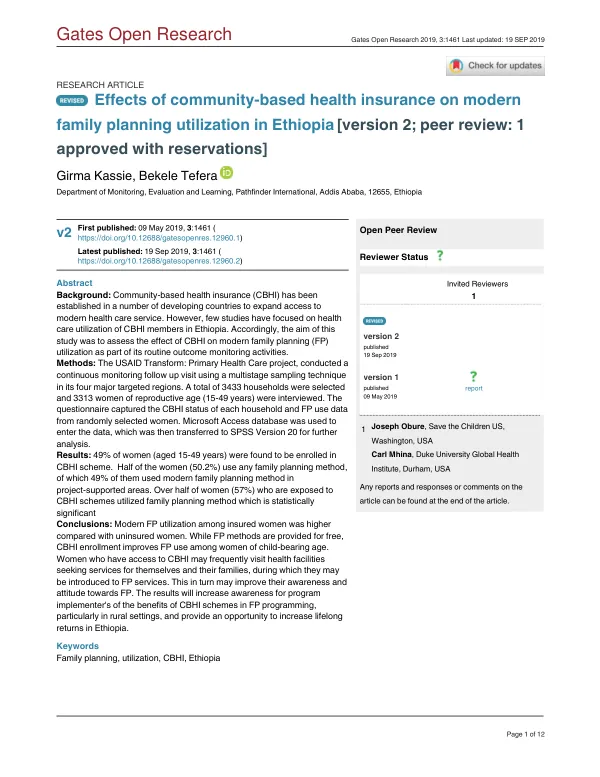
Abstract
In Ethiopia, the Government introduced a CBHI program in 2011, initially piloted in 13 woredas (districts) of the four most populous regions. The program was scaled up to 512 woredas in six regions and two city administrations. CBHI is a health insurance scheme that pools resources from citizens in the informal sector, managed by a scheme management body and governed by board members drawn from CBHI scheme members and other key stakeholders. The USAID Transform: Primary Health Care project provides technical support in its focus woredas towards the initiation, launching, and operationalization of CBHI schemes. CBHI is believed to increase the demand for healthcare services by removing the financial burden on households and/or individual beneficiaries at the time of seeking healthcare. The design of the Ethiopian CBHI learned from the experience of other countries and has recorded notable progress in several community health outcomes over the past 10 years. Family planning (FP) is a proven strategy to reduce maternal and child mortality and morbidity among women of reproductive age. In Ethiopia, the use of modern family planning methods is low but is showing an increase in recent years. In 2019, 41 percent of currently married Ethiopian women were using a modern method of contraception, a significant improvement from 6 percent in 2000. However, the low increase in the rate of contraceptive use over the decade suggests sluggish progress in the family planning program. This suggests that the challenge for the Ethiopian family planning program is to promote family planning by providing better information and services about family planning as well as reproductive health, especially in rural areas. The main aim of this study was to evaluate the effect of CBHI on modern FP utilization. The study used a multistage sampling technique in its four major targeted regions, selecting a total of 3433 households and 3313 women of reproductive age (15-49 years) for interview. The questionnaire captured the CBHI status of each household and FP use data from randomly selected women. The results showed that 49% of women (aged 15-49 years) were enrolled in the CBHI scheme. Half of the women (50.2%) used any family planning method, of which 49% used modern family planning methods in project-supported areas. Over half of women (57%) who were exposed to CBHI schemes utilized family planning methods, which is statistically significant. Modern FP utilization among insured women was higher compared with uninsured women. While FP methods are provided for free, CBHI enrollment improves FP use among women of child-bearing age. Women who have access to CBHI may frequently visit health facilities seeking services for themselves and their families, during which they may be introduced to FP services. This may improve their awareness and attitude towards FP. The results will increase awareness for program implementers of the benefits of CBHI schemes in FP programming, particularly in rural settings, and provide an opportunity to increase lifelong returns in Ethiopia.