USAID DEC
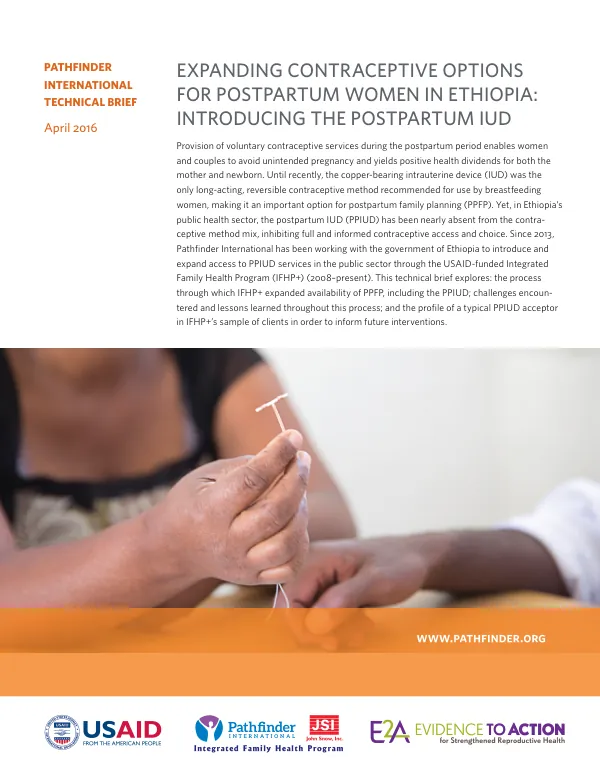
Expanding Contraceptive Options for Postpartum Women in Ethiopia: Introducing the Postpartum IUD
Sign inJOHN SNOW INTERNATIONAL
Expanding Contraceptive Options for Postpartum Women in Ethiopia: Introducing the Postpartum IUD
The postpartum intrauterine device (IUD) is a long-acting, reversible contraceptive method that can be used by breastfeeding women.
2016 · 8 pages
Sign in to readA free account is required to download.
Abstract
In Ethiopia, the postpartum IUD (PPIUD) has been nearly absent from the contraceptive method mix, inhibiting full and informed contraceptive access and choice. The Integrated Family Health Program (IFHP+) has been working with the government of Ethiopia to introduce and expand access to PPIUD services in the public sector. The World Health Organization (WHO) recommends that pregnancies be spaced by at least 24 months, yet in Ethiopia, nearly half (47 percent) of postpartum women have short (<23 months) birth-to-pregnancy intervals. The two-year period following a birth is correlated with a particularly high unmet need for contraception globally, and in Ethiopia, this rises to a full 74 percent. These figures suggest a critical gap in contraceptive service delivery during the postpartum period. The WHO's Medical Eligibility Criteria for Contraceptive Use 4th Edition, released in 2009, recommended the copper-bearing IUD as the only long-acting reversible contraceptive method for immediate use among breastfeeding women. However, in June 2015, the WHO released the 5th edition, which deemed that in addition to copper-bearing IUDs, progestogen-only contraceptive pills, levonorgestrel and etonogestrel contraceptive implants, and levonorgestrel-containing IUDs are safe for use by breastfeeding women during the six weeks following childbirth. IFHP+ achieved success across the maternal and newborn health continuum throughout its original lifecycle (2008-2013). When the program was awarded a three-year extension, IFHP+ built on these achievements to expand access to postpartum family planning, including the PPIUD. The program prioritized supporting the government to strengthen the MNH continuum as the foundation for any further program initiatives. By IFHP+'s original endline date (2013), improvements could be seen across the continuum in project sites: skilled birth attendance increased from 6.5 to 35.9 percent; the percent of women who completed four ANC visits rose from 14.7 to 41 percent; PNC uptake jumped from 1.1 to 24.9 percent; contraceptive prevalence increased from 27.4 to 39.1 percent; and long-acting method use (implants and IUDs) rose from 0.8 to 6.3 percent. To introduce PPIUD services, IFHP+ built on its experience supporting the government's broader interval IUD initiative. Since 2011, the program has worked closely with public sector health facilities, woreda heads, and health office managers to train clinicians on interval IUD insertion and removal, generate demand for services, and counter myths and misconceptions about the IUD within communities. Through this initiative, IFHP+ supported 866 health centers (68 percent of all health centers in the IFHP+ catchment area) to introduce interval IUD services from December 2011 to September 2015, and scale-up continues to date. Nesting PPIUD services within this broader initiative enabled timely initiation of services by providers already familiar with interval IUD insertion and removal techniques. The PPIUD can be inserted postplacental, immediately postpartum, or intracesarean, and at any other time as long as the woman is not currently pregnant and at least four weeks have passed since a prior delivery. The program planned to initially pilot introduction of the PPIUD in 17 program-supported health centers from July to September 2013. After this three-month period, the program then planned to use lessons learned from the pilot to expand services to an additional 100 health centers.