ABT ASSOCIATES
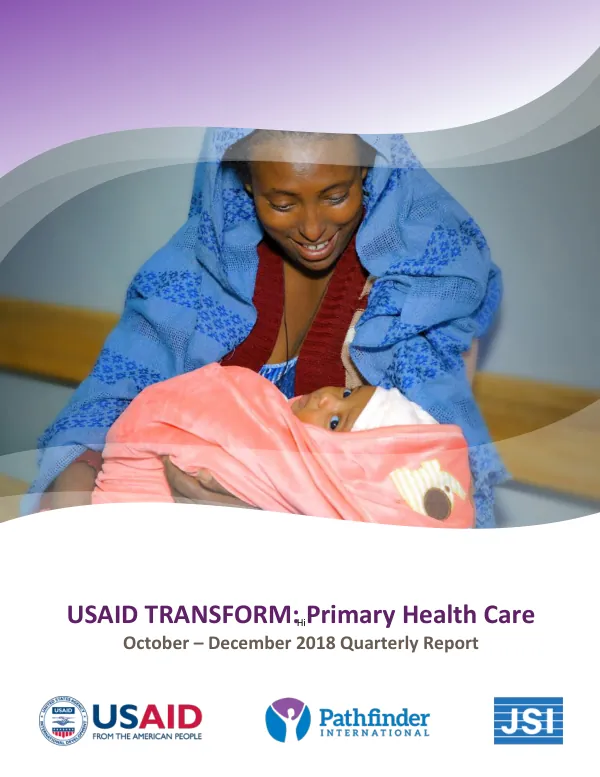
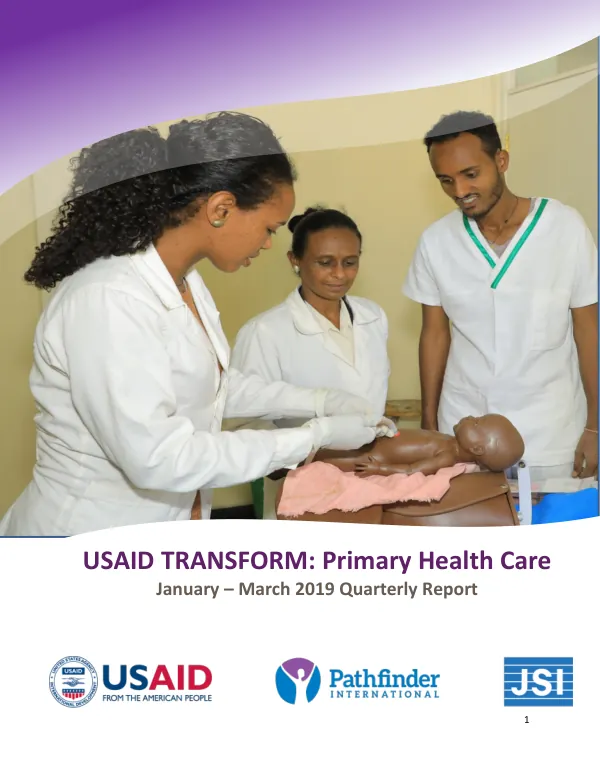
USAID TRANSFORM: Primary Health Care January – March 2019 Quarterly Report
USAID TRANSFORM: Primary Health Care is a project that aims to make breakthrough and sustainable progress toward preventing child and maternal deaths in Ethiopia.
2019 · 64 pages
Sign in to readA free account is required to download.
Abstract
The project works alongside the Government of Ethiopia to contribute to the 2030 Sustainable Development Goals and support the operationalization of the Government of Ethiopia's 2015/16 - 2019/20 Health Sector Transformation Plan (HSTP). Transform supports the attainment of four HTSP transformational agendas, including woreda transformation, quality and equity in healthcare, caring, respectful, and compassionate providers, and information revolution. The project focuses primarily in the areas of maternal, newborn, and child health (MNCH); family planning (FP); reproductive health (RH); and malaria. Success is measured through achievement of four high-level results: (1) Improved management and performance of health systems; (2) Increased sustainable quality of service delivery across the PHCU's continuum of care; (3) Improved household and community health practices and health-seeking behaviors; and (4) Enhanced program learning to impact policy and programming related to eliminating preventable child and maternal deaths (EPCMD). The project provides integrated support to the health sector to enhance access to and quality of health services. Performance, as measured by the agreed Performance Monitoring Plan (PMP) indicators, is provided in Annex 1, which highlights this quarter's achievements against the plan and progress toward the annual target. The project has achieved significant improvements in various indicators, including the percentage of health centers reviewed EHCRIG chapters, initiation of intrauterine contraceptive device (IUCD) services, post-partum family planning (PPFP) services, and women-friendly delivery services. In terms of management and performance of health systems, the project has established and strengthened innovative processes to sustainably enhance health system management and performance. This includes the establishment of a twinning partnership, reporting progress of performance improvement ideas/projects, and support to the Federal Ministry of Health. The project has also enhanced the functionality of the health system within the context of primary-level care, including health information systems, public finance management, and community-based health insurance. In terms of quality of service delivery, the project has strengthened skills for delivery of quality and integrated RMNCAH-N services, including family planning and reproductive health, maternal health, and child health and development. The project has also improved provider behaviors and communication skills toward a compassionate, respectful, and caring health workforce. Additionally, the project has introduced and scaled innovative service delivery interventions to prevent child and maternal death. The project has also made significant progress in improving household and community health practices and health-seeking behaviors. This includes increased individual and household level care-seeking behavior and uptake of healthy practices, as well as strengthened enabling environment for health-seeking behavior, including community engagement in health service oversight. Finally, the project has enhanced program learning to impact policy and programming related to preventing child and maternal deaths. This includes strengthening health system capacity to generate learning and evidence, evidence of what works in preventing child and maternal death, informed by results from program learning and iterative adaptation, and evidence used to inform programming and policy with local and global stakeholders.
Related documents