USAID DEC
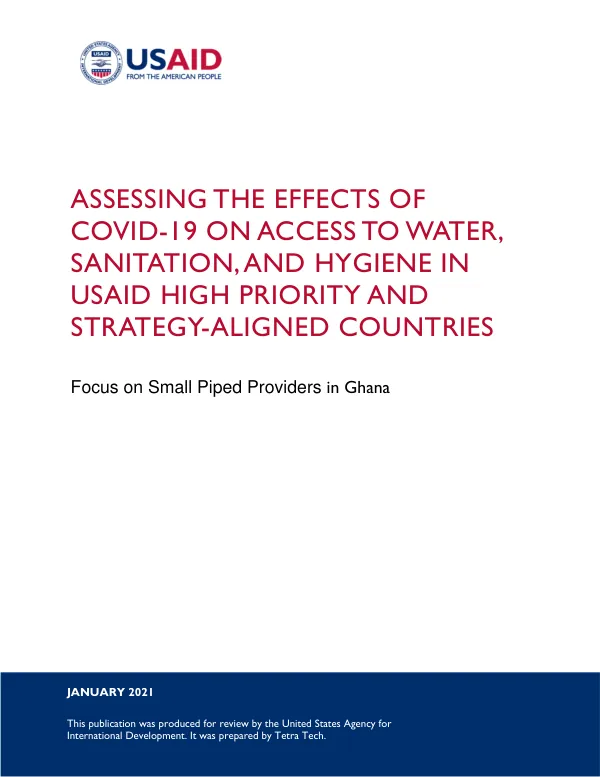
Effects of COVID-19 on Access to WASH in USAID High Priority and Strategy-Aligned Countries: Focus on Small Piped Providers in Ghana
Sign inGLOBAL COMMUNITIES
Effects of COVID-19 on Access to WASH in USAID High Priority and Strategy-Aligned Countries: Focus on Small Piped Providers in Ghana
The COVID-19 pandemic has had a significant impact on access to water, sanitation, and hygiene (WASH) services in Ghana, particularly for small piped water systems.
2021 · 36 pages
Sign in to readA free account is required to download.
Abstract
Between June and October 2020, the USAID Water, Sanitation, and Hygiene Partnerships and Learning for Sustainability (WASHPaLS) project conducted a rapid assessment and forecasting analysis of the effects of the pandemic on WASH services and products in USAID high priority and strategy-aligned countries, including Ghana. The government's extended free water directive appeared to be combining with the pandemic's income shock to threaten the ability of smaller water service providers to continue operating at acceptable performance standards. In response to this finding, USAID tasked WASHPaLS with conducting a follow-on analysis in Ghana to gain further insights into the challenges faced by small water providers and the ramifications on their customers. The research sought to examine the operational status of small piped water systems in Ghana and potential constraints on government institutions for providing reimbursement support to small providers. The approach combined interviews with rural piped system operators and other key stakeholders with consumer surveys via SMS in communities served by these rural piped systems, as well as elsewhere in Ghana, to provide comparisons by water supply modality. Operators themselves reported performance declines, with increases in the number of days unavailable and decreases in the number of hours per day of service. However, rural piped water supply systems have not yet experienced widespread shutdowns. Participants in the SMS surveys in areas purposively sampled to capture customers of rural piped systems reported significant improvements in water availability, with the average increasing from 10 hours per day to 11 hours per day after the onset of the pandemic. Despite the free water directive, a significant fraction of small piped systems have continued to collect revenue to support operating expenses. In addition to the 38 percent that continued to collect revenue, 84 percent of the respondents to the SMS surveys reported still paying some amount for water. Rural respondents reported spending an average of 47 GHS (roughly USD 8) per month and urban respondents spent an average of 66 GHS (roughly USD 11) per month. Reimbursements by the Government of Ghana to the operators interviewed have been minimal to date. While 67 percent of water systems reported receiving some compensation, the amount received was only a small fraction (4 to 16 percent) of the amount requested. The findings suggest that the medium- to long-term financial and operational soundness of these rural systems is at risk. Operators reported increases in system water production of nearly 50 percent, placing increasing wear on their equipment without concurrent maintenance. The majority (62 percent) reported a cessation in revenue collection under the free water directive, reducing reported operating reserves from an average of three months to an average of two months. The proportion of the rural population that reported piped water to be their main drinking water modality dropped following the onset of COVID-19, suggesting that some system service may have been disrupted. The results highlight the need for targeted support to small piped water systems to ensure their continued operation and maintenance, particularly in the face of the ongoing pandemic and economic crisis.