UNIVERSITY OF CALIFORNIA BERKELEY
Effects of USB port access on advanced cookstove adoption
Advanced cookstoves equipped with thermoelectric generators (TEGs) and USB ports have been introduced to improve biomass combustion and reduce emissions.
2018 · 9 pages
Sign in to readA free account is required to download.
Abstract
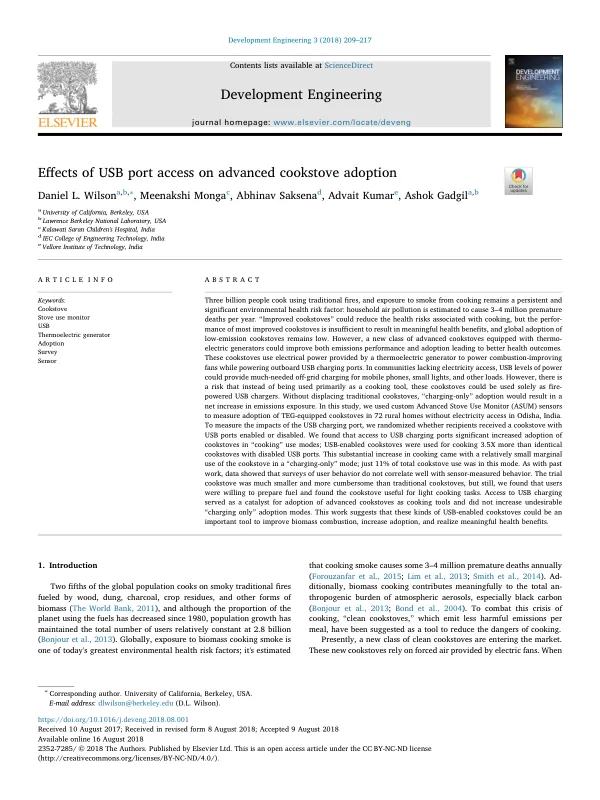
These cookstoves use electrical power provided by TEGs to power combustion-improving fans and outboard USB charging ports. The USB ports enable off-grid charging for mobile phones, small lights, and other loads, which is a disruptive technology and an important benefit for many customers. The study aimed to investigate the impact of USB charging ports on the adoption of TEG-enabled cookstoves. A randomized controlled trial was conducted in 72 rural homes without electricity access in Odisha, India. The trial cookstove was a customized version of BioLite's TEG-enabled "CampStove," which was equipped with a TEG module, fan, USB port, and a 600 mAh 3.7 V lithium ion backup battery. The Advanced Stove Use Monitor (ASUM) sensors were used to measure the adoption of TEG-equipped cookstoves and the impacts of the USB charging port. The results showed that access to USB charging ports significantly increased adoption of cookstoves in "cooking" use modes. The USB-enabled cookstoves were used for cooking 3.5 times more than identical cookstoves with disabled USB ports. However, the marginal use of the cookstove in a "charging-only" mode was relatively small, accounting for just 11% of total cookstove use. The study also found that users were willing to prepare fuel and found the cookstove useful for light cooking tasks, despite its smaller and more cumbersome design compared to traditional cookstoves. The study suggests that the presence of USB ports on fan-powered cookstoves can influence adoption in three categorical ways: (i) the willingness to pay for a cookstove, (ii) the impacts of USB on adoption of the cookstove as a cooking tool, and (iii) the extent to which USB access creates a perverse incentive to use the cookstove solely as a fire-powered charger. The study's findings highlight the need to understand the impacts of TEG-enabled USB charging on cookstove adoption and to develop strategies to promote the adoption of clean cookstoves as cooking tools. The study's results have implications for policy makers and stakeholders in the cookstove space. The emergence of TEG cookstoves on the global marketplace highlights the need to understand the potential risks associated with this technology, including the possibility of cookstove "misuse." The study's findings suggest that the presence of USB ports on fan-powered cookstoves can increase adoption of cookstoves as cooking tools, while minimizing the risk of cookstove "misuse."
Related documents