DELOITTE INC.
EGGI Budget Reform Retreat Report Lessons Learned from 2010-2011 and Looking Ahead
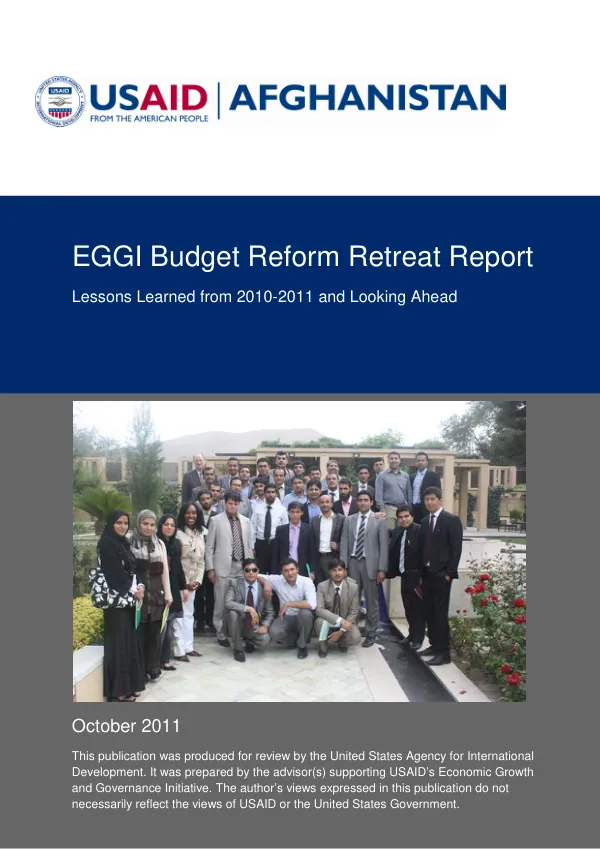
The USAID Economic Growth and Governance Initiative (EGGI) organized a one-day retreat on July 30, 2011, to review EGGI's performance in supporting the Ministry of Finance in budget reform implementation for 2010-2011.
2011 · 13 pages
Sign in to readA free account is required to download.
Abstract
The retreat aimed to identify opportunities for the project to improve its budget reform support to the Ministry of Finance going forward. The USAID/EGGI Program Management team and Ministry of Finance Budget Department officials participated in the retreat, with Ministry of Finance counterparts providing feedback on the successes, challenges, and areas of improvement identified during working group sessions. The retreat was the first workshop organized by USAID/EGGI to discuss lessons learned from the project's 2010-2011 past experience with budget reform. The Ministry of Finance counterparts were involved in the discussion since the inception of USAID assistance to the Ministry of Finance in program budget reform in 2007 and provincial budgeting reform in 2010. The retreat program included welcome remarks by the USAID COTR and EGGI Component Lead, a presentation on the EGGI project's Year 2 budget reform activities, and working group sessions to discuss lessons learned from Year 2 and how to better integrate the program/provincial budgeting reform activities for Year 3. A key objective for conducting the retreat was for the EGGI Budget Reform Team (BRT) participants to reach a consensus on its Year 2 work achievements, challenges, and areas for improvement for the project's Year 3 (2011-12). The BRT achieved this through facilitated working group discussions during the first half of the retreat program. Participants identified achievements, challenges, and areas for improvement separately for program budgeting reform and provincial budgeting reform. The EGGI Budget Reform Team identified key successes achieved in program budgeting and provincial budgeting reform to date. In program budgeting reform, the team noted successful implementation across all budgetary units, submission of budget deliverables to the Ministry of Finance by Line Ministries generally on time, capacity building through training, mentoring, and coaching of Government of the Islamic Republic of Afghanistan (GoIRA) employees, and increasing knowledge of program budgeting reform in Line Ministries. The team also noted the graduation of eight Line Ministries from USAID/EGGI technical assistance and greater Afghanization of program budgeting reform implementation. In provincial budgeting reform, the team noted that the Ministry of Finance, with EGGI support, conducted consultation and coordination training for 20 provinces with a total of 600 provincial officials participating. The team also noted that EGGI assisted the Ministry of Finance to organize a national provincial budgeting policy symposium in May, with over 500 national and provincial officials participating, to introduce the Ministry's new provincial budgeting policy approach. Despite the successes, the EGGI Budget Reform Team identified key challenges that need to be addressed to ensure the Government has capacity to successfully implement these reforms for future sustainability. In program budgeting reform, the team noted frequent changes in staffing of Line Ministry Program Budget Implementation Teams, lack of coordination and communication among the Ministry of Finance and Line Ministries, internet connection problems in Line Ministries, low capacity of Line Ministry staff in computers, IT, and economic knowledge, and a less number of experienced EGGI team members assigned to budgetary units due to internal staff turnover each year. In provincial budgeting reform, the team noted delays in conducting provincial budgeting workshops according to the schedule due to funding or logistical issues, difficult security situation in the Southern and Eastern Regions, lack of communication and coordination between provincial line directorates and their respective line ministries on planning and budgeting activities, and lack of public financial management information in the provinces and general low capacity of provincial officials.
Related documents