THE INTERNATIONAL FOUNDATION FOR ELECTORAL SYSTEMS
Elections in Zimbabwe: 2018 General Elections Frequently Asked Questions
The 2018 General Elections in Zimbabwe were a significant event in the country's history, marking a major political transition after the resignation of President Robert Mugabe in November 2017.
2018 · 10 pages
Sign in to readA free account is required to download.
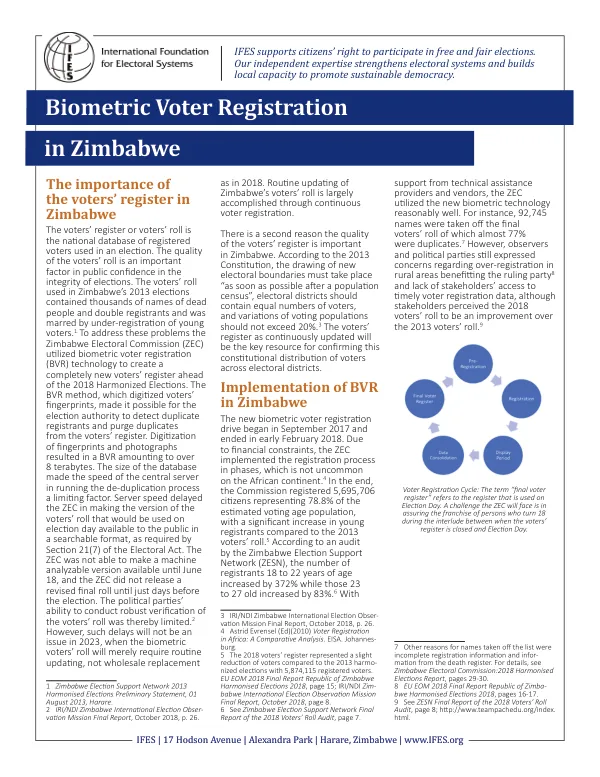
Abstract
The elections were held on July 30, 2018, with a two-round majoritarian electoral system, where the candidate receiving a majority of the valid votes cast (at least 50 percent plus one) would be elected. The electoral system in Zimbabwe is governed by the Constitution of 2013, which outlines the structure of government and the powers of the election management body, the Zimbabwe Electoral Commission (ZEC). The ZEC is responsible for preparing for, conducting, and supervising elections and referendums in accordance with the laws of Zimbabwe and electoral management best practices. The ZEC is composed of a chairperson and eight other commissioners, who hold office for a term of six years up to a maximum of two terms. The 2018 elections marked the country's first use of biometric voter registrations for the preparation of the voter roll, as well as the first time that the ZEC was responsible for putting together the voter roll, a responsibility previously held by the Department of the Registrar General of Zimbabwe. The elections also saw the introduction of a party-list system of proportional representation for the Senate and National Assembly, with a requirement for party lists to list male and female candidates alternatively and every list to be headed by a female candidate. The Government of Zimbabwe is made up of an executive branch, legislative branch, and judicial branch. The executive branch consists of the president, vice president, and presidential Cabinet. The legislative branch consists of the Senate and National Assembly, with the Senate consisting of 80 senators elected from each of the provinces in Zimbabwe through a party-list system of proportional representation. The National Assembly consists of 210 members elected under a party-list system of proportional representation, with an additional 60 women members. The elections were significant because they marked a major shift in the country's politics, with the ruling ZANU-PF party facing increased competition from opposition parties. The elections also raised the stakes for the country's future, with the new government facing significant challenges in addressing the country's economic and social issues. The ZEC played a crucial role in ensuring the smooth conduct of the elections, with the commission working to promote cooperation between the government, political parties, and civil society with regard to elections and keeping the public informed about electoral processes.