USAID DEC
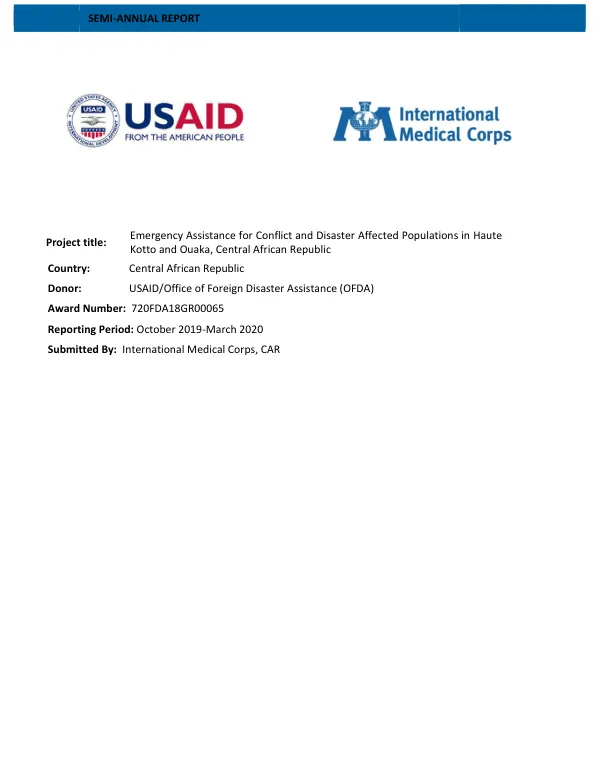
Emergency Assistance for Conflict and Disaster Affected Populations in Haute Kotto and Ouaka, Central African Republic
Sign inINTERNATIONAL MEDICAL CORPS
Emergency Assistance for Conflict and Disaster Affected Populations in Haute Kotto and Ouaka, Central African Republic
The Emergency Assistance for Conflict and Disaster Affected Populations in Haute Kotto and Ouaka, Central African Republic project began in July 2019 with funding from the USAID/Office of Foreign Disaster Assistance (OFDA).
2020 · 25 pages
Sign in to readA free account is required to download.
Abstract
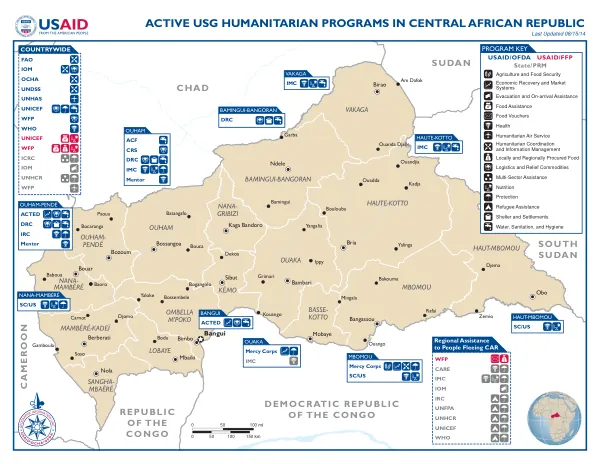
The project aimed to provide emergency assistance to conflict and disaster affected populations in Haute Kotto and Ouaka districts. The project's goal was to improve access to primary and secondary health care services, provide good quality preventive and curative nutrition services, and strengthen awareness of protection risks and access to GBV response services. In Haute Kotto, the project supported the PK3 clinic, which functioned as a static health facility providing services 24/7. The clinic was managed by a nurse supervisor who worked in collaboration with a midwife, a health promoter, an IYCF counselor, and a WASH officer. The project also supported the Bria maternity ward within Bria Hospital, where it piloted the use of Tranexamic Acid (TXA) for the treatment of post-partum hemorrhage (PPH) for emergency obstetric patients. Training on the usage of TXA was conducted for 13 people, representing 83.3% of the originally planned number of trainees. In Ouaka district, the project supported three static health facilities, including Ngaloua, Batobadja, and Bokolobo, from December 2019. The Bokolobo health facility was supported by OFDA funding, following the end of the Bill and Melinda Gates Foundation's funding. The project provided a full package of support, including health, nutrition, and protection services, to all supported sites. The project's nutrition component provided good quality preventive and curative nutrition services among the conflict-affected population. Community outreach, OTP, referral to SC, and IYCF services were provided, as well as ready-to-use supplementary food (RUSF) for the treatment of moderate acute malnutrition (MAM) in the targeted supplementary feeding program (TSFP) in Bambari and Bria districts. The project also trained 170 mothers to screen their own children using MUAC tape and bilateral pitting edema detection, to identify acute malnutrition at an earlier stage. In the Protection component, the project increased awareness of protection risks and access to GBV response services, and provided case management and psychosocial services to GBV survivors and vulnerable women. A consultant was recruited to develop a men engagement approach, which was completed and trained the country in December. The engaging of men has commenced. The population movement in the area has been significant, with multiple clashes between armed groups affecting and involving the local population, gendarmes, UN Peacekeeping troops, the FACA, and several NGOs. According to the Population Movement Commission report of November 2018, the IDPs population in Ouaka health district was estimated at 37161 people and 45603 people in Haute Kotto. However, episodes of violence have decreased in both districts of intervention as a result of the peace agreement process between conflict stakeholders in CAR. A return movement of IDPs from PK3 in Haute Kotto, and from elsewhere in Bria, MINUSCA, and PK8 IDP camps in Bambari has been observed. The PK3 site went from 49521 individuals to 44044 IDPs in August 2019. Currently, the population at PK3 is 45302 people, according to INTERSOS results following the displacement of IDPs in January 2020.