USAID DEC
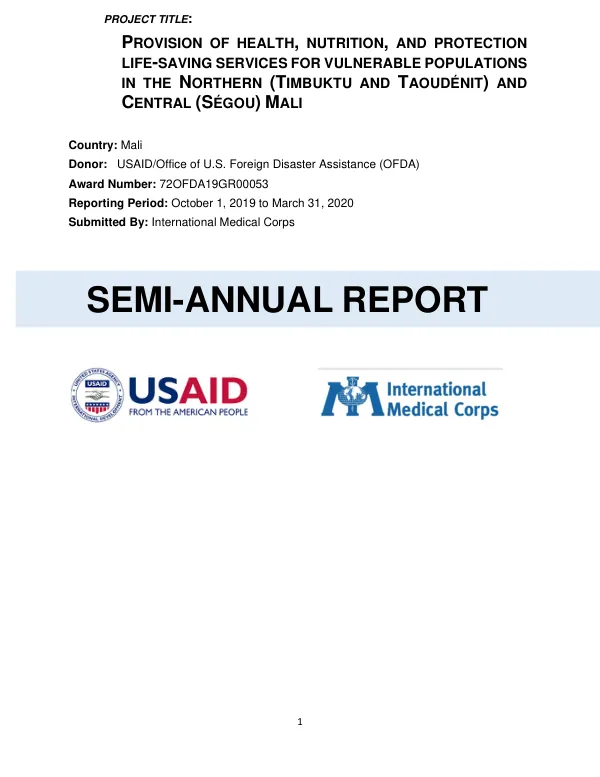
Provision of Health, Nutrition, and Protection Life-Saving Services for Vulnerable Populations in the Northern (Timbuktu and Taoudénit) and Central (Ségou) Mali
Sign inINTERNATIONAL MEDICAL CORPS
Provision of Health, Nutrition, and Protection Life-Saving Services for Vulnerable Populations in the Northern (Timbuktu and Taoudénit) and Central (Ségou) Mali
The health, nutrition, and protection life-saving services project for vulnerable populations in the Northern (Timbuktu and Taoudénit) and Central (Ségou) Mali regions began in May 2019 with funding from USAID's Office of U.S.
2020 · 35 pages
Sign in to readA free account is required to download.
Abstract
Foreign Disaster Assistance (OFDA). The project aimed to improve access to free, quality, lifesaving health services and ensure the sustainability of health services for targeted conflict-affected populations. In the Health sector, International Medical Corps (IMC) maintained 12 health facilities, providing free and quality primary and secondary health care through capacity building of the centers based on the six World Health Organization (WHO) pillars. The project initially aimed to initiate cost recovery in Timbuktu and Taoudénit, but discussions with OFDA resulted in a transition back to cost-free care for all persons. During the reporting period, 18,426 people, including 4,934 men, 5,657 women, 4,099 girls, and 3,736 boys, directly benefited from health services supported by IMC in the Timbuktu and Taoudénit regions. International Medical Corps also contributed to the management of Severe Acute Malnutrition (SAM) with and without medical complications in 24 outpatient therapeutic programs (OTP) and 2 stabilization centers (SC) in the Timbuktu, Taoudénit, and Ségou regions. The organization carried out activities with community-based organizations to educate the population on good infant, young, and child feeding (IYCF) practices. In total, 23,319 people, including 3,027 men, 18,791 women, 652 girls, and 849 boys, directly benefited from nutrition services. The program goal was to affect 525,746 people in the target area, with a total of 367,010 individuals targeted. The program objectives included improving access to free, quality, lifesaving health services and ensuring the sustainability of health services for targeted conflict-affected populations, contributing to mitigating excess mortality and morbidity due to malnutrition among children under five and pregnant and lactating women, and improving access to services and support for survivors of gender-based violence (GBV) and strengthening communities' capacity to mitigate GBV in the Northern region (Timbuktu), Mali. International Medical Corps worked with Community Health Workers (CHWs), Community Health Volunteers (CHVs), and ASACOs to promote hygiene, ensure nutrition community-based activities, and behavioral changes within households and communities. Key activities included training committees on Infection Prevention and Control (IPC), awareness campaigns, individual awareness, and household and community discussions on specific hygiene and sanitation behaviors. These activities reached 24,899 people, including 8,002 men, 9,427 women, 4,040 girls, and 3,430 boys, who directly benefited from WASH services. The organization reinforced the prevention of gender-based violence (GBV) and GBV survivors' case management in close collaboration with community-based organizations, including three women and girls' safe spaces (WGFSs) in two districts. International Medical Corps also supported two international campaigns, including the "16 Days of Activism" and "International Women's Day" on March 8, 2020. General GBV prevention community awareness-raising activities were also conducted, reaching a total of 35,359 people, including 21,132 women, 9,415 men, 1,867 girls, and 975 boys. In March 2020, COVID-19 pandemic cases were officially reported in Mali, becoming a critical health priority for the Government of Mali, humanitarian actors, donors, and the Malian population. The regions of Timbuktu and Ségou, which had initially remained on the fringes of the epidemic, recorded three and one cases, respectively. The pandemic raised new constraints concerning project implementation, including the need to adapt or cancel activities with a gathering of individuals, such as meetings, workshops, and awareness-raising sessions. The Mobile Medical Unit (MMU) deployed by IMC in the Taoudénit Region conducted eight visits in each of the three targeted health districts (Araouane, Al-Ourche, and Boujbeha) from October 2019 to March 2020. Through the MMU interventions, beneficiaries received curative, preventive, and promotional activities. There were 4,814 curative consultations, of which 2,671 were women and 2,143 men. Children under five years represented 22% of total consultations (1,083/4,814). The predominant diseases were acute respiratory infection (ARI – 28%), malaria (15%), diarrhea (14%), high blood pressure (12%), trauma (14%), sexually transmitted infection (STI – 12%), and mental health conditions (0.5%). The Mobile Clinic's maternal health service reached 92 women, including 55 women for the first antenatal care visit, 18 women for the second anten
Related documents