WORLD VISION
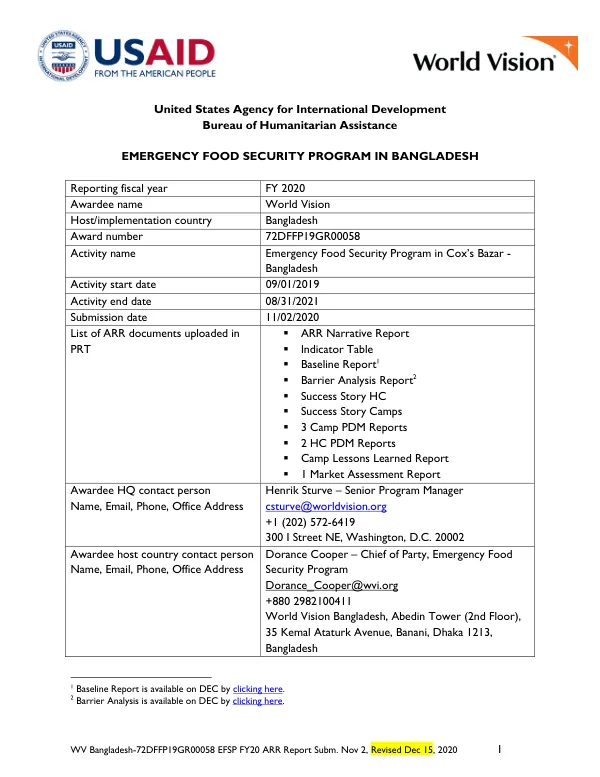
Emergency Food Security Program in Bangladesh FY20 ARR Report
The Emergency Food Security Program in Bangladesh was implemented by World Vision from September 1, 2019, to August 31, 2021.
2020 · 24 pages
Sign in to readA free account is required to download.
Abstract
The program aimed to improve the food security and nutrition status of vulnerable households in both Rohingya refugee camps and the Bangladesh host community. The program successfully operationalized all planned interventions, meeting 100.01% of the project target. Fresh Food Vouchers (FFV) were distributed to 74,736 households living in 13 Rohingya refugee camps, allowing most beneficiary households to have 'acceptable' Food Consumption Scores (FCS), thereby being food secure. The provision of FFV also contributed to decreased re-selling of General Food Distribution (GFD) and the smooth transition to e-Voucher modality of food assistance. In the host community, $1,024,944.77 USD of conditional and unconditional cash assistance was distributed in FY20, including 3 rounds of unconditional cash assistance provided during the height of COVID-19 lockdown restrictions. Sustainable access to nutritious and diversified food was further enhanced through interventions emphasizing learning and practical application. In the host community, 5,191 households received seeds, agricultural tools, and orientation training to establish homestead gardens, planting a total of 1,697 kg of seeds (value $27,265 USD). In the Rohingya refugee camps, 2,750 women safely made meals for their families in Community Cooking and Learning Centers (CCLCs) while learning about nutrition, hygiene, home gardening, disaster risk reduction (DRR), and prevention of gender-based violence (GBV). The program also focused on empowering women through various activities. 150 Lead Mothers led nutrition groups to prevent malnutrition, and trained 1,866 women in Infant and Young Child Feeding (IYCF) counselling, demonstrated nutritious and diverse food preparation, promoted exclusive breastfeeding, and how to refer to local clinics. Theoretical lessons were put to use during COVID-19 movement restrictions as beneficiaries mobilized to share learnings with neighbors, while cultivating gardens to provide nutritious food for their families when market access was limited and food prices fluctuated. In the host community, community assets and infrastructures were restored through Cash for Work (CFW) activities, while community savings systems were strengthened through the establishment of income-generating activities (IGAs) and Savings for Transformation (S4T) groups. 108 schemes were identified and approved by the community and local government, with 24 schemes re-started after COVID-19 forced 5-months of activity stoppage. 5,229 households received business development training, and 2,106 beneficiaries completed IGA business plans to receive start-up cash grants, with $375,089 USD distributed in FY20. The program also aimed to improve social cohesion between the Rohingya refugee community and the host community. In the 6 Multipurpose Training Centers (MTCs), members of the refugee and host communities trained alongside each other, particularly united during COVID-19 to sew cloth facemasks to ensure support common community health and wellbeing. 2,777 men and 1,852 women have participated in Male Engagement Groups (MEGs), fostering equitable relationships in the home and community with a goal to reduce rates of gender-based violence (GBV).
Related documents