USAID DEC
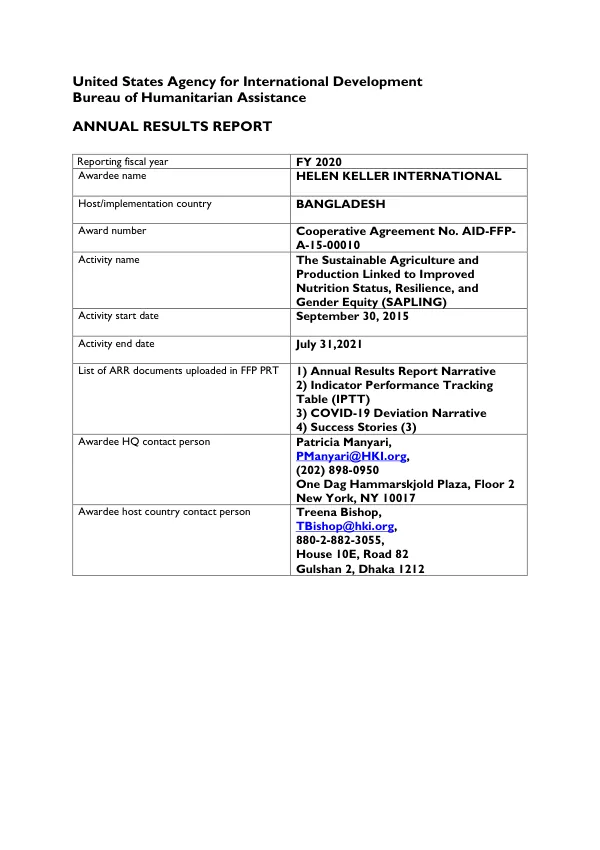
Annual Results Report FY 2020: The Sustainable Agriculture and Production Linked to Improved Nutrition Status, Resilience, and Gender Equity (SAPLING) Development Food Security Activity
Sign inCATHOLIC RELIEF SERVICES ORGANIZATION
Annual Results Report FY 2020: The Sustainable Agriculture and Production Linked to Improved Nutrition Status, Resilience, and Gender Equity (SAPLING) Development Food Security Activity
The Sustainable Agriculture and Production Linked to Improved Nutrition Status, Resilience, and Gender Equity (SAPLING) Development Food Security Activity is a consortium-led program implemented in the Chittagong Hill Tracts (CHT) region of Bangladesh.
2020 · 34 pages
Sign in to readA free account is required to download.
Abstract
The program aims to improve gender-equitable food security, nutrition, and resilience in five upazilas of Bandarban. Helen Keller International (HKI) is the lead organization, responsible for the program's overall vision, management, and technical direction. SAPLING operationalizes its theory of change through three purposes: (1) increased income and access to nutritious foods attained more equitably by both women and men, (2) improved nutrition and health status of children under five years of age, pregnant and lactating women, and adolescent girls, and (3) improved ability of households, communities, and systems to mitigate, adapt to, and recover from human-induced and natural shocks and stressors. The program achieves these outcomes through multiple, interconnected pathways that build livelihoods assets, improve health and nutrition, and engage in disaster risk management (DRM) at all levels. The program's interventions include Integrated Enhanced Homestead Food Production (IEHFP), Income Generating Activities (IGAs), Savings and Internal Lending Communities (SILC), Maternal and Child Health and Nutrition (MCHN), and DRM. Local capacity building, water, sanitation, and hygiene (WASH), gender equality and social inclusion (GESI), and environment are integrated throughout SAPLING's activities. GESI intersects with all aspects of life in the CHT, and SAPLING's interventions are targeted primarily at women to provide them with knowledge and skills to improve their abilities to earn and save income, produce nutritious food, care for their families, and protect against shocks and stressors. Throughout the first half of Fiscal Year 2020, SAPLING continued implementation in all 1,579 paras (villages), pourashavas (municipalities), and 24 unions in its target area. However, the initiation of the program's planned phase-down from village-level activities and consolidation of offices into centralized Administrative Zones was disrupted by the COVID-19 epidemic. The program pivoted to focus on COVID-19 prevention and mitigation, shifting to virtual training and social behavior change communication (SBCC) methods. The team created over 40 how-to videos, provided phone support to participants, continued support for satellite antenatal care (ANC) services, rehabilitated water sources, established handwashing stations, and continued support to the Bangladesh Red Crescent Society (BDRCS) volunteers and the Government of Bangladesh (GOB). In mid-July, when movement was once again allowed throughout the District, small-scale localized activities resumed, following established COVID-19 prevention procedures. The program engaged a total of 94,795 unique participants, 73% of whom are women, and 27% men, against the annual target of 101,268. A survey of participants reported that 93% have not yet recovered economically from the ongoing COVID-19 disaster, and 38% say they are struggling to access basic necessities. Despite these challenges, SAPLING has adapted to the new normal of virtual support and socially distanced, smaller group sessions, with mandated mask wearing and handwashing, etc. The program continues to support participants during this difficult time, with a focus on handwashing and COVID-19 risk prevention.
Related documents
Documents in this collection
 2019
2019USAID DEC
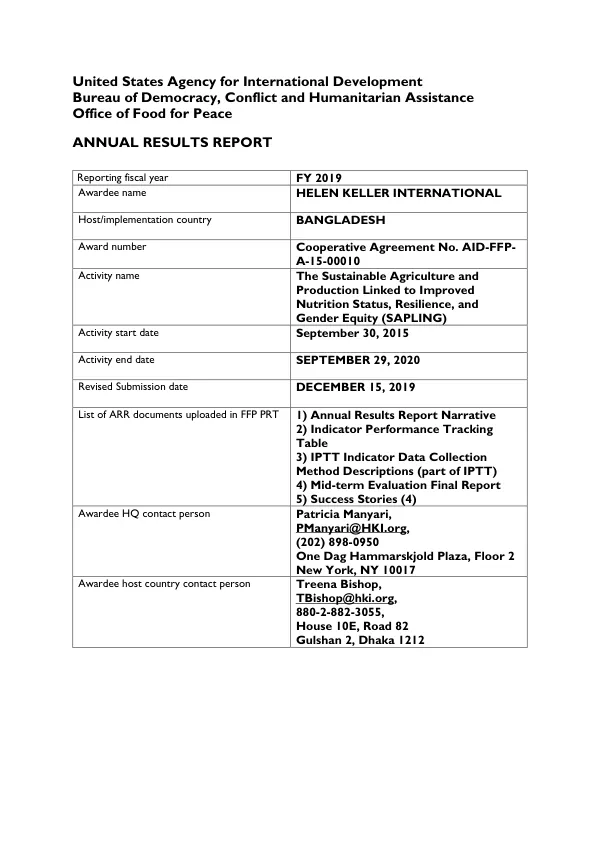
Annual Results Report FY 2019: The Sustainable Agriculture and Production Linked to Improved Nutrition Status, Resilience, and Gender Equity (SAPLING) Project in Bangladesh
Open record 2018
2018USAID DEC